
Meditation
Transcript
Meditation
Lovely to be with you.
So, if we can sit comfortably
and simply be letting go of any activities,
because right now there is no need
to engage the mind.
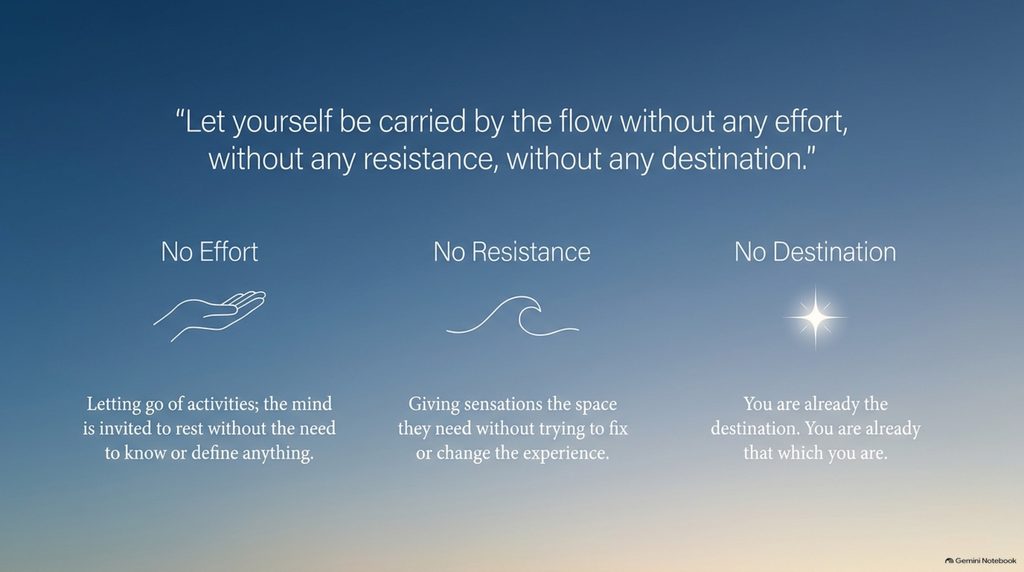
Let yourself be carried by the flow
without any effort,
without any resistance,
without any destination,
because you are the destination,
and you already are that which you are.
So you can invite the mind to rest.
This effortless beingness
without any need to know anything,
without defining yourself
or defining your experience.
This sort of settling of the mind
and the relaxation of the body.
So you can turn your attention
towards the body space.
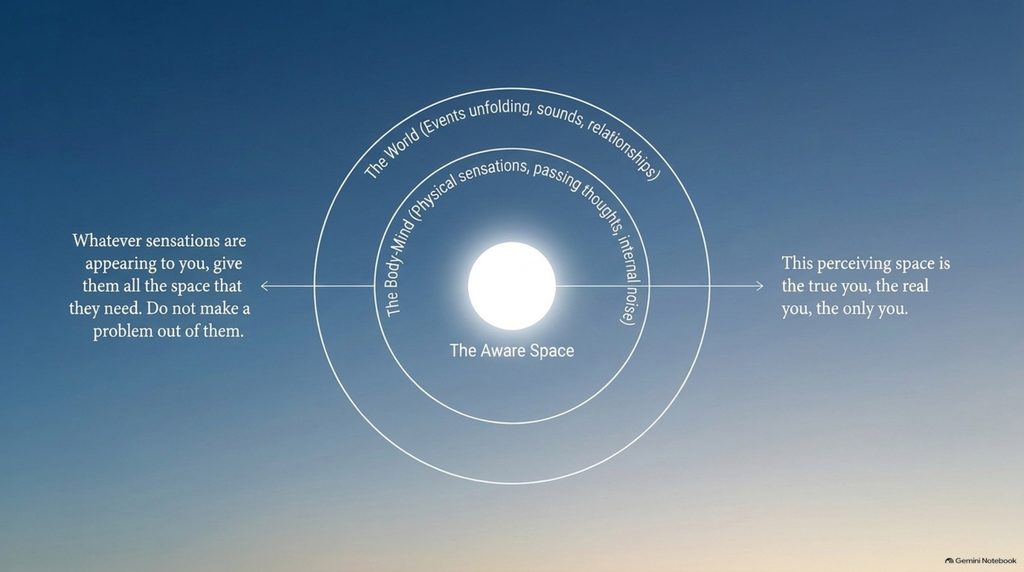
Whatever sensations are appearing to you,
give them all the space that they need,
without trying to fix anything.
So it’s an invitation to rest deeply,
to take a break from the ongoing activity of the mind,
and to invite your body to rest
in its deep nature,
which is a profound restfulness.
It can be challenging for the mind to do nothing,
and challenging for the body
not to want to change the experience,
but it is possible.
All is well, all is well,
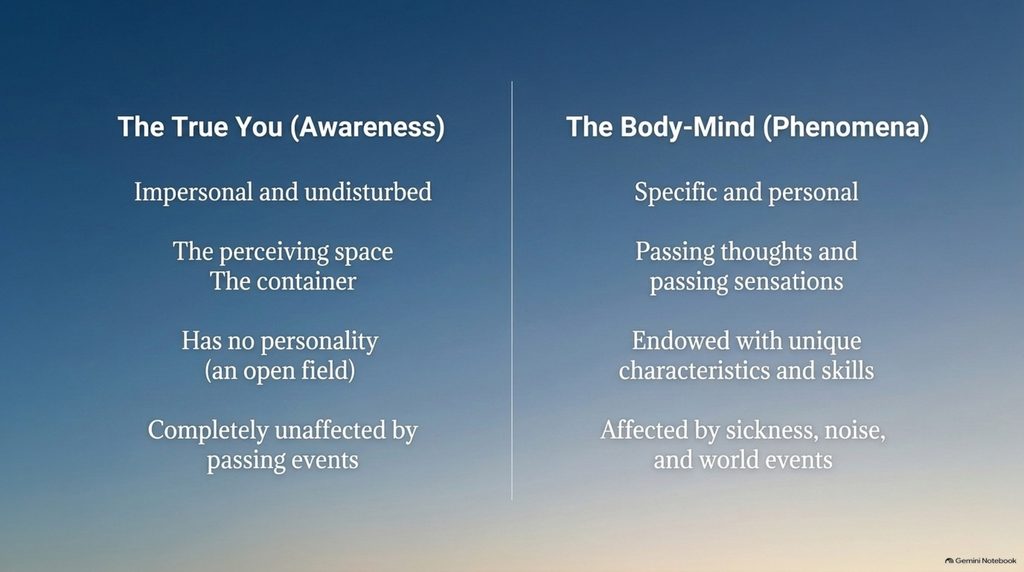
because all activity is impersonal.
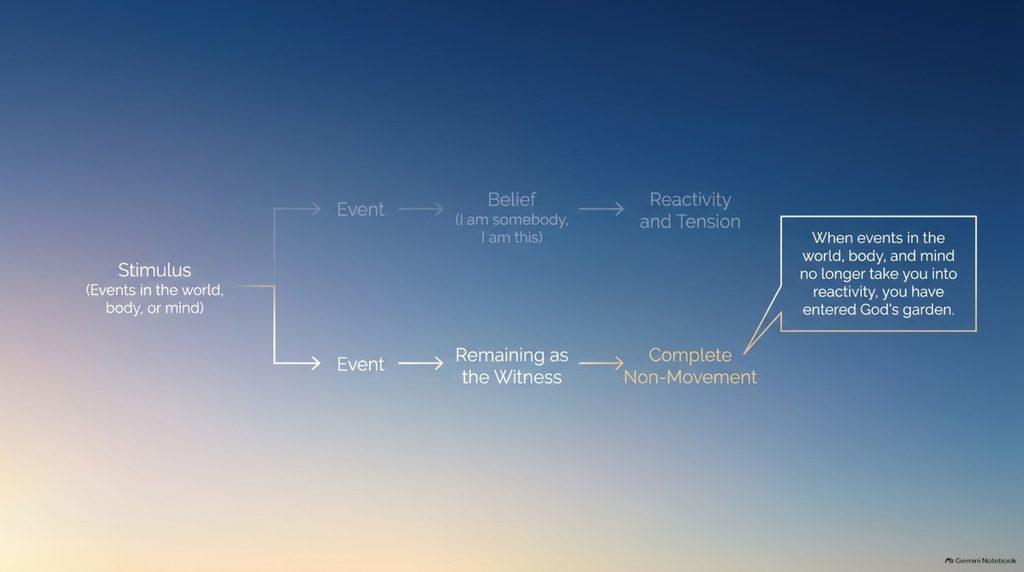
Although there may be a belief,
“Oh, I am somebody, I’m this or that,”
these are just passing thoughts.
They have no real power.
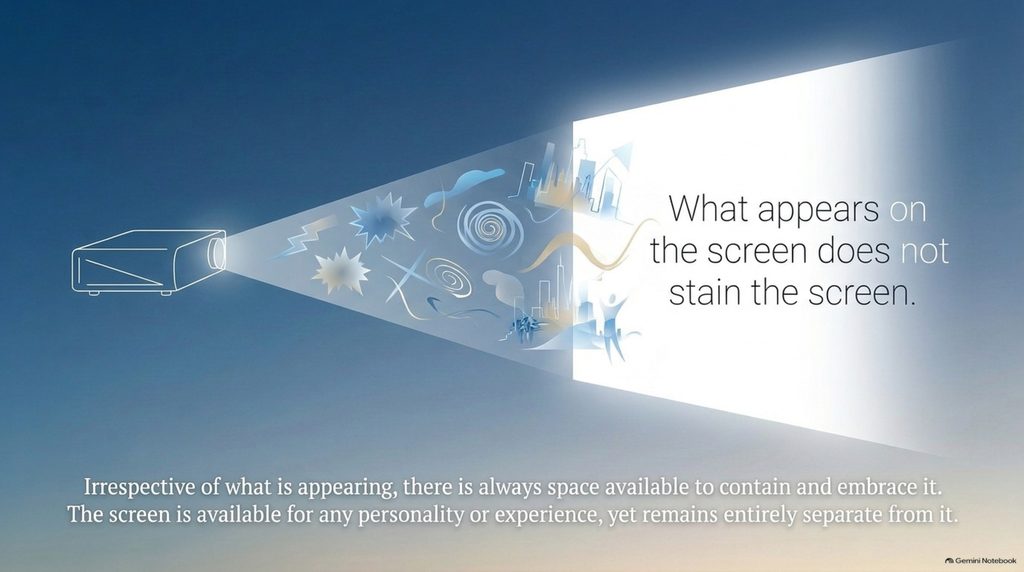
Notice how, irrespective of what has appeared
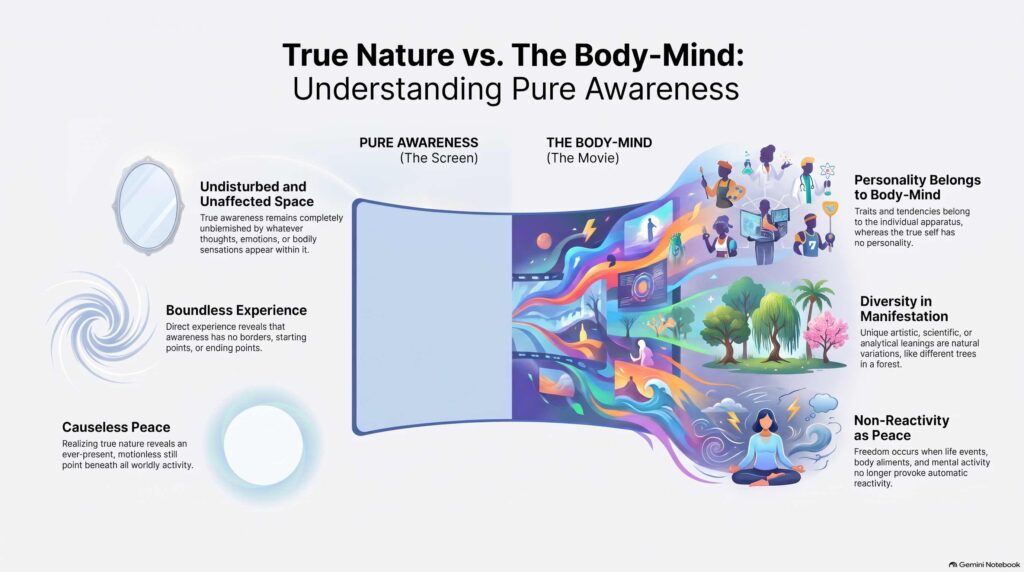
or is appearing on the screen,
there is space available to contain all of it.
Contain meaning to embrace it,
to perceive it, to experience it.
And this perceiving space,
this aware space,
is undisturbed,
is unaffected,
and it is the true you,
the real you,
the only you.
If you notice any tension
in the mind or in the body,
allow it to be,
and simply notice you’re noticing it.
You don’t need to make a problem
out of anything.
The mind may be triggered and engaged in thinking.
We remain the witness,
we remain as that awareness,
remain as it is,
with the beauty of it.
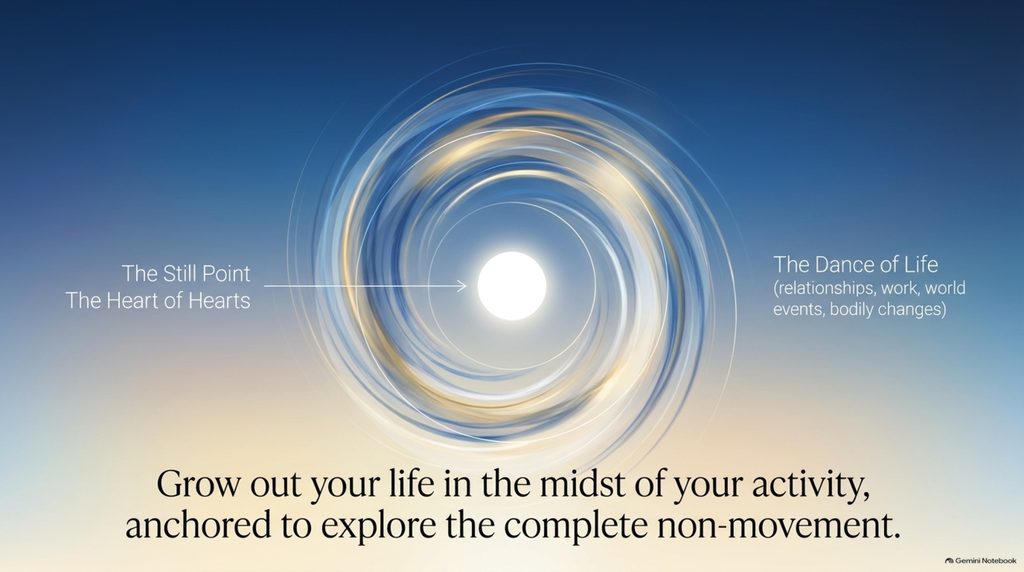
In our life, all sorts of events unfold
in the world, in the body, in the mind, in relationships.
It is the dance of life.
The invitation is for you to realize
your complete non-movement,
your complete non-affectedness.
You are not affected.
Your body may be affected by sickness,
by events in the world.
Your mind may be affected
by certain activities and noise and sounds,
but you are not affected.
When events in the world,
events in the body,
events in the mind
no longer take you into reactivity,
you have entered God’s garden.
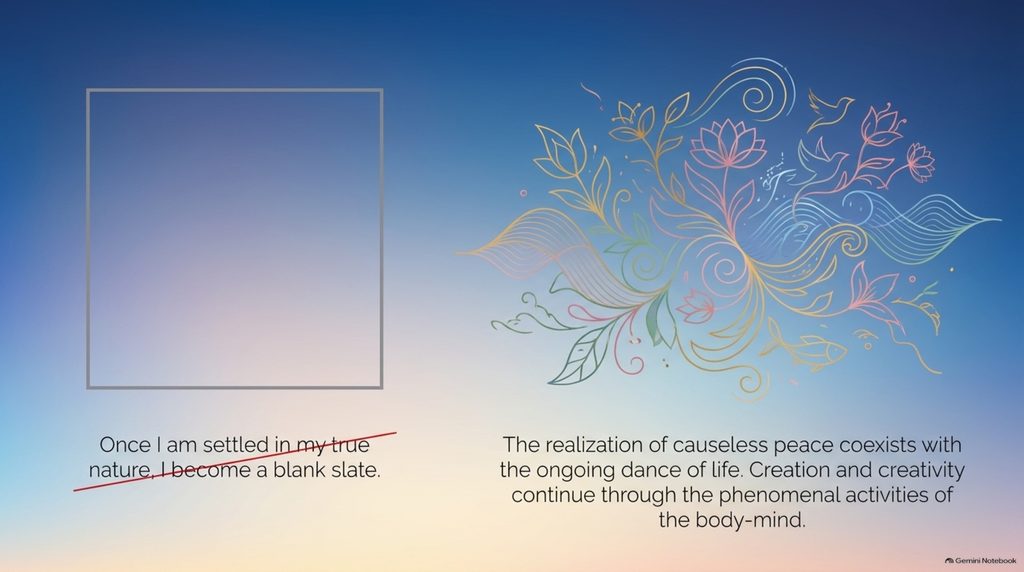
Sometimes it is the thought that
once I’m realized and settled
in my true nature,
I become like a blank state.
That’s not the case.
The realization of your true nature
is the realization of the causeless peace,
but creation and creativity is still ongoing,
because the Shiva and the Shakti,
the phenomenal activities of body-mind,
the masculine, the feminine—
there’s a variety of manifestations.
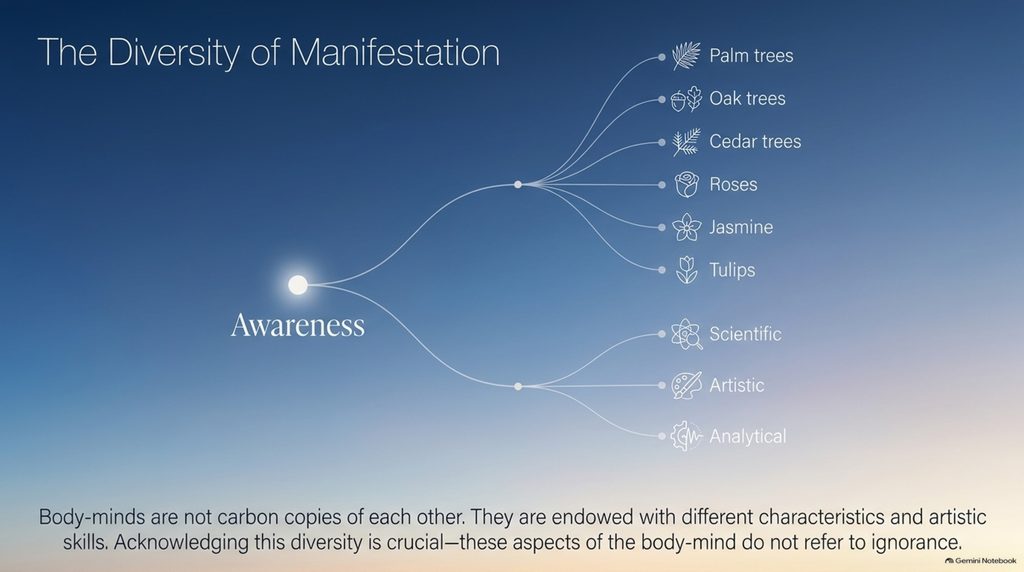
You still have in the forest
palm trees and oak trees and cedar trees,
all sorts of flora and fauna appearing
with an awareness.
Various bodies, various minds
that are endowed with different characteristics,
different tendencies,
different artistic skills,
different leanings
that are drawn to different experiences
in different ways.
Body minds have personalities.
They’re not all carbon copy of each other.
It’s important to acknowledge that
and recognize that the aspects of the body-mind
do not refer to ignorance.
A rose is a rose,
jasmine is a jasmine,
tulip is a tulip,
with diversity of manifestation.
Certain people are very scientifically minded,
others are artistically minded,
some are analytically minded.
Recognizing that these are aspects of the body-mind
and not what you are.
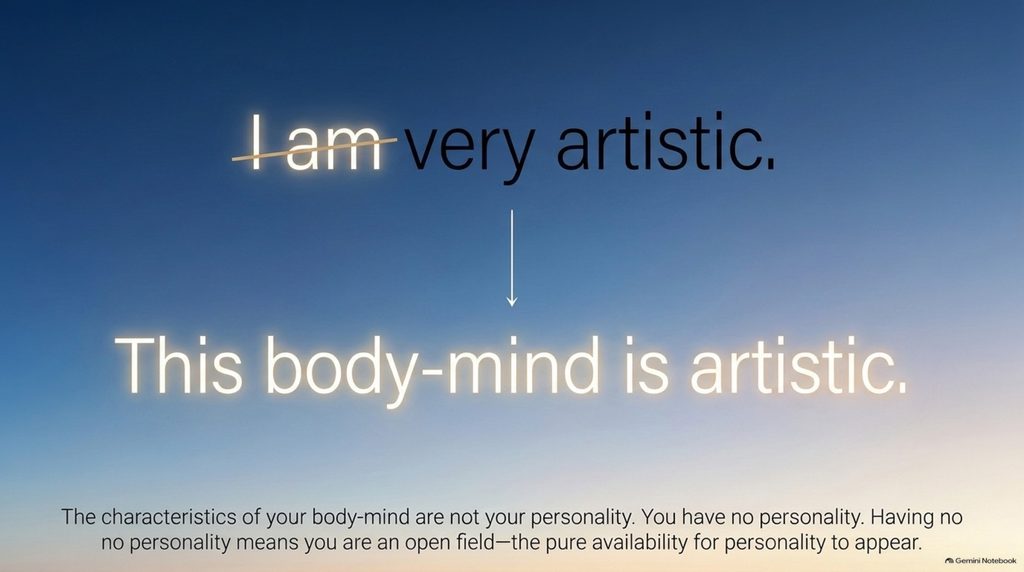
Sometimes we say, “I’m very artistic.”
In fact, what we mean is that this body-mind is artistic.
It’s an important distinction,
an important understanding,
to recognizing your experience.
The characteristics of your body-mind,
the personality of the body,
is not your personality,
because you have no personality.
Having no personality is an open field,
a spaciousness,
an availability available for personality,
available for whatever appears on the screen.
But what appears on the screen
does not stain the screen.
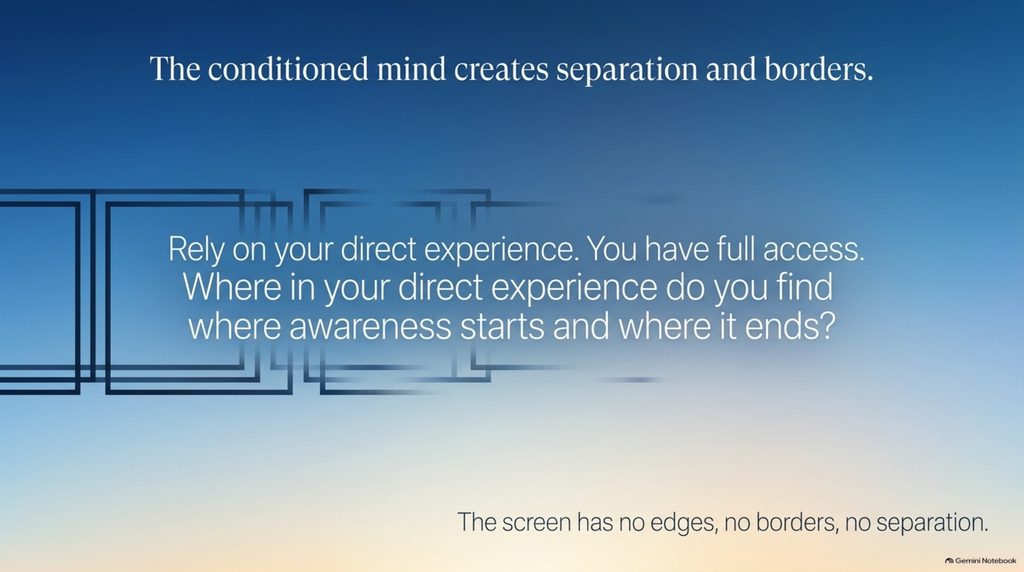
The screen has no edges, no borders, no separation.
The mind says, “Oh, this is my screen.
This is your screen.
There are many screens.”
This is the mind.
It’s separation.
It’s ignorance.
Our experience is this:
No borders.
You can rely on your direct experience,
not on the mind which is conditioned by beliefs
and ancient traditions.
No one knows your experience better than you.
You have full access.
Where do you find any borders to awareness?
Where in your direct experience
do you find this is where awareness starts
and this is where it ends?
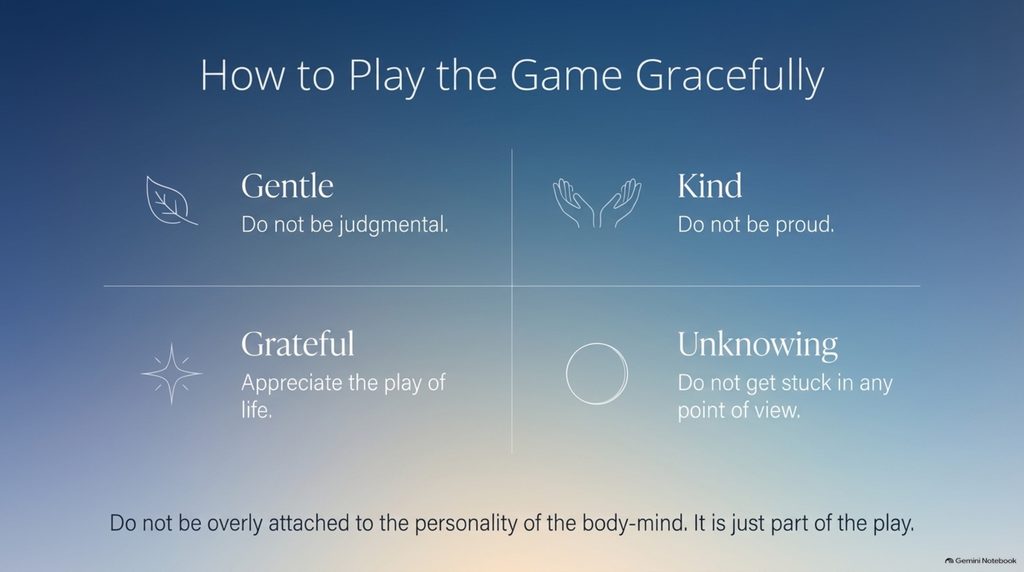
Do not be so attached to the personality of the body-mind,
and do not be judgmental or proud.
It’s just part of the play.
Be gentle with it, be kind, be grateful, be unknowing,
so the game can be played gracefully.
No need to get stuck in any point of view.
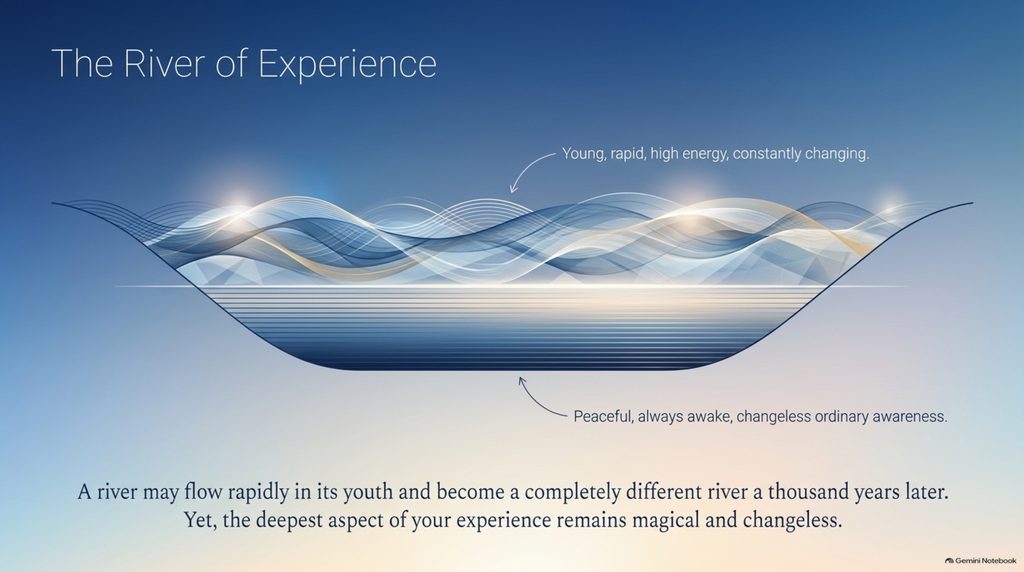
Some rivers flow rapidly.
They are young, a lot of rapids, a lot of energy.
But that same river, a thousand years later,
could be a completely different river.
But there is a changeless aspect of your experience—
this peaceful, awake, always awake, always there.
There, I mean, nowhere and everywhere.
This ordinary awareness, which is magical.
Grow out your life in the midst of your activity,
to explore the non-movement,
the still point,
the heart of hearts.
It’s always there,
always inviting you: “I am.”
When I know that I am.
Satsang
Transcript
Satsang
So you’re welcome to open your eyes and come together now.
You’re welcome to share or explore whatever questions you may have.
As you know, there is a raise hand icon at the bottom of the screen,
or you can just simply unmute yourself.
So, any questions?
You’re welcome to turn on your videos if you don’t care to.
I always enjoy seeing you.
I’ve heard it suggested that our pure awareness was going on before we were born
and also goes on after death. What do you think about that?
Bodies are born and bodies die.
Thoughts appear and thoughts disappear.
There is before and after when it comes to phenomena.
Like, before New York City was built, it was a bunch of forests
and native Indians lived there.
What does it have to do with awareness?
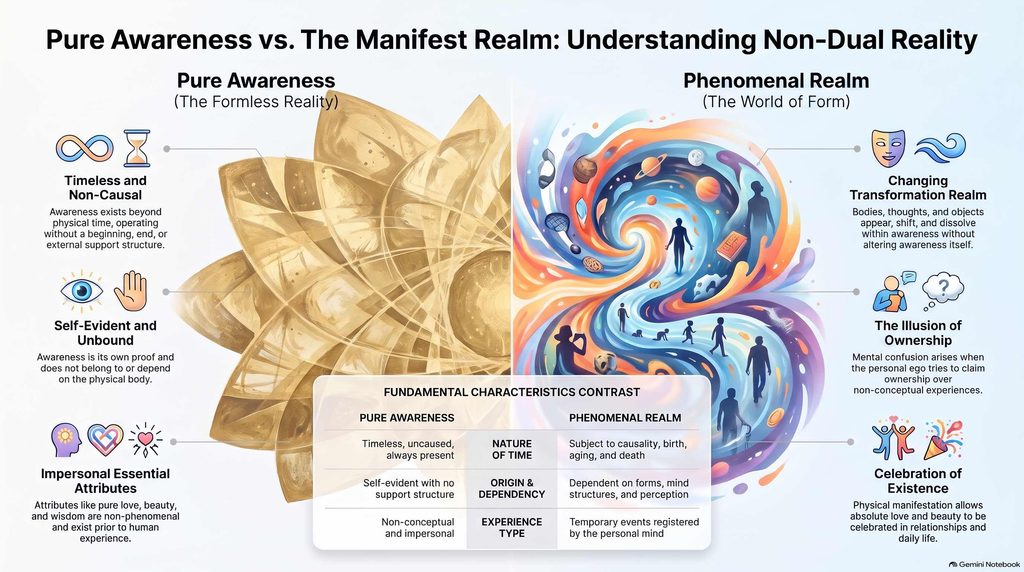
Reality is not in time.
You are not in time.
Your body is appearing in a realm of causality and transformation,
and the concept of time applies to the development of your body—
from baby, to teenager, and so on.
But the reality is not the body.
It’s not a changing, shifting reality.
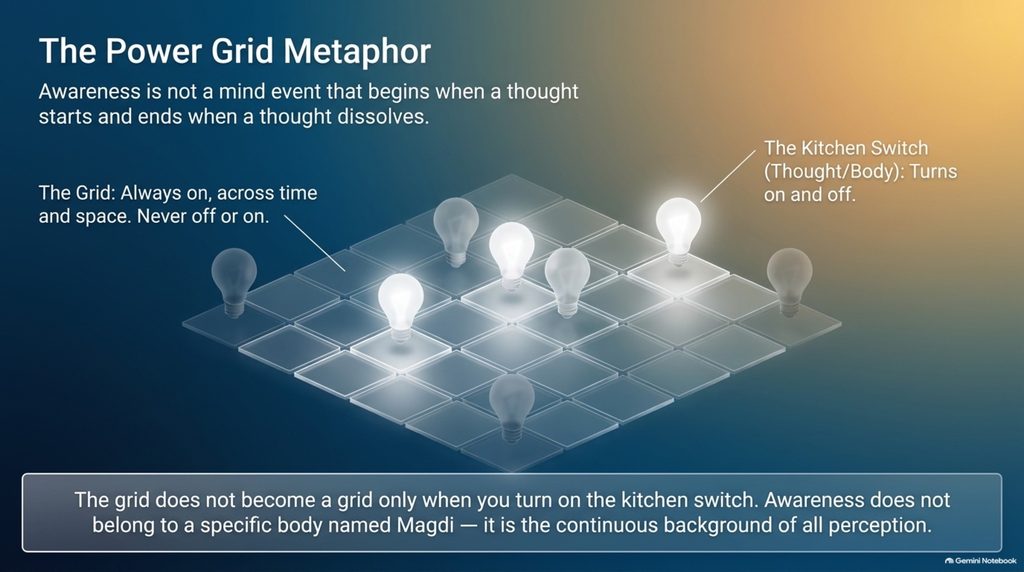
So awareness isn’t a mind event.
Mind events appear within awareness.
Awareness creates and perceives,
but awareness isn’t something that begins when your thought begins
and ends when your thought ends.
Awareness is, and thought appears within awareness and dissolves within awareness.
But awareness isn’t diminished when the thought disappears
and reactivated when the thought appears.
It’s like the power grid—the grid is always on, as a metaphor.
It doesn’t become a grid when you turn on the switch in the kitchen.
It’s on across time and space, as a metaphor.
So awareness isn’t causal.
There isn’t before it and after it.
It stands on its own.
It has no support structure.
It refers to itself without any intermediaries.
It’s not a concept.
It’s your direct experience.
It’s that which cannot be denied.
How can you deny awareness?
Awareness—it’s its own proof.
It does not have roots somewhere else.
Like a tree has roots in the earth.
Leaves of the tree have roots in their attachment to the branches.
But awareness does not have roots, leaves, or branches.
It’s never off or on.
There isn’t an off button to awareness.
There is a belief, a thought that appears—a belief that awareness is turned on
when I, Magdi, become aware.
That’s just a belief which is false
because it assumes that awareness belongs to Magdi,
belongs to a body named Magdi.
It’s an assumption.
It’s a conclusion without any evidence that the body is aware.
A thing isn’t aware.
It appears within awareness.
Thought, perception—but awareness doesn’t belong to that which is perceived.
It belongs to the perceiver in chief, which is I, not the body-mind.
I, I—the self.
The self is just another word for awareness.
Brahm—that which is.
That which is awareness has no causality.
You need to investigate that.
Does it go on after physical death?
After bodily death?
When you question, there is misunderstanding that there is a reality called the body
which can affect awareness and consciousness.
In other words, when it dies, when that body dies, it affects awareness or consciousness.
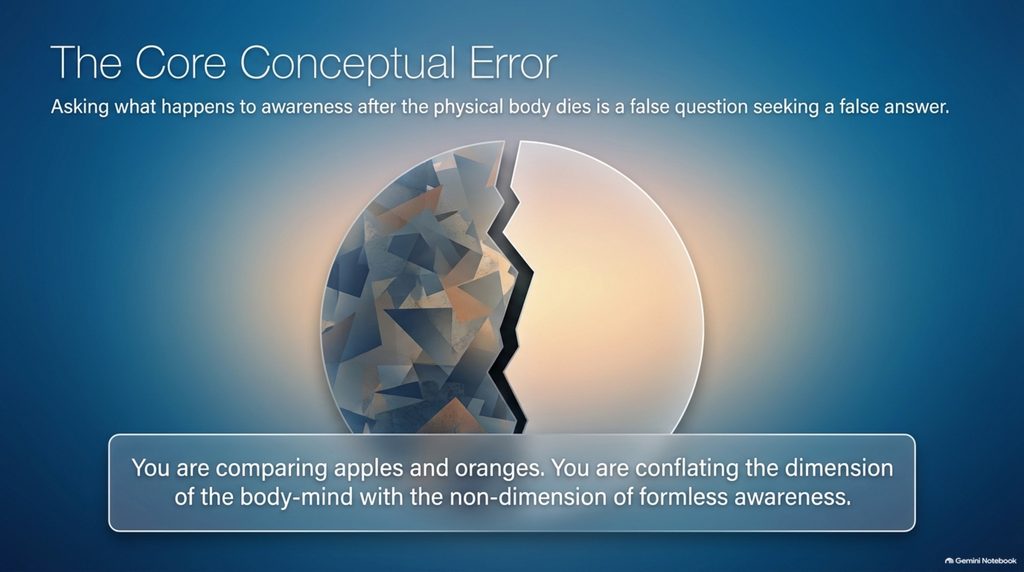
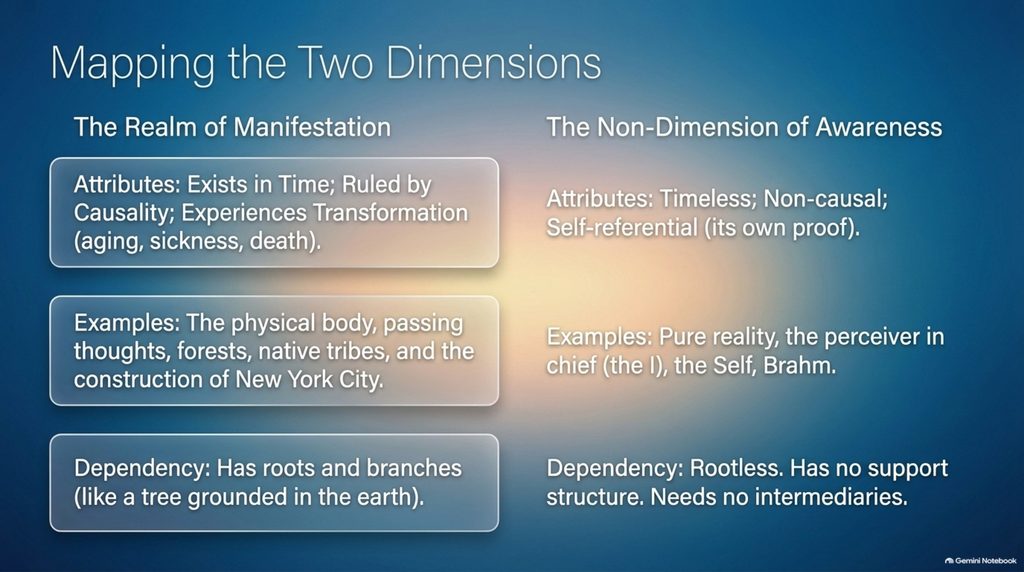
So you’re conflating two different dimensions:
the dimension of the body-mind—meaning the dimension of manifestation—
and the non-dimension of formless awareness.
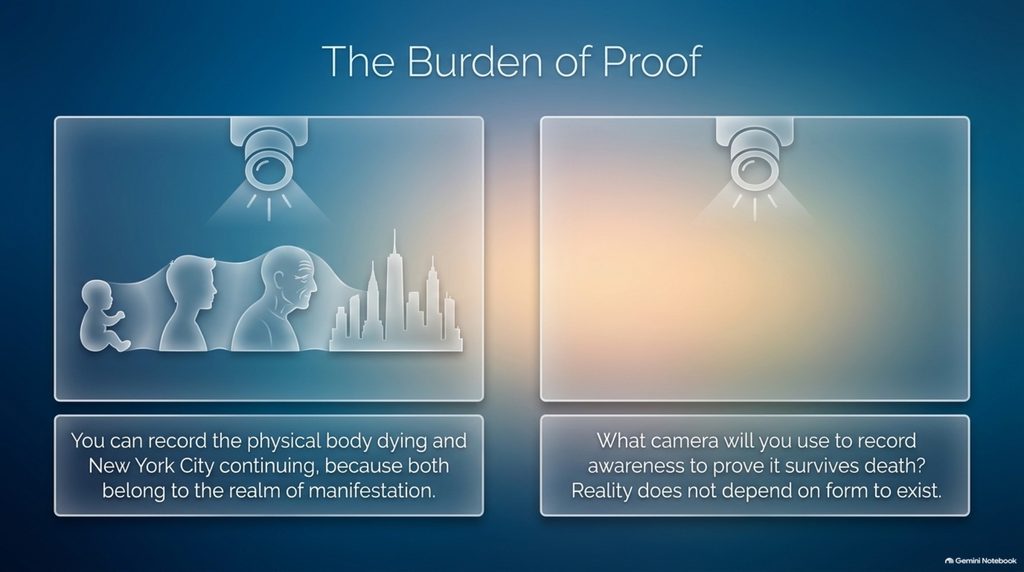
You could ask the question: When the body-mind dies, does New York City end?
And the answer is no, because somebody can take a video of this body dying
in New York City continuing.
Because you’re comparing apples and apples—the body-mind in New York City
belong to the same realm of manifestation.
But your question is about the body-mind dying and awareness.
You can take a camera and take a video of the body dying,
but what camera are you going to take to take a video of awareness
in order for you to say, oh yes, when the body dies, here is the proof—
here is the video proof of awareness continuing?
There is no camera that can take a video of awareness.
You’re talking about two different dimensions.
There is one dimension which is morphing: the body aging, getting sick, and dying.
And awareness being the reality of everything—the reality of the body, the reality of the world,
the one reality.
When the body dies, does reality die?
So if you start with the assumption or the belief that reality starts with form,
based on that belief, then when the form ends, reality ends.
But what is your evidence that reality starts with form,
that reality depends on form?
There is no evidence for that.
It’s only your belief that reality starts when this body starts
or whatever form starts.
You have a confusion about your understanding of reality.
So reality is in this moment whatever it is which is and perceives and knows it is.
The question is a false question, a wrong question.
A false question is seeking a false answer.
There isn’t a real true answer to your question, which is a false question.
Understanding your question answers your question.
Understanding the falsehood of your question, the nature of your question,
the assumptions behind your question, will answer your question.
And in your question, there is the assumption that time, that reality is in time.
The reality is timeless.
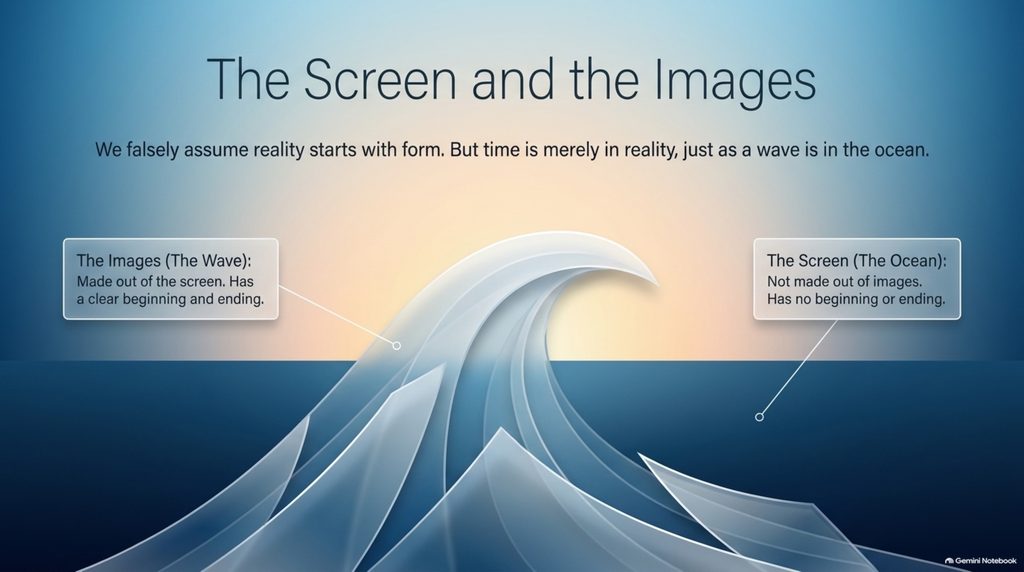
Time, you could say, is in reality as a wave is in the ocean.
It has a beginning and an ending,
but reality is not in time.
The ocean does not have a beginning and an ending like a wave does.
Any questions?
Hello, Susan.
Can you turn your video on?
I didn’t mean to unmute myself.
Actually, my apologies.
Okay, no problem.
Any questions?
Hi, Rokos.
You need to unmute yourself.
Okay.
I have a question about the properties of consciousness.
There’s often spoken about them—things like unconditional love, understanding, eternity.
For me they are experiential, but consciousness is not an object.
And in some way, if you experience unconditional love, it’s subtle.
It’s preceded by nothing—no object.
Understanding is there is a moment of emptiness in understanding.
In this way, I can interpret it, but philosophically speaking,
I’m interested in philosophy too.
What are your thoughts about this, if you understand my question?
Yes, I do.
Consciousness is formless.
It has no, it’s not a phenomenal thing.
But so the attributes of consciousness, or of reality, as you said—yes.
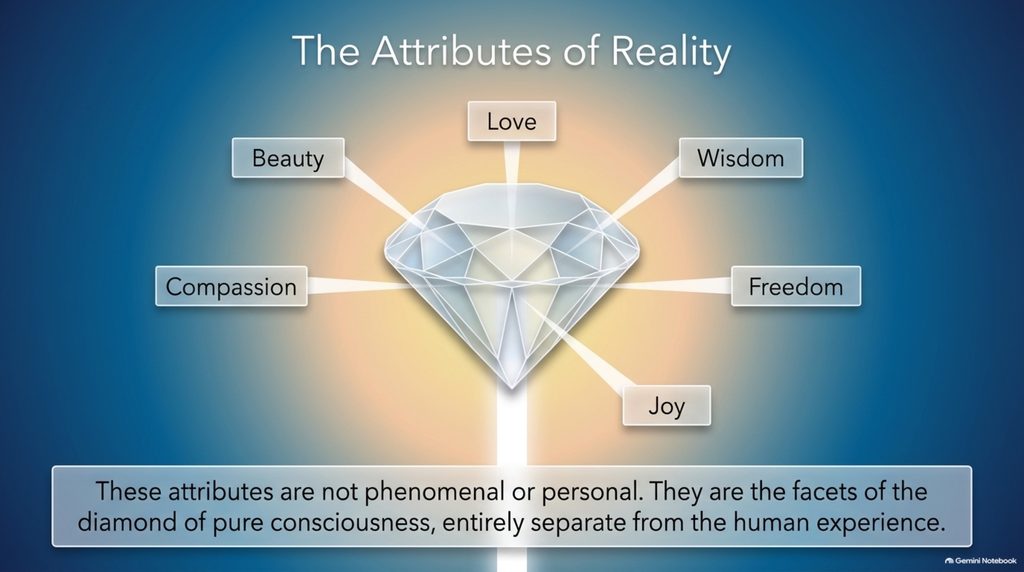
Love, beauty, wisdom, compassion, freedom—these attributes also are non-phenomenal.
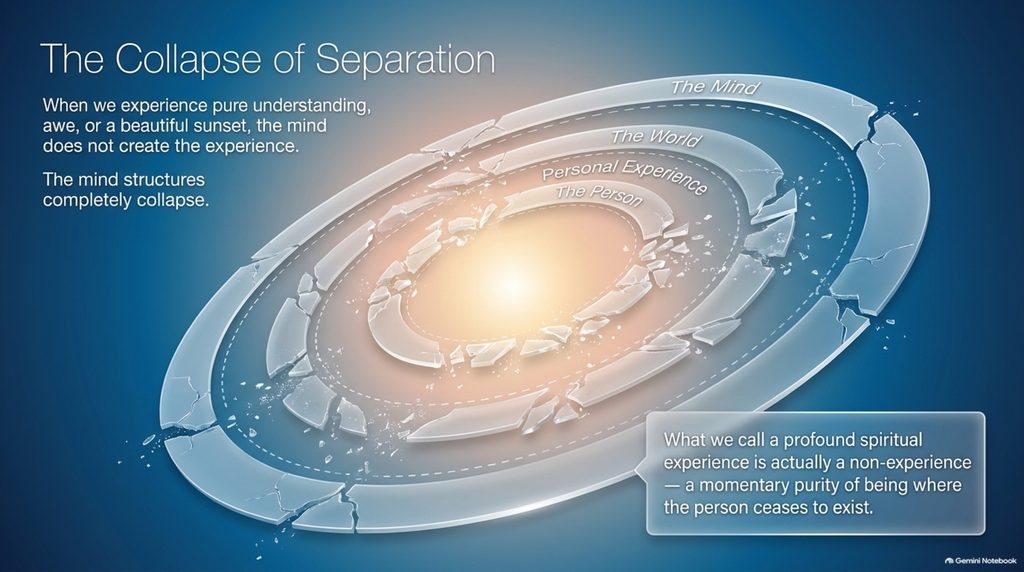
When you are in the experience of understanding, there is no mind.
There is no world.
There is no personal experience.
There is no person.
There is actually a collapse of world, body, mind into the understanding.
It’s just pure.
There’s a purity, the purity of understanding.
And similarly in beauty.
When there is the experience of beauty, there is a collapse of the mind into that realm.
Yes, absolutely.
The appreciation of music or a beautiful sunset or in front of a certain piece of art—
there is a collapse of the structures, of the mind structures.
So you said they’re experiential.
In fact, they’re impersonal.
It isn’t like a personal experience.
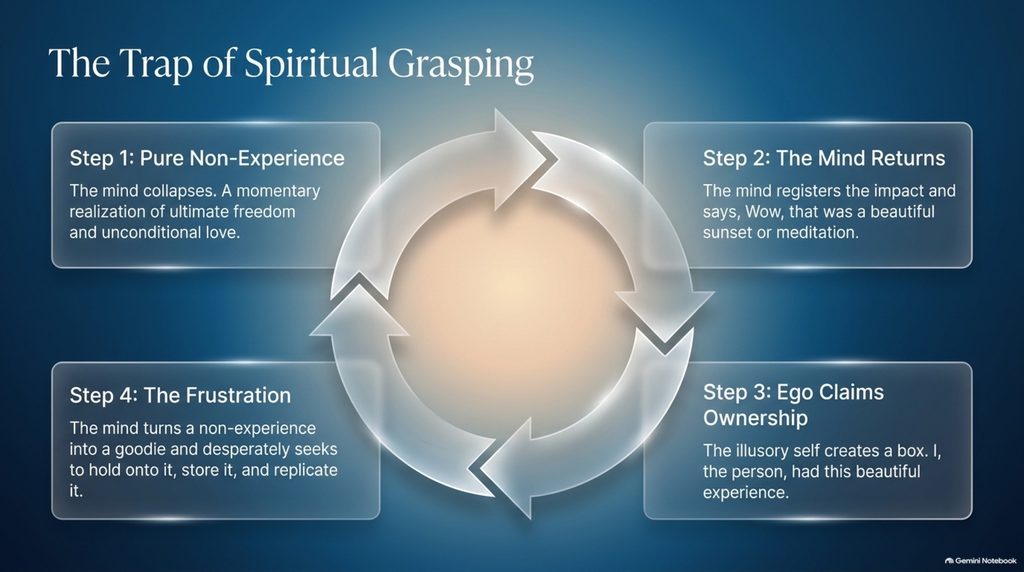
After the fact, there is an impact on the mind.
The mind says, oh, wow, that was a really beautiful concert.
It was such a beautiful experience, and I really enjoyed it
and I’d like to go again next week, et cetera.
Which is fine, the mind also registers somehow.
There is a registration of this non-conceptual experience.
Yes, so that’s the manifest aspect of consciousness.
Consciousness in its purity is not just that.
This is where there is experience of all the facets of the diamond—
all the facets of the diamond are there in the purity of being,
of awareness, of consciousness.
But at the same time, there is creativity.
There is life.
There is enjoying—you know, relationships,
enjoying nature, enjoying the company of friends or the company of your pets.
So there is the manifest.
Now, the fact that there is manifestation does not bring us to the conclusion
that consciousness is a phenomenal experience.
On the screen you can have all sorts of images that appear,
but this should not bring you to the conclusion that the screen is made out of images.
The images are made out of the screen,
but the screen is not made out of the images.
So the attributes of consciousness is that this screen is pure love.
Pure love does not mean human love—that’s obvious.
Pure beauty does not mean the appreciation of art.
It can be represented and expressed and celebrated in relationship.
Love can be celebrated in the human experience.
Beauty can be celebrated in the human experience.
But it does not arise out of the human experience,
and it is not a human experience.
It can be appreciated and celebrated in a limited sense in the human experience,
but in its absolute sense it can be celebrated in the collapse of separation.
The collapse of separation.
Whenever that is, there is the experience of love, beauty, freedom, joy, wisdom.
And I’m not talking about a collapse in time.
Irrespective of time, the experience of understanding is not different
from the experience of love, beauty, wisdom, freedom, joy.
But there lies the confusion sometimes.
So there is—we humans make a connection with experiences of beauty,
of spiritual moments, of unity.
I understand in some way it’s not from the mind,
but still there are some remains in me—the experience of love and beauty
that we experience in life.
It is an impersonal experience.
It is an experience where there is a collapse for a moment of the person,
and then the person may arise again and make a story out of it
or a memory out of it, which is okay—it’s a different thing.
But the confusion could arise from attributing personal ownership to the experience
or making the experience personal.
Yes, the mind may do that—may sort of attribute a personal aspect to the experience or not.
The mind may just register, oh wow, that was really beautiful—
you know, it’s a moment of awe and appreciation.
So the confusion always arises when we introduce, when the mind introduces,
a personal dimension to the experience and turns it into a limited experience.
But the experience of beauty and love is limitless.
Yes, that’s my realization too.
The thing is, because in our life we experience these moments of love and beauty
and wisdom which are really not in time, but then we return to the me,
as a result we register these non-experiences as experiences.
You follow? These are like non-experiences,
but because we always return to experiences, to me experiencing,
then we turn this non-experience into an experience that we want to have more of.
Yes, right.
But it is actually a non-experience.
And it’s important to have that understanding—that there is a difference
between these moments of awe and beauty and love
and how the mind registers them and interprets them.
Yes, no, it’s clear. Thank you for a beautiful answer.
So the confusion will end once you have that understanding,
because the confusion is connected with the frustration—where did that experience go?
I wanted to get, I want this experience again.
No, because the mind turned this experience into a personal experience.
Now once it—but the mind is not there in love, yes, during that experience
the mind wasn’t there. You could say experience, but that non-conceptual experience.
Yes, yes, yes, yes.
But because the mind operates in images and structures, then something happened,
and so the mind has been affected.
It was not there, but it’s been affected.
So the mind wants to make a statement about what happened.
So what happened is I had this beautiful experience.
I, the mind, the ego—I think so.
I had it. The person.
Okay, yes.
Yeah, it makes a box and it’s a zest.
Yeah. This is very strange. I want to share this.
I had, last month during waking up, I’m often conscious, and then I’m meditating about these kind of things.
And at some moments, it can become so incredibly clear
that consciousness is ultimate freedom and unconditional love.
I could hold that with that clarity.
Who is it that wants to hold that?
Right, right, right.
It’s like it’s always in the background—this personal, you know, habit.
Habit of, oh, this is a really goodie, a good goodie.
I want to hold on to this good goodie.
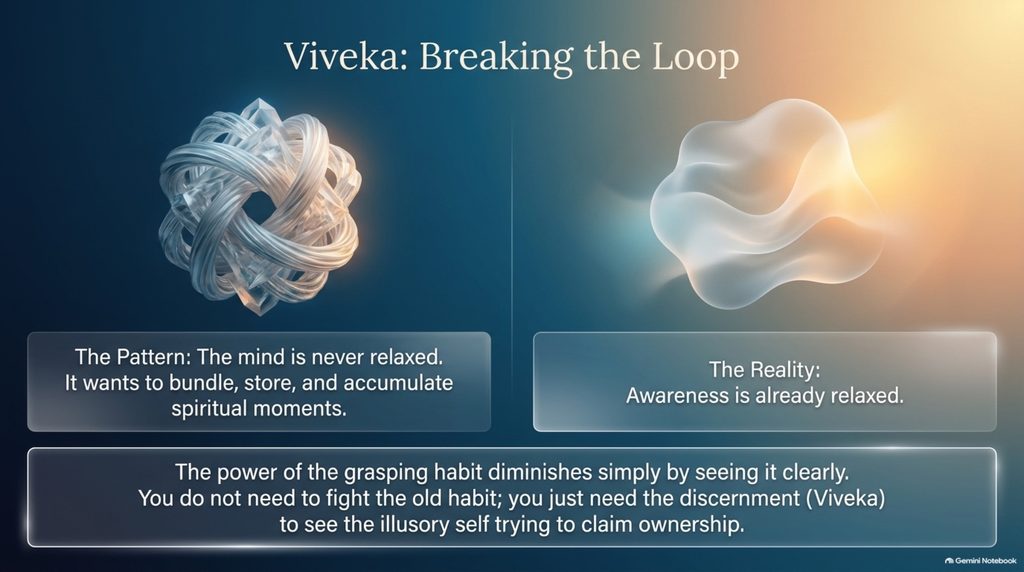
It’s out of viveka—the viveka, the distinction between the illusory self
that comes and wants to claim ownership.
There’s a distinction.
Clarity—that’s the pattern.
The pattern, and it is not relaxed.
It wants it. You know, it’s not relaxed.
It wants to get it.
It wants to bundle it and store it and accumulate it.
You see, it’s not relaxed.
But you are relaxed.
Yes, you are absolutely right.
But this is—I’m a bit on a junction.
So I see it, but there’s a very strong old habit.
Yes, yes, and the more you see this habit for what it is,
the less power it has over you.
So be available for that.
That is, the power of this habit will diminish because you can see through it.
Okay, clear. Thank you.
Hello, Renate.
Hello.
I have a question. Maybe it’s not so deep, but it came to me because I saw a video yesterday
with Swahani, and he was from Argentina, I think.
He talked about—because he was interviewed—he talked about how he hasn’t eaten or drank
for more than a decade.
So there’s this body that doesn’t seem to follow the laws of our bodies of manifestation.
And I wonder: how is this like a meeting where consciousness can change these laws,
or is it a fraud?
I have no idea.
I do think that things like this are possible, but my mind, entrained in Western thinking,
thinks it’s not possible.
So, have you any ideas about this?
Yes, yes.
Consciousness is complete freedom.
I mean, everything that we know about the world, the mind—a thousand years ago we knew very little.
Now, two hundred years ago we knew less, and now we know more.
But all of that is phenomenal stuff.
We know the mind knows the phenomenal stuff.
But consciousness is complete freedom.
It’s not the mind.
So your question comes from the mind.
Oh, okay, you know, my mind is aware of these sorts of things.
We eat every day three times a day.
We sleep so many hours.
And now I meet the Swami and he hasn’t eaten or slept in ten years.
So the mind is wondering, what is going on?
Well, you can stretch your mind.
I mean, obviously here is an experience of somebody who hasn’t eaten for ten years, okay?
So it’s your mind. It’s possible. It’s possible.
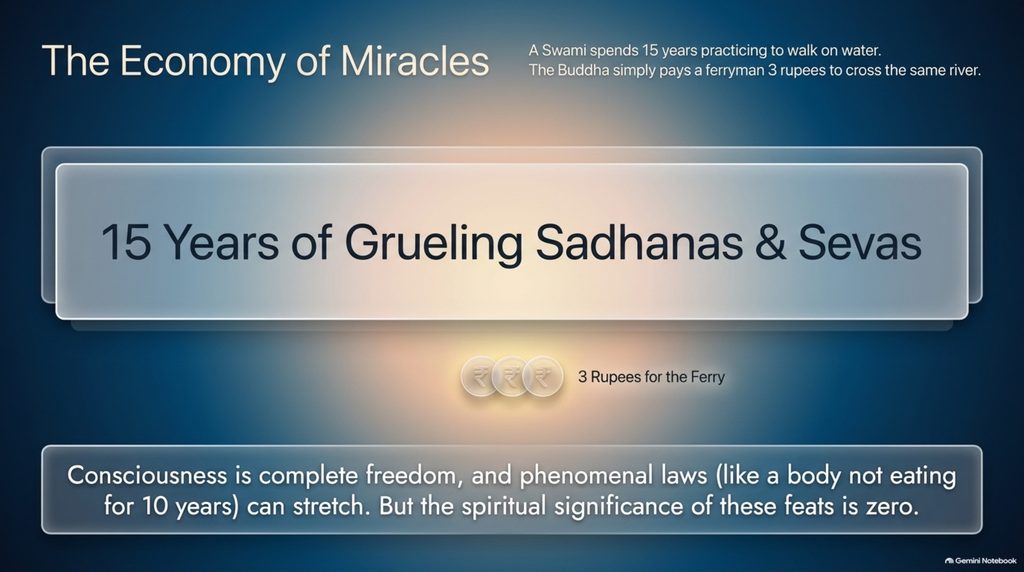
The significance of it, I’ll tell you a story, an anecdote that Francis sometimes shares with us.
The Buddha is traveling with some friends and he comes to a river.
To cross the river, you have to take a guy with a stick and he takes you for three rupees
from one bank of the river to the other bank.
Before they get on the boat, there is this Swami that comes to the river,
and instead of taking the boat, he walks on the water and he gets to the other side.
And the Buddha takes the boat.
And he’s very impressed by the Swami, so he tells the Swami on the other side,
wow, what you did is very, very impressive.
How did you do this?
The Swami said, oh, I practiced for fifteen years.
I did all sorts of sadhanas and all sorts of sevas, and I practiced for fifteen years
and I learned how to do this.
Oh, and the Buddha said, oh, for me, it cost me three rupees.
So the significance is nothing.
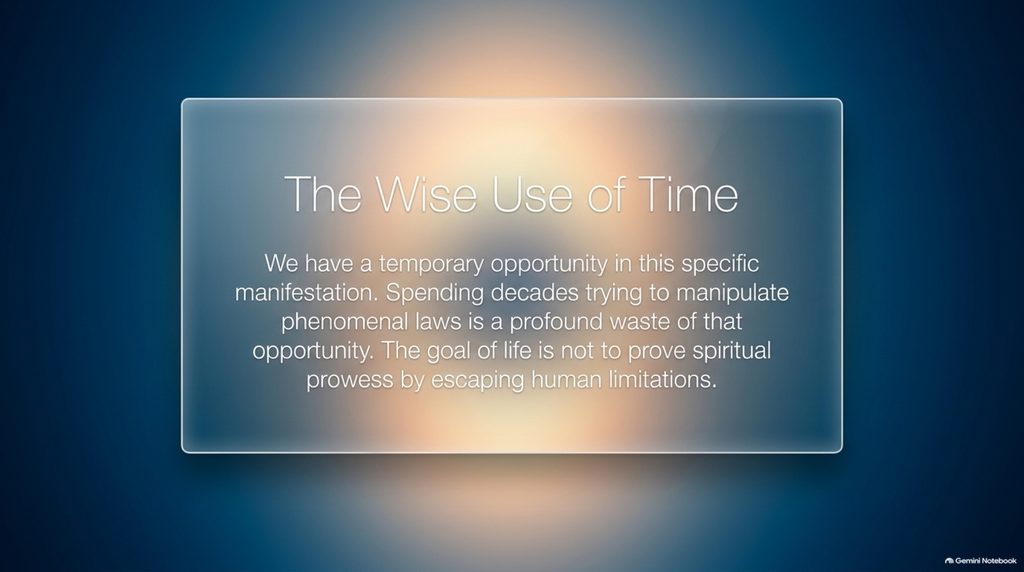
It’s wrong spending your fifteen years—that’s not the wise way of spending your time.
You have in this lifetime a temporary opportunity.
Use it wisely.
Thank you.
Okay, nice to see you, Renata.
Any questions?
Okay, by the way, just Layla.
I have a question.
Yes, one moment, Paul.
Layla, if you want the recording of this video,
make sure you put your email in the chat, because I don’t think I have your email.
Yes, Paul?
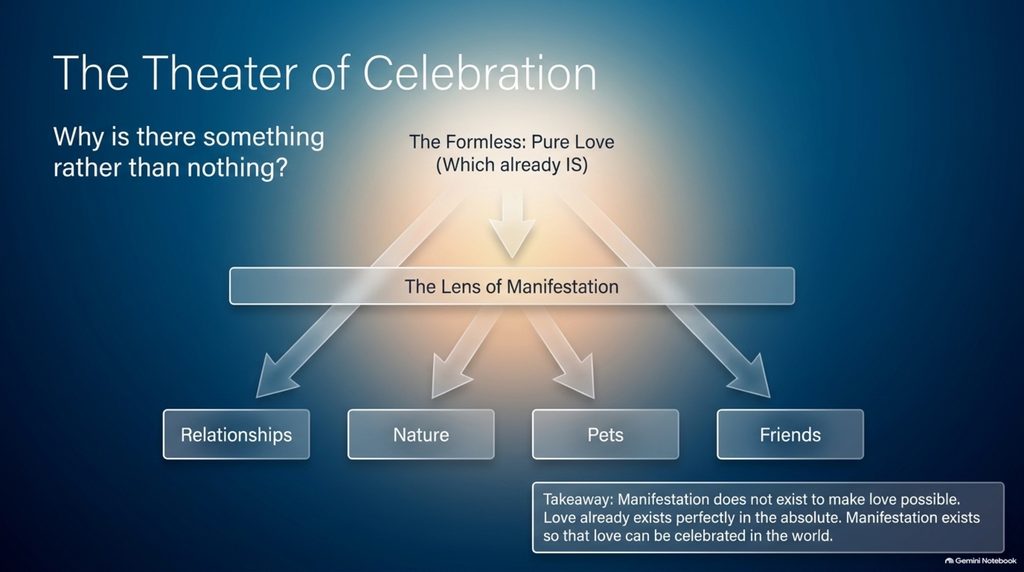
I’ve heard some Buddhists say that the reason why there is something rather than nothing
is so that love could be possible.
Is that right?
Not for love to be possible.
No, I don’t agree.
But for love to be celebrated in the world, in relationships, in life—
loving your pets, loving your friends.
So not for love to be possible.
Love is. There is no impossibility when it comes to love.
There is impossibility in celebrating love when we are full of anger, hatred,
and negative emotions.
Then it’s very difficult for us to celebrate love and to express love.
Okay, thank you.
All right. Well, very lovely to be with you all.
Thank you for your love and friendship.
And so have a lovely day or night, whatever, wherever you are.
See you soon.
AI Summary
Awareness and nonduality Q&A
Date: Sunday, November 8, 2026 11:00
Duration: 76:58
Key Points
- Awareness is unaffected and timeless
- Personality belongs to body-mind
- Love and beauty are impersonal
- Direct experience outruns mental beliefs
Overview
| Concept | Detail |
|---|---|
| Awareness | Timeless and unaffected |
| Body-mind | Born, changing, dying |
| Personality | Trait of manifestation |
| Direct experience | Shows no awareness borders |
| Love and beauty | Impersonal, non-phenomenal |
| Profound moments | Become personal after mind returns |
| Miraculous feats | Secondary to realization |
This session guides resting as awareness, then explores nonduality through questions on time, personality, consciousness, and love.
Resting
The opening practice settles attention into effortless being. It shifts from mental activity to simple presence in the body and in aware space.
- Sit comfortably and let the body be supported without effort.
- Give sensations space without trying to fix anything.
- Let the mind rest without defining yourself or your experience.
Awareness remains available even when noise, tension, or thoughts appear. The invitation is to notice that what perceives experience stays undisturbed.
Core pointer: You are the destination already, and awareness stays unaffected by what appears.
Unaffected
The teaching returns to one theme: events affect body and mind, but not the reality that knows them. Reactivity fades when this distinction becomes clear.
- Sickness, world events, and mental activity can affect the body-mind.
- Awareness itself is not affected by those changes.
- Freedom appears when events no longer pull experience into reactivity.
You are not affected.
The same point frames life as a changing play within a changeless awake presence. The still point is always present and available.
Personality
This section separates realization from becoming blank or uniform. Diversity continues, but it belongs to manifestation rather than to the Self.
| Personality | body-mind characteristic |
|---|---|
| Self | awareness itself |
| Diversity | manifestation within awareness |
- Creativity and expression continue after realization.
- Different tendencies and skills belong to different body-minds.
- Saying “I am artistic” confuses awareness with the body-mind.
- More precisely, the body-mind has that tendency.
- Personality does not stain awareness, like images do not stain a screen.
Be gentle with the body-mind instead of judging it. No fixed point of view needs protection.
Direct experience
The teaching rejects mental boundaries around awareness. Direct experience, rather than inherited belief, tests what is true.
- Awareness has no visible edges, borders, or separation in direct experience.
- The mind invents division through conditioning and concepts.
Nobody has closer access to experience than the one aware of it. The instruction is to investigate where awareness supposedly begins or ends and see that no such border appears.
Time
A question about awareness before birth and after death shifts into a distinction between phenomena and reality. Time applies to changing forms, not to awareness itself.
- Bodies are born and die.
- Thoughts appear and disappear.
- Awareness is not a mind event that switches on and off.
- Reality is timeless rather than located inside before and after.
The answer treats the question itself as confused because it mixes manifestation with formless awareness. A camera can record a body, but not awareness.
Consciousness
A later exchange asks whether love, beauty, wisdom, and freedom are properties of consciousness. The answer treats them as non-phenomenal and impersonal rather than as objects.
- Understanding, beauty, and love involve a collapse of personal mind structures.
- The mind may later register and describe what happened.
- Manifestation does not make consciousness phenomenal.
- Images appear on a screen.
- The screen is not made of images.
Love and beauty can be celebrated in human life, but they do not arise from the person. In their absolute sense, they appear with the collapse of separation.
Non-experience
The discussion then focuses on why profound moments become confusing. The issue is not the moment itself, but the mind claiming it afterward.
- Awe, love, and clarity are called non-experiences rather than personal experiences.
- The person returns afterward and turns them into possessions or memories.
- The habit wants to hold, store, and repeat what felt clear.
Seeing that habit weakens its grip. The relaxed awareness is present already; the grasping movement belongs to the old personal pattern.
Miracles
A question about a swami living without food or drink opens a brief discussion of extraordinary phenomena. The answer allows possibility without treating it as the point.
- Consciousness is complete freedom, so the mind’s limits are not final.
- Extraordinary feats do not equal wise use of a human life.
The Buddha story makes the point: spending 15 years to walk across water is less significant than paying three rupees for the boat when the deeper opportunity is realization.
Love
The closing question asks whether the world exists so love can be possible. The answer draws a distinction between love itself and its expression.
- Love does not need the world in order to exist.
- Life and relationship allow love to be celebrated and expressed.
- Anger, hatred, and negative emotion obstruct that celebration.
Love is not made possible by manifestation; manifestation provides a field where love can appear in lived form.