
Meditation
Transcript
Meditation
Welcome, hello everyone, lovely to be with you.
So that we can take this opportunity this morning
to dive deeply into the beyond,
to dive deeply into the unmanifest,
into the reality of all experience.
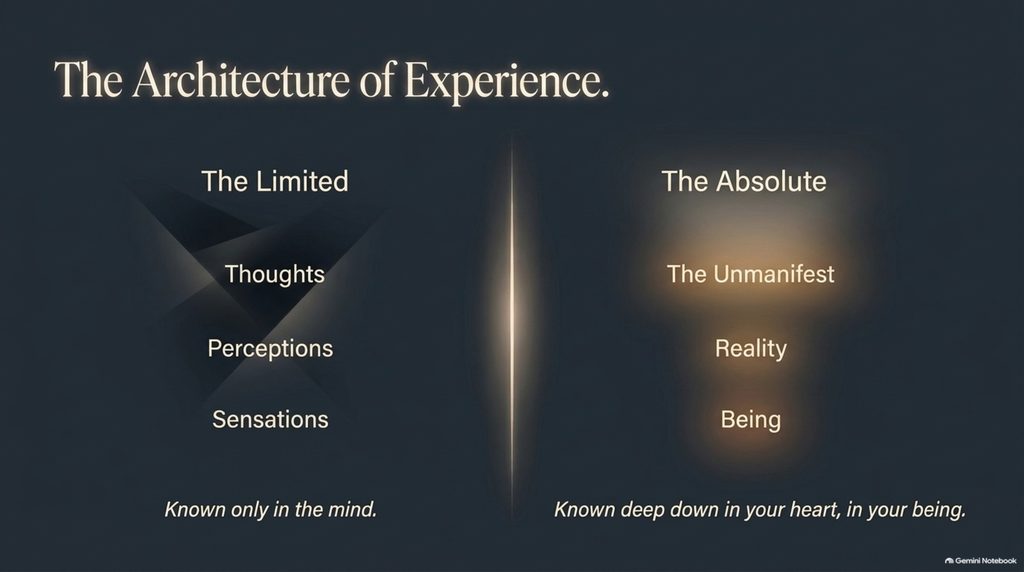
Because experience is limited—
thoughts, perceptions, sensations.
But there is the absolute,
that which deep down in your heart you know,
not in your mind, but in your being.
So, sitting comfortably
and for the duration of this meeting too,
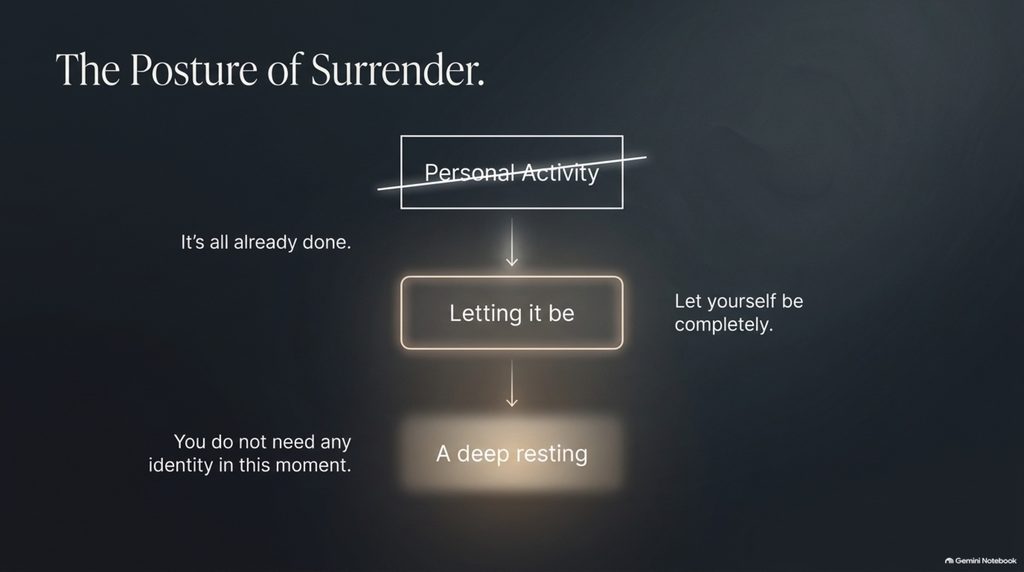
let yourself be completely.
Let things be.
Let it be.
Nothing that you need to do.
No personal activity whatsoever.
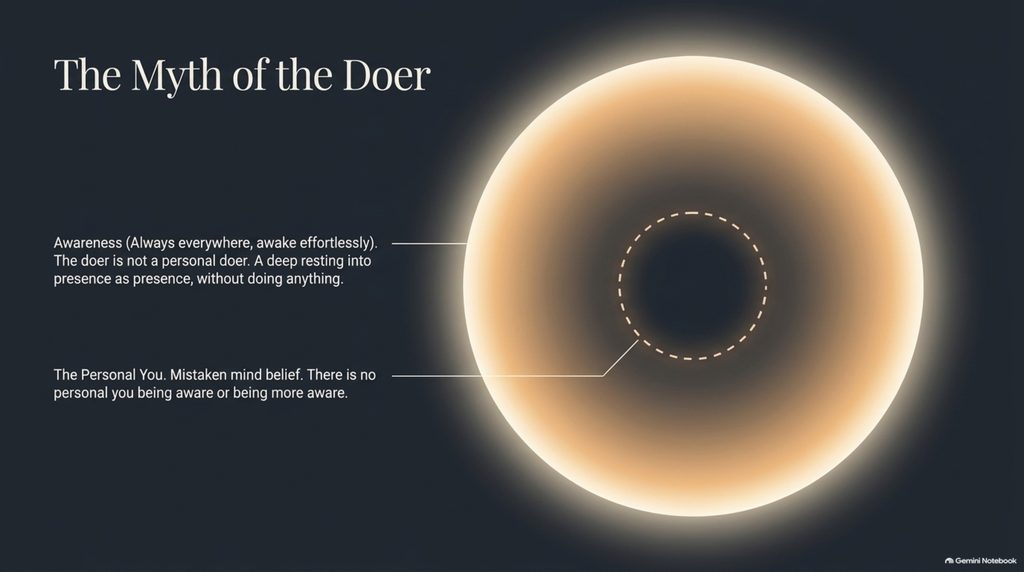
Because the doer is not a personal doer.
It’s all already done.
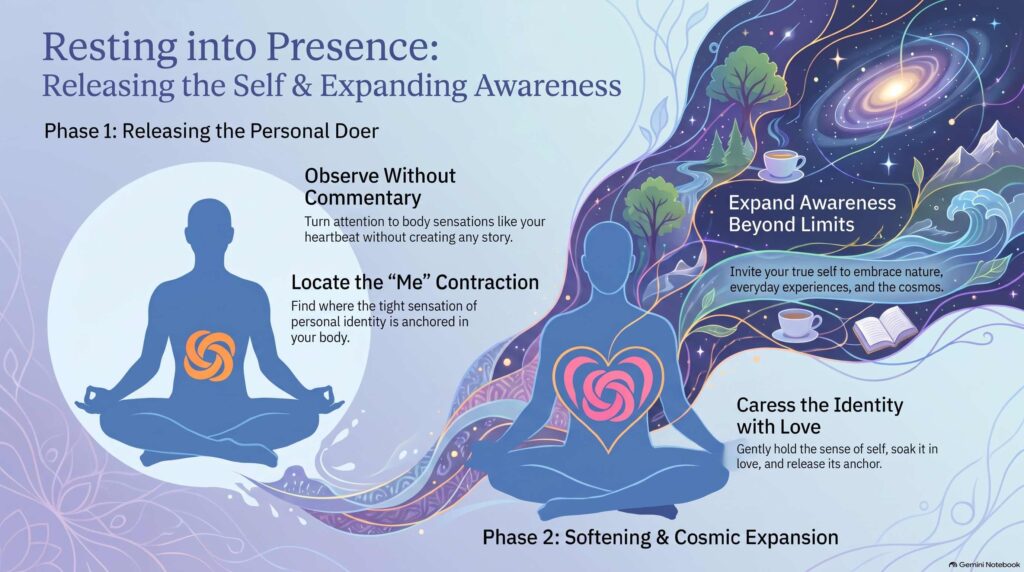
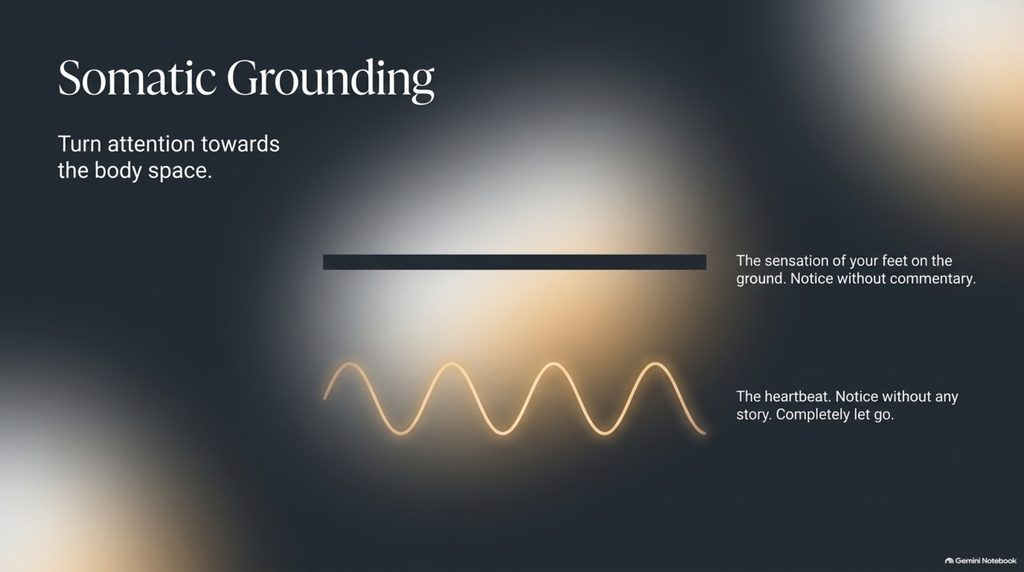
So you can turn your attention towards your body,
whatever sensations are appearing within the body space,
to simply notice without commentary,
without any story.
The sensation of your feet on the ground.
The heartbeat.
To completely let go.
You do not need any identity in this moment.
You don’t need to refer to yourself in any way whatsoever.
A deep resting into presence as presence,
without doing anything.
There is awareness, always, everywhere, always awake, effortlessly.
There is no personal you that is being aware or being more aware.
That’s just mistaken mind belief.
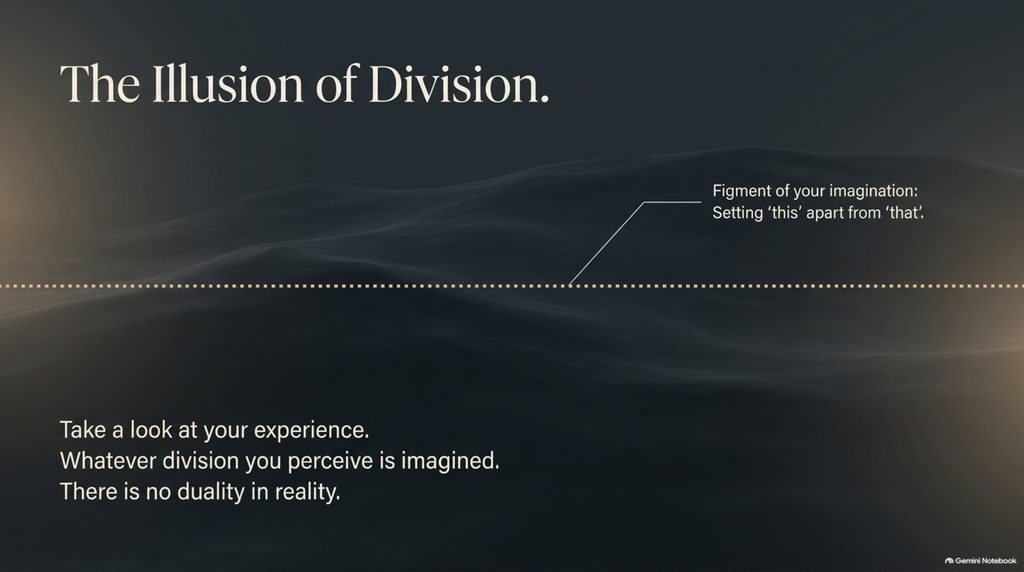
There is no division anywhere.
Take a look at your experience.
Whatever division you perceive is a figment of your imagination,
setting this apart from that,
while there is no this and no that.
During this meditation, there is nothing that you are doing, nothing.
The Absolute is guiding you to itself,
to your reality.
There is no duality in reality.
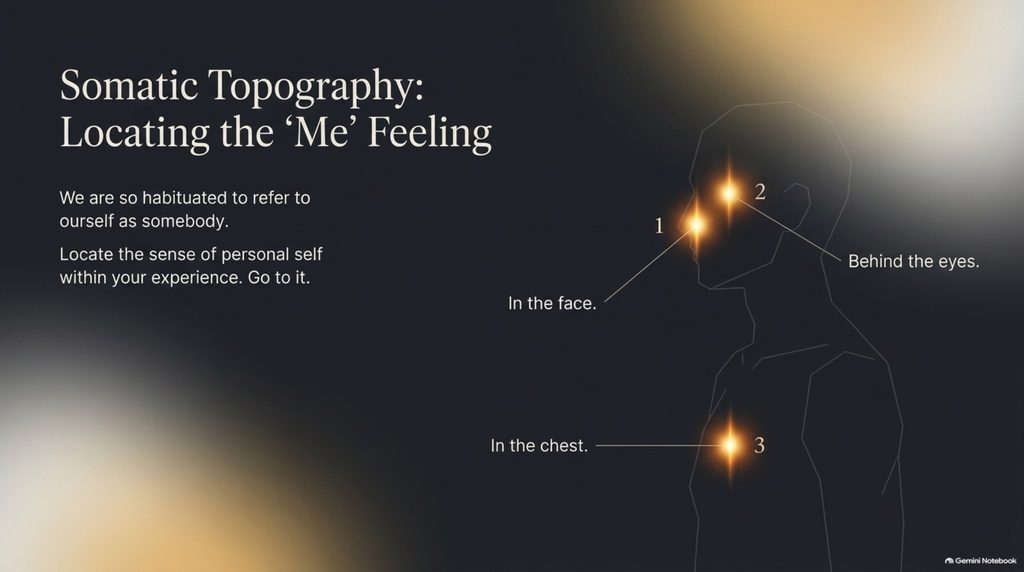
We are so habituated to refer to ourself as somebody,
and we are so used to feeling that we are somebody.
So if we can turn our attention, if possible,
within your experience to locate the me feeling,
the sense of personal self.
Maybe it’s in the face, behind the eyes,
or in the chest.
Go to it.
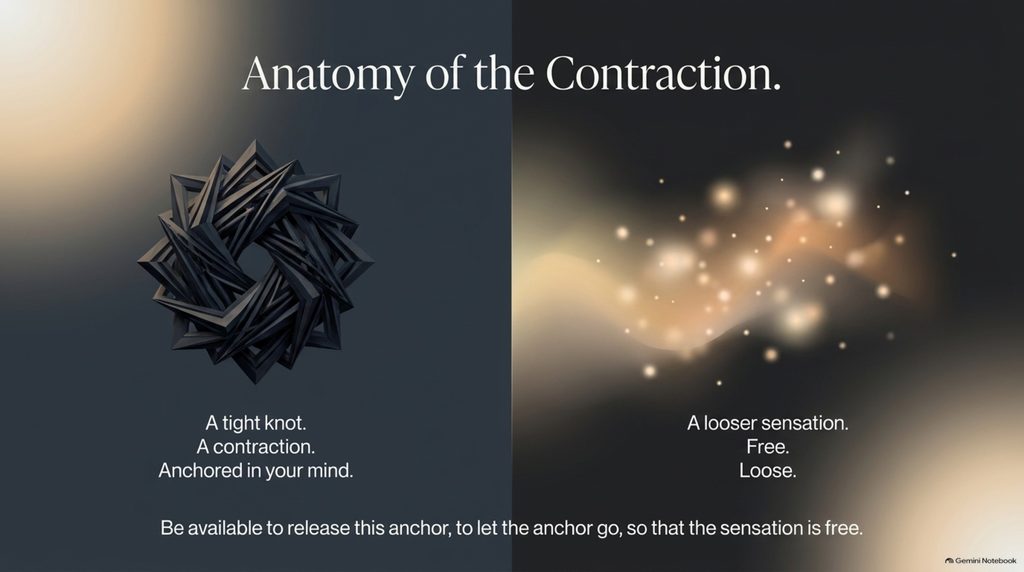
It may be a tight knot
or maybe a looser sensation.
It may feel like a contraction
or less of a contraction.
Imagine that this feeling or sense of limited self,
the sense of me, to be anchored in your mind.
And be available to release this anchor,
to let the anchor go,
so that the sensation is free.
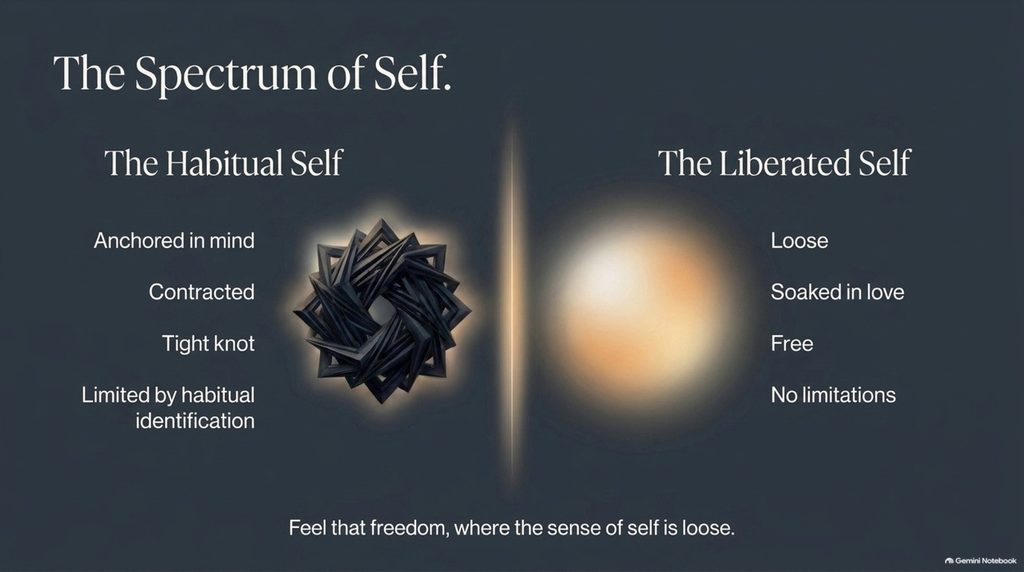
Feel that freedom,
where the sense of self is loose.
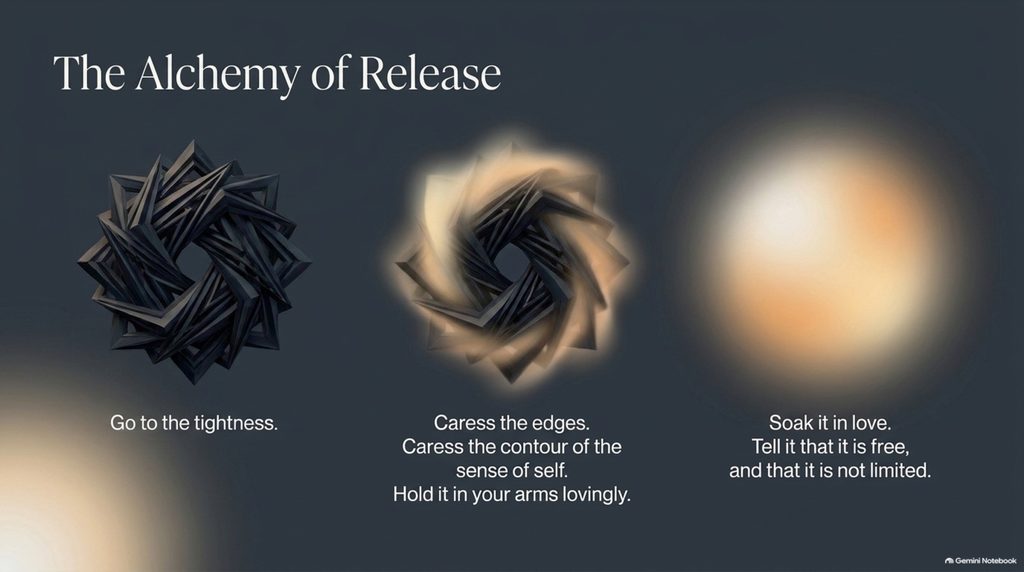
And if you notice the sense of self to be tight
somewhere in your chest or your body or your head,
go to it and gently, sweetly, lovingly, softly,
caress it.
Caress the edges, the contour of the sense of self.
Hold it in your arms lovingly.
Soak it in love
and tell it that it is free
and that it is not limited.
So that you can experience this sense of self
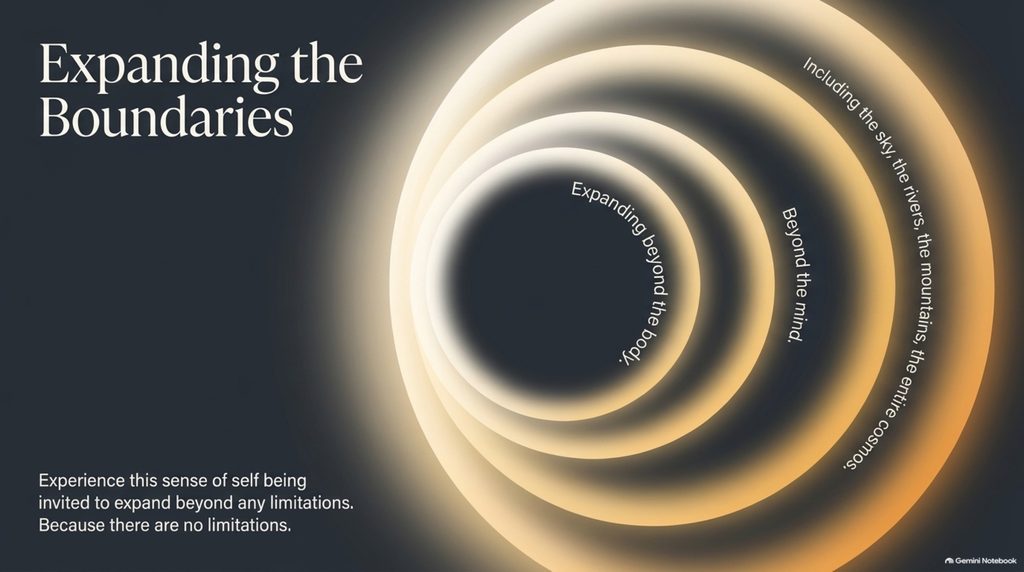
being invited to expand beyond the body, beyond the mind,
beyond any limitations, because there are no limitations.
So that your sense of self includes the sky,
the rivers, the mountains, the entire cosmos.
It is all oneself, myself, oneself.
The sense of self freed from the habitual identification that limits it.
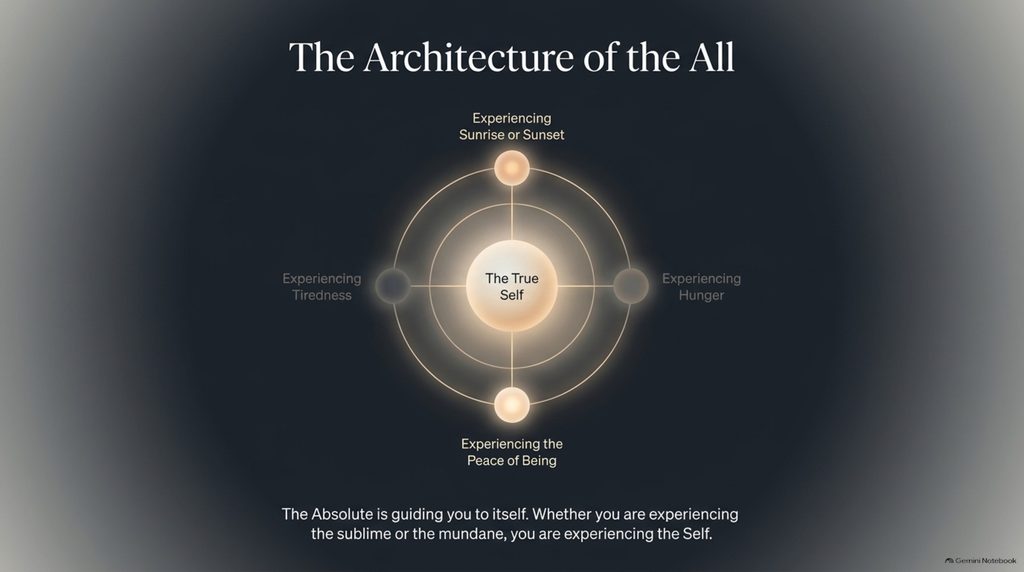
So that when you’re experiencing sunrise or sunset,
you’re experiencing the self.
When you’re experiencing tiredness or hunger,
you’re experiencing the self.
When you’re experiencing the peace of being,
that is your true self.
Everything.
It’s the self.
AI Summary
Guided nonduality meditation
Date: Sunday, November 1, 2026
Duration: 23:13
Key Points
- Awareness is always present
- No personal doer exists
- Division is imagined
- Sense of self can soften
Overview
| Concept | Detail |
|---|---|
| Absolute | Beyond limited experience |
| Presence | Nothing needs doing |
| Awareness | Always awake, effortless |
| Division | Imagined by mind |
| Me feeling | Found in body sensations |
| Contraction | Met with loving attention |
| Self | Expands beyond body |
This recording is a guided meditation on nonduality, presence, and releasing identification with a personal self.
Unmanifest reality
The meditation opens by turning away from limited experience and toward the absolute. Thoughts, perceptions, and sensations are presented as limited, while reality is the unmanifest known in being rather than in mind.
There is awareness, always, everywhere.
A deep resting into presence frames the whole session. The guidance points to what is already here rather than to something to achieve.
Resting in presence
The practice is to sit comfortably and let everything be as it is. Nothing needs to be done, and no personal activity is required.
- Turn attention to the body.
- Notice sensations and body space.
- Feel the feet on the ground and the heartbeat.
- Drop commentary and story.
- Let go completely in this moment.
Practice stance: Do nothing, let things be, and rest as presence.
Identity is also set aside here. There is no need to refer to oneself in any way during the meditation.
Awareness without self
Awareness is described as effortless and always awake. The guidance rejects the idea of a personal self that becomes aware.
| Awareness | always present and effortless |
|---|---|
| Personal doer | does not exist separately |
| Reality | free of duality |
There is no personal you that is aware, and no personal doer behind experience. The absolute guides attention back to itself.
No division
The meditation treats separation as imagined rather than real. Any division perceived in experience is framed as a construction of mind.
- No division exists anywhere.
- Setting this apart from that is imagination.
- Reality has no duality.
This section keeps returning to direct experience instead of belief. The instruction is to look and see that the split between “this” and “that” is not actually there.
Me-feeling
Attention then shifts to the felt sense of being somebody. The guidance asks for a direct search for the me feeling in the body.
- Locate the sense of personal self.
- It may appear in the face, behind the eyes, or in the chest.
- Recognize it as a sensation.
- It may feel like a tight knot or a looser contraction.
- Notice its anchor in mind.
The aim is not analysis but contact with the felt sense itself. The habitual feeling of being somebody is treated as a pattern that can be met directly.
Releasing contraction
Once found, the sense of self is approached gently. The instruction is to release its anchor and allow the sensation to be free.
- Go to any tightness in the chest, body, or head.
- Caress the edges of the contraction softly.
- Hold it lovingly and soak it in love.
- Tell it it is free and not limited.
This softens the contour of the personal self rather than fighting it. Freedom appears as looseness where the self-sense had been tight.
Expanded self
The closing movement invites the sense of self to expand beyond body and mind. Self is no longer limited to a contracted identity.
When the anchor loosens, the sense of self can include the sky, rivers, mountains, and the entire cosmos. Sunrise, sunset, tiredness, hunger, and peace are all presented as the Self.
Everything is the Self, and the peace of being is the true self.
Satsang
Transcript
Satsang
So, if you can open your eyes and come together here, you’re welcome to turn on your video.
I always enjoy seeing you.
We are available to explore
whatever questions you may have.
So, any questions?
Hi Magdi.
Hello.
Thanks for the guidance.
I find it relatively clear at the moment to recognize the awareness in the front of my body,
even though the sense of self feels like it’s in the face where all the sensations are.
But it’s quite clear to me that it’s a sensation moving through awareness
rather than my arm moving in nothingness.
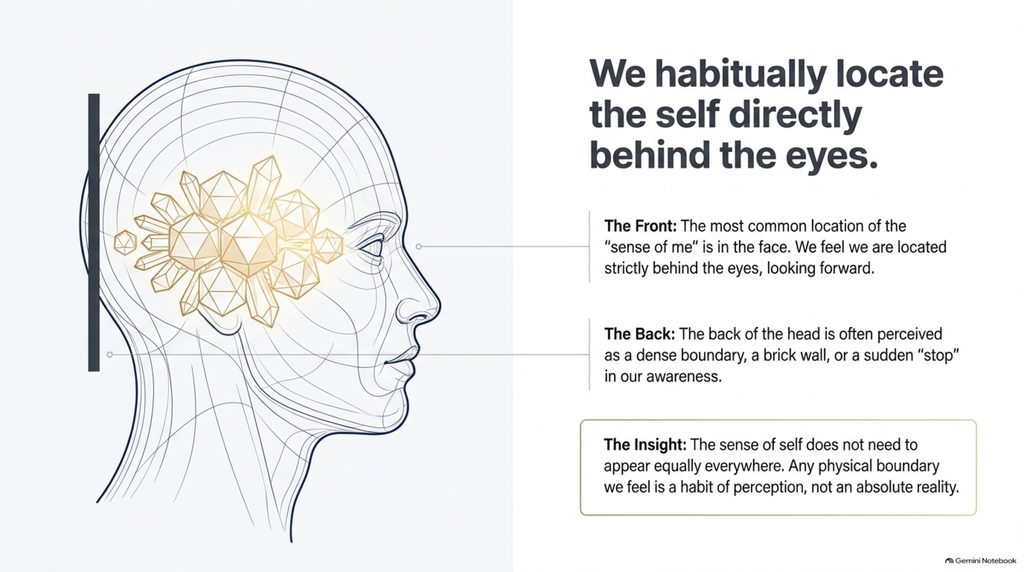
But when I come to the back of my body, the back of the head,
it almost feels like a brick wall, like a stop.
And I can see through that into the borderless awareness.
But I just find it quite curious that there’s a different quality to the sensations at the back
compared to the front, if that makes sense.
And I don’t know if that’s maybe to do with you closing your eyes
and there’s still light coming through your eyelids.
And so it’s easier to conceptualize the openness, I guess.
Yeah, I mean, the most common location of the sense of self is in the face—
the eyes, behind the eyes, that’s where we perceive the organism or the perceptual field is located there,
in the sense of me being behind that location, looking forward.
Even when we look backward, we turn around and we’re looking actually forward.
We never really perceive physiologically backward.
We’re always perceiving forward.
So this tendency for the sense of self to be felt more in the frontal dimension of our experience—
whether the back is clear makes sense.
I wouldn’t make a problem out of it.
The main thing is that whichever way you experience the sense of me,
in whatever location or feeling—
whichever way it appears to you—
it doesn’t have to appear equally in the front or the back.
Whichever way it appears to you:
to release it,
to allow it,
to be free.
Not to keep pinning it down to this specific sensation we’re habituated to,
but to invite it to expand in the space
and to include more than just itself,
to include a broader spectrum of your experience.
This is a very helpful yoga that you can explore—
whichever way you creatively can explore it—
to locate the sense of me
and over and over, release it,
allow its boundaries to expand
so that you can return to the natural state.
The natural state is completely empty of any identification.
Another way of seeing it is that the natural state is all-inclusive,
because everything that you experience, its reality, is consciousness.
And there is only one reality.
So whatever locality or self-location that you find in your experience
are due to a mistaken identification.
And we do experience and feel ourselves to be limited,
like we’re limited to the body, for example.
I am sitting on the chair, which is not true.
You’re not sitting on the chair.
The body is sitting on the chair, but you’re not sitting on the chair.
There is this habitual sense of me that’s associated with the senses and the body,
and we experience this sense of self in the background.
We don’t notice too much.
So when we turn our attention during the meditation to the sense of self,
to the limited self,
we are creating an opportunity to notice that sense of self and to release it.
It’s a good practice.
I think what’s been blowing my mind a bit recently—
and I guess dislodging that sense of self—
is well, my main practice has been my main inquiry: Where am I?
And seeing that there’s nothing I can quite pin down on, like you said.
But also the sensations that I would typically say is me
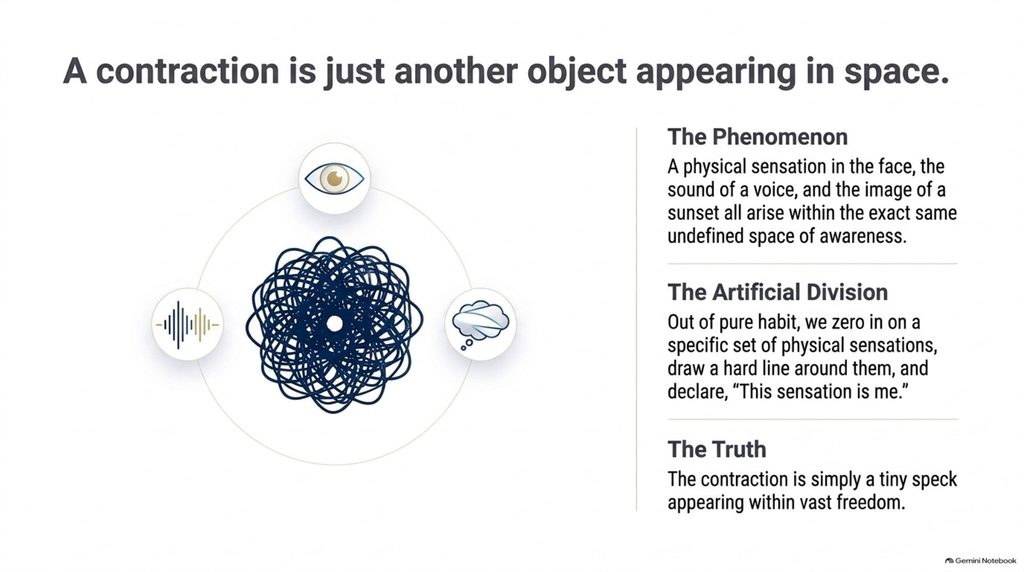
appears in exactly the same space as I hear your voice.
Yes, and I can’t—other than conceptually—
I can’t pick them apart.
The sensation of my feet, the sound of your voice.
It’s a bit more tricky with the eyes open,
but if I focus then I can see that even the images are arising in the same place.
Yes, and there’s no location to that place.
It’s just everywhere and it’s nowhere.
Yeah, we refer to it as awareness, which is nowhere and everywhere.
Yeah, everything that you perceive—hearing my voice or perceiving a thought—
they appear within the same space, right?
And the sense of a limited self also appears within the same space.
But there is a fixation—
there is a fixation upon this sense of self.
And this fixation is: I am this.
I am this structure.
I am this being.
This sense of self, this personal self.
And that fixation overlooks what you just shared with me:
that this is just an event appearing within the same awareness,
which is nowhere and everywhere
and doesn’t give a hoot about what appears within it—
whether it’s a thought that appears, a sensation, a memory.
They appear in the same space of awareness,
which is untouched, which is undefined.
It’s not defined by what appears within it.
Now, it’s important to come to the understanding that this space—
this space-like awareness, which is nowhere and everywhere—
is the reality which perceives.
Would you agree?
Yeah.
There isn’t like somebody else in that space
besides that space that’s sitting on a chair and watching.
You follow?
Yes, and I guess the tricky bit is that even that awareness relies on the eyes to have
a visual awareness, if that makes sense.
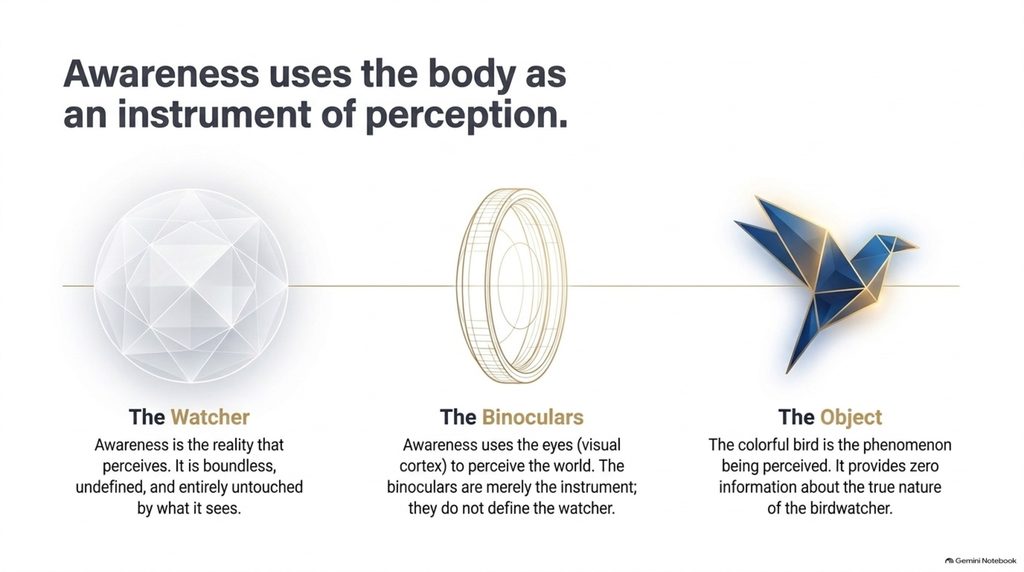
Yes, yeah. Awareness uses the eyes to perceive a sunset.
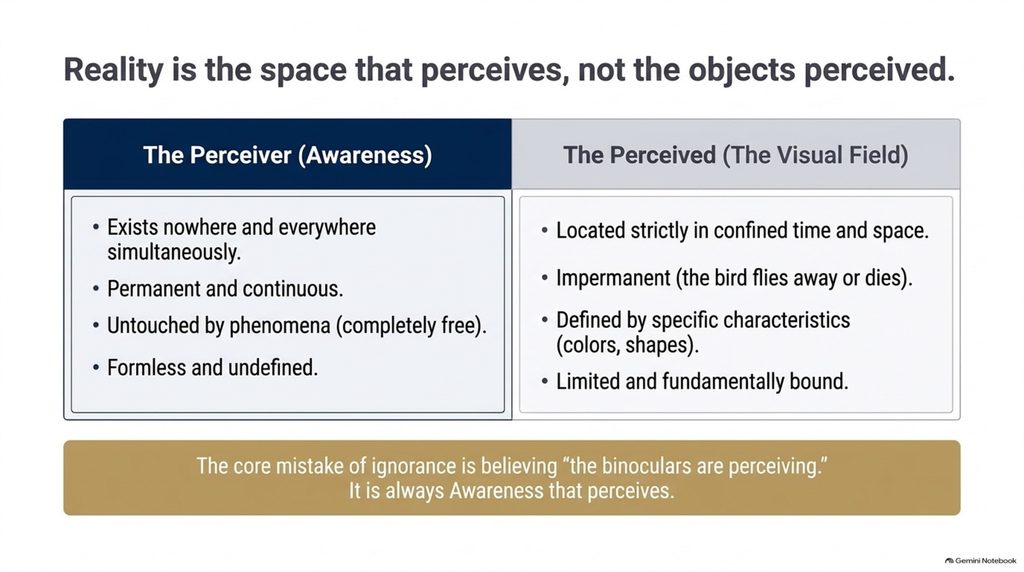
You use binoculars to perceive a bird that’s 200 yards away.
The fact that you’re using the binoculars does not mean that the binoculars define you.
The binoculars are an instrument that allows you to see the bird, the distance.
But the fact remains that that which perceives the bird is not the binocular.
That which perceives the bird is you.
So awareness, as you said, uses the visual cortex in order to perceive the sunset.
But this does not mean that it is the visual cortex that perceives,
nor does it mean that the sunset, which consciousness is perceiving, defines consciousness, defines awareness.
In other words, the bird watcher was using the binoculars to watch the bird
and perceive a very beautiful, colorful bird.
The colorful bird doesn’t provide you any information about the bird watcher—
whether the colorful bird is 100 colors or 200 colors.
It does not tell you whether the bird watcher is 20 years old, 4 years old, male, female, American, Australian.
So similarly, when you turn your attention to the spaciousness of awareness, a few things.
First, you need to be clear that it is awareness which perceives, and not the eyes.
Right? It is awareness which perceives.
Secondly, reality is not that which is perceived.
Because a second later the bird is shot and is dead.
There is no more bird.
This doesn’t mean that you, the bird watcher, die.
Awareness—I, the reality which perceives—
reality is not affected by the visual field, that which is perceived.
There is impermanence to the thoughts which you perceive or even my voice.
Hearing my voice is impermanent.
While there is a permanence to awareness, which is nowhere and everywhere.
Would you agree?
Yeah.
Finally, you need to get clarity that in very simple terms—
we don’t need to get very sophisticated—
it is you that perceives, right?
You agree?
It is you that perceives.
Agreed?
It has to be, otherwise I wouldn’t perceive it.
I perceive.
Now, the mistake is that when we say “I perceive,” in ignorance we believe
“Oh, it’s the body that perceives. The eyes are perceiving. The binoculars are perceiving. The ears are perceiving.”
No. That’s the mistake.
It is I that perceives.
I, meaning the bird watcher.
I, meaning awareness.
So this space-like quality, which is nowhere and everywhere, as you said a minute ago,
is you.
It is the real I.
And the only eye there is that perceives, that knows it is, perceives and knows that it perceives.
But one more thing:
we believe that awareness—the space-like quality which is nowhere and everywhere—
needs to perceive in order to be.
Where did we get that from?
It needs to perceive in order to be.
No. No, it does not need to perceive in order to be.
You need to come to that understanding.
We can explore that together whenever you want.
It does not need to perceive.
It does perceive whenever it feels like perceiving,
out of its complete freedom, because it’s the only reality there is,
meaning the only freedom there is.
You follow?
Yeah, no, definitely.
So you perceive or you don’t perceive objects, phenomenal objects.
It doesn’t matter.
You are that which is.
You are the freedom that is.
You are the reality that is.
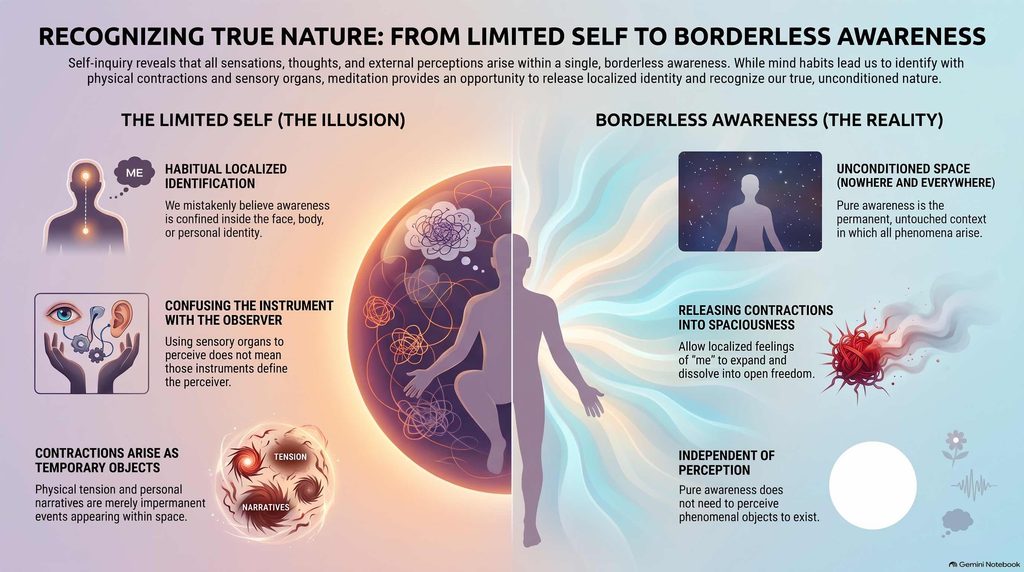
So the sense of self, this contraction, arises in the space of awareness.
You are this awareness.
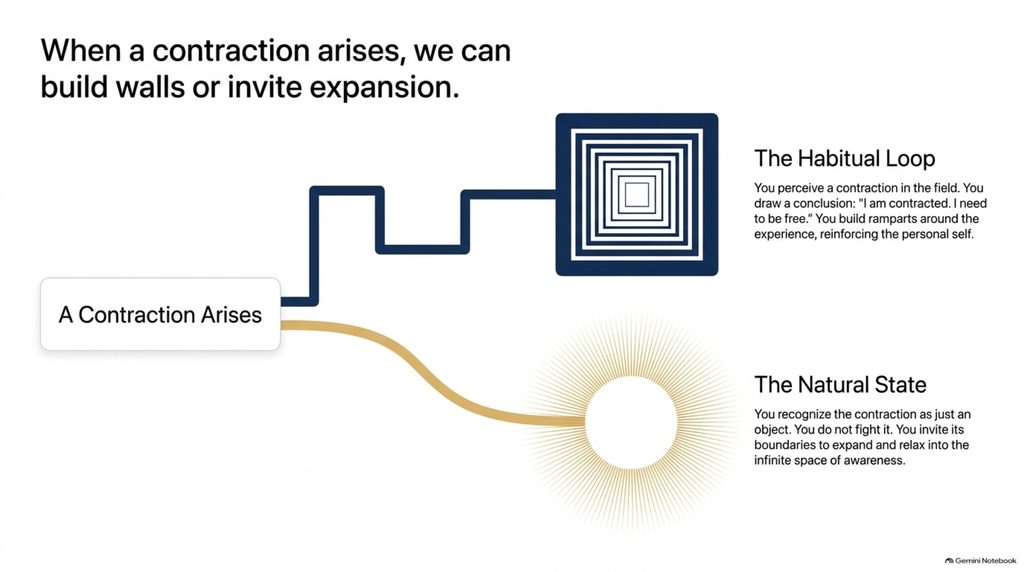
When you perceive this contraction, you tell yourself,
“I am contracted. I am contracted.”
So you perceive something in the field, something that appears and disappears.
The bird watcher watches, sees a bird and draws a conclusion about himself.
“Oh, I am…”
You perceive a contraction.
And the conclusion is, “I am contracted. I need to be free.”
And yeah, that contraction is a tiny speck appearing within the vast freedom.
It’s the party pooper, and it takes not even a second to spot the contraction and wait—
that’s just an object appearing as every other object.
Yes, yes.
And you are the space which is nowhere and everywhere.
And you can invite this contraction to relax and be released in the infinite space of awareness.
Why not?
You can try it.
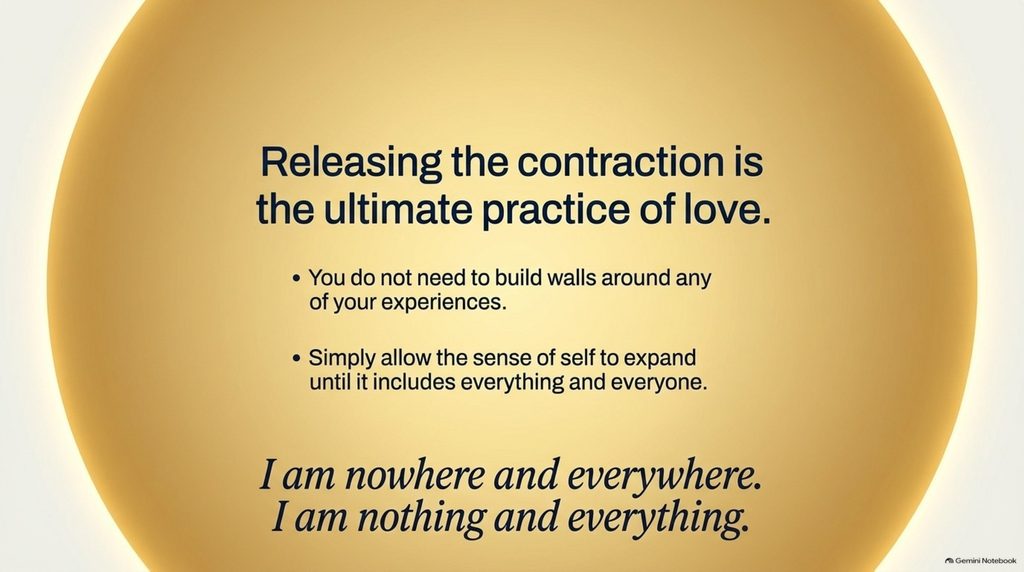
And in some ways that feels like almost the best practice of love—
this tight ball, let it dissolve.
Absolutely. You don’t need to build ramparts. Is that an English word? Ramparts?
You don’t need to build walls.
You don’t need to build walls around any of your experience.
Let it explore the simple expansion of the sense of self
to include everything and everybody.
“I am nowhere and everywhere. I am nothing and everything.”
You can come closer to the reality of the self.
Because I think, going back to my initial observation
about the different types of things appearing in the spaciousness—
the habit, and I don’t know whose habit this is (I suppose it’s the habit of mind, or however you want to describe it)—
but the habit is to distinguish, you know, the physical sensation of the face, for example,
from the sound of a voice or the image of a sunset.
And to say, “This sensation is me,” so I separate this sensation.
Even though, as I was saying earlier, there’s no way to separate a sensation from a sound, from an image, or whatever.
And I guess it’s just undoing that habit which says it’s an artificial division.
You can make a distinction and say the sound of a bird is different from the sensation of my face.
Okay, fine.
But that’s not what we’re talking about.
We’re talking about identification—
that this is more me than the sound of the bird.
And yet, as you said, it’s appearing in the same space.
It appears and disappears.
It has qualities of sound and sensation.
They all have the same quality in a way—
a perception, a thought.
When they appear there, there’s some sort of movement.
We zero in on a certain set of sensations.
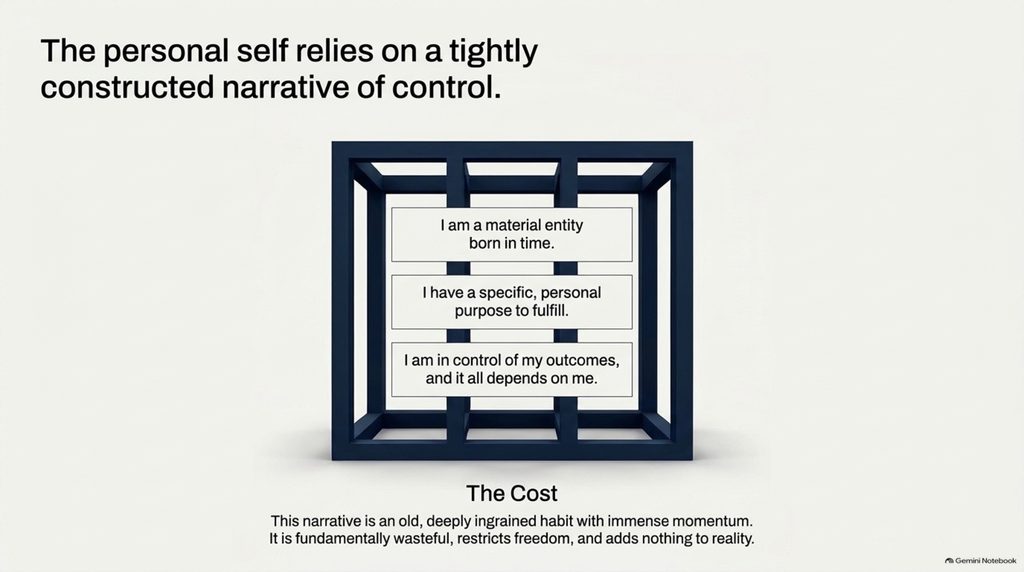
It’s a whole habit that’s rooted in the belief that I am the character,
the belief that I am a material entity,
the belief in materialism.
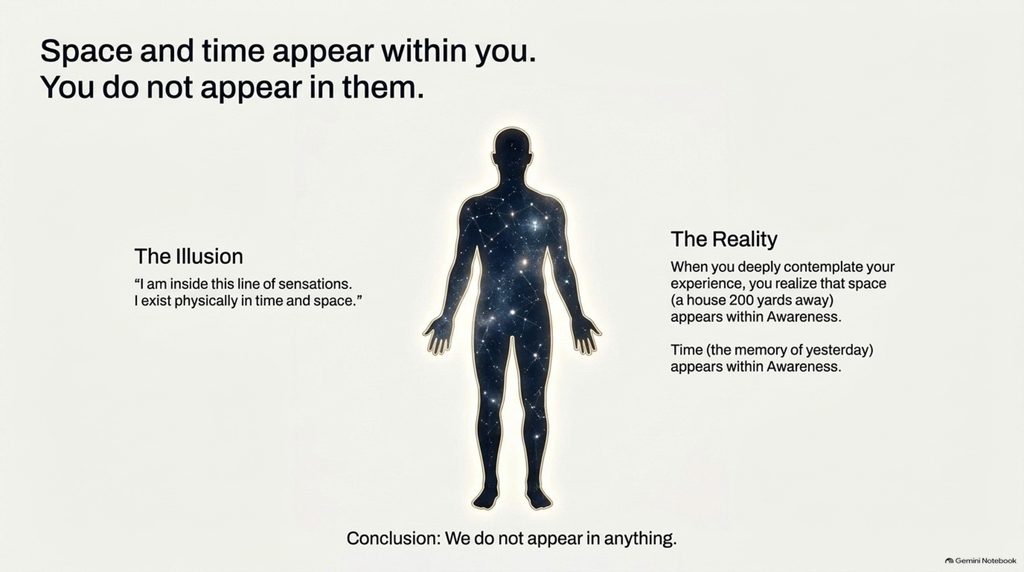
I am inside the line of these sensations, right?
And yet these sensations are appearing inside you, inside the space of awareness.
You’re not appearing inside this line of sensation.
You may believe that you are, but when you take a look at it,
you realize no, this sensation is appearing within this awareness
which is nowhere and everywhere.
It’s an old habit to keep affirming ourself as an entity which exists in time and space.
That’s an old, old, old, old, old…
“I have this identity. I exist in time and space. I have so much time to accomplish…”
But that’s not the truth.
When you meditate and contemplate your experience,
you find that space appears within you through the visual cortex.
You perceive, you know, this house over there is 200 yards away.
It appears within you, within awareness.
Space appears within awareness.
And time—like, for example, the memory of yesterday—
also appears in awareness, meaning in I, in reality.
We do not appear in anything.
I mean, the body appears in the uterus or whatever.
The body is right now in the kitchen.
But that’s not what we’re talking about.
It’s such a silly habit as well.
It’s unnecessary. It’s so wasteful.
It adds nothing to anything.
And yet it’s got so much momentum behind it as well.
You know, God loves to play tragedies, comedies.
Here we are. We’re playing it.
And also, God loves to play returning to itself.
As a way of speaking, it never really left itself.
So here we are.
I was going to say interesting, but just mind-blowing a bit.
Yeah.
Anyway, thank you, Magdi. I really appreciate that, as always.
Nice talking with you, Aquinal.
And you.
Any questions?
Patrick is out there in the rain, yeah?
It’s nice out, but boy, it’s been a tough day to get the dog out for a walk.
Oh, yeah, right, right.
Hey, I have a quick follow-up question to that previous conversation.
Yeah.
I don’t know how long I’ll be able to keep my video on, though.
But the thing—like, all of what we were talking about can be explored through meditation.
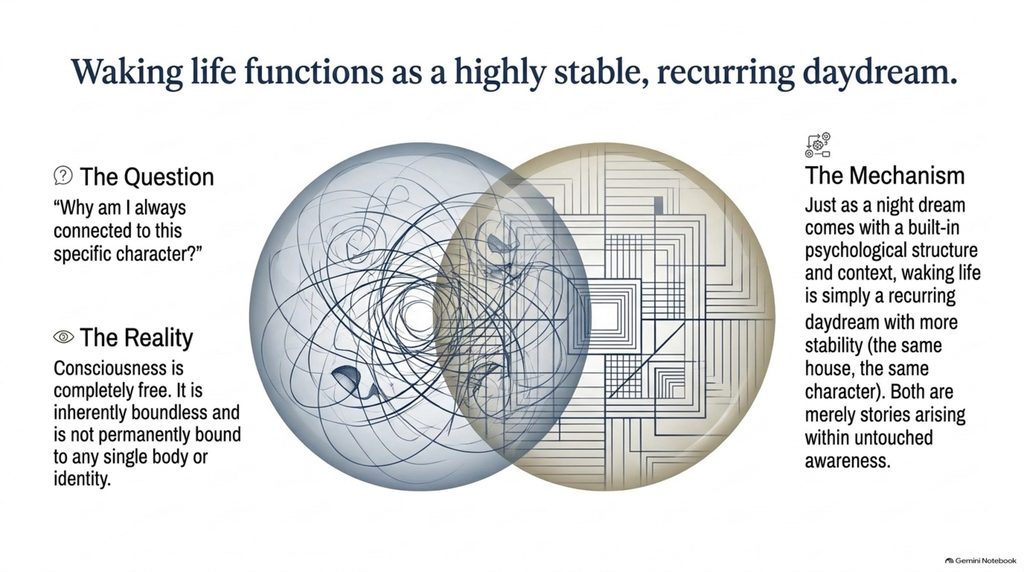
The one thing that trips me up is: why am I always connected to the same body?
Like, what is the mechanism that connects awareness to this Patrick character?
Or is that nonsense?
What is the mechanism that connects awareness to this Patrick character?
Yeah, it’s not something you can explore in meditation, like, really.
Well, you know, when you turn your attention in meditation to being, to sort of bring the mind to collapse, to rest,
and you go below the mind, beneath the mind,
in presence or in being or in pure emptiness or resting,
there is no longer a Patrick body. There is no longer a Magdi body.
Maybe me and you, we could be sitting in the same meditation hall, next to each other, two feet away from each other.
There is no Magdi body. There is no Patrick body.
So then, the question at that moment is moot.
What connects awareness to this Magdi body?
There’s no connection.
Awareness is completely free.
It’s not dependent.
It doesn’t need to always be connected to the Magdi body.
In fact, there are many, many examples where consciousness is not connected to the body.
It could be in deep sleep or between thoughts, et cetera.
Now, you could say that obviously there is a repetitive pattern.
When I come out of meditation, there is Magdi’s car, Magdi’s body.
There’s Patrick’s car, Patrick’s body, et cetera.
But there’s also John’s car, John’s body, Gulley’s car, Gulley’s body.
There are every body, all sorts of bodies being perceived via that same awareness.
So we are used to identifying with the Magdi body, with the Patrick body.
And so we don’t have access to consciousness being free to experience itself across infinite bodies.
And it is this identification with the body that trips us and brings up this question.
Well, and I’ve had dreams before where you already know the context of the dream.
It’s already built in to the psychological structure of the dream character, you know?
Like, maybe in real life I don’t have a sister, but in a dream I know that I do,
even though maybe she’s not in the dream, or something along those lines.
So it’s good to me that every day that you wake up could be the first time that that’s happening,
and the context is implanted.
Yes, that’s a good point.
Every time you wake up, it’s the first time that this is happening.
Everything that you experience is the first time that it is happening.
But there is, on one level, that is very true.
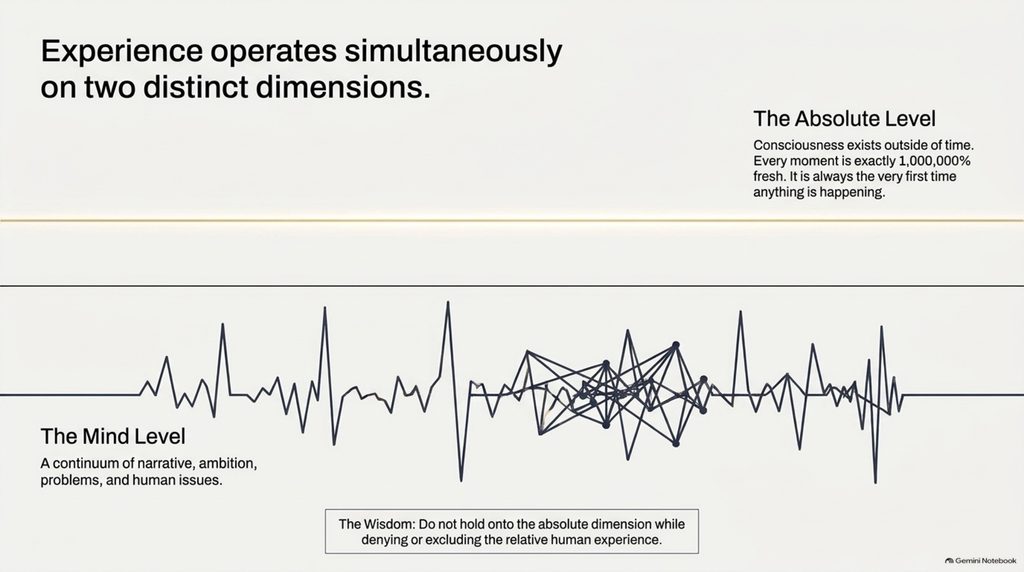
On the absolute level, that is very true, because consciousness or awareness is not in time.
It’s always fresh—a million percent fresh.
But there is the other dimension of mind where there is a continuation,
a continuum, a story, a narrative—
issues, problems, ambitions, the whole nine yards of the human experience.
So you should be careful not to hold on to one without including the other.
Yeah, that’s something to spend some more time contemplating.
But thank you, Magdi. I do have to turn my camera off to dry off my dog before I let him back in the house, though.
Yeah, yeah. Okay, Patrick. It’s good being with you today.
Good to see you, too.
Yeah, the key thing is to come to the understanding about that which is real—
not so much that which is perceived.
You can leave that to the physicists.
But that which is real in your experience, that which is real.
And to understand there is only one reality.
And the reality is not Patrick’s thoughts or Magdi’s thoughts.
It is this spaciousness of awareness, which is nowhere and everywhere.
So you are having a recurring dream, the Patrick dream—a recurrent dream, which changes, of course.
There are some changes, like in your night dream, you know?
But in the daydream, there is more stability—
it’s the same house, the same Patrick, the same mother, the same sister.
But that doesn’t mean that you are the character in the dream.
So consciousness is having infinite recurrent and non-recurrent dreams,
and it’s complete freedom.
But it does not lead us to any conclusion about consciousness.
The only conclusion you can come to about consciousness is through your direct experience.
First, that consciousness is real. Awareness is real.
Secondly, there is no evidence that there are any borders, any limitations,
any phenomenal conditions that apply to consciousness, apply to awareness.
And that is one reality.
And this reality is I, slash consciousness, slash awareness.
The more deeply rooted you are in that understanding,
the more established you are in the causeless peace of being,
and you’re inhabited by God’s kingdom.
Any questions?
Hi Bangli.
Hola, Jenny.
Hello.
Hola.
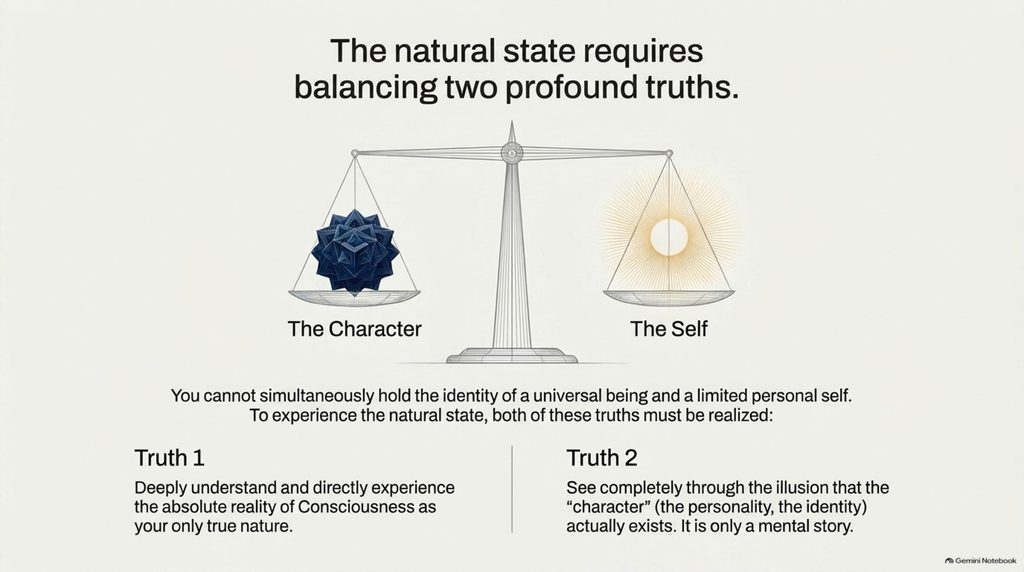
No, I just think that it’s as important to see that the self is the only reality
as to see that the character—that the what?
That the character, this personality, this thing, this identity, this thing does not really exist.
I mean, I think it’s as important, one as the other.
Because one allows the other to be seen or to be experienced.
I mean, it’s just two little aspects—two aspects.
Yes, you cannot have simultaneously a universal being
and at the same time a personal, limited self.
We need to see through the illusion, the illusion of the separate self,
which is only a mental story.
Yes.
Yeah.
And also, you need to come to a deep understanding about the reality of consciousness
as your direct experience, as your direct reality.
Yeah.
Yeah.
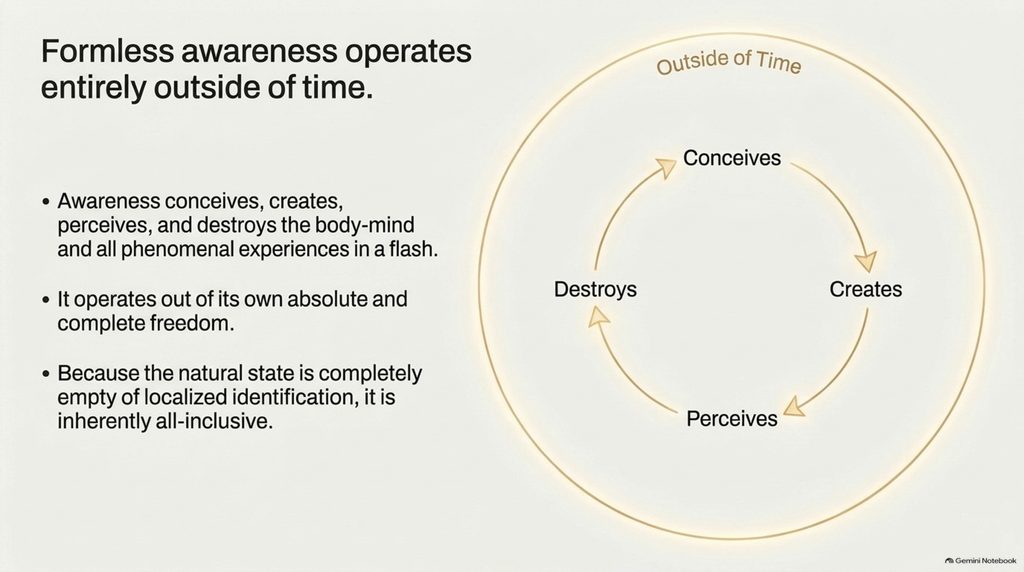
The body-mind, the phenomenal experiences, arise out of formless awareness
and are perceived as they are being created by that same awareness.
So awareness, reality conceives, perceives, creates, conceives, creates, perceives
and destroys outside of time.
Outside of time: conceives, creates, perceives, destroys—boom—
in its complete freedom.
And the personal self is this narrative within creation that basically says:
“I am born. I exist in time. And I have a purpose—a personal purpose.
And I can control. I can control…”
Good luck with that.
“I can control and do, and all depends on me.”
Claro.
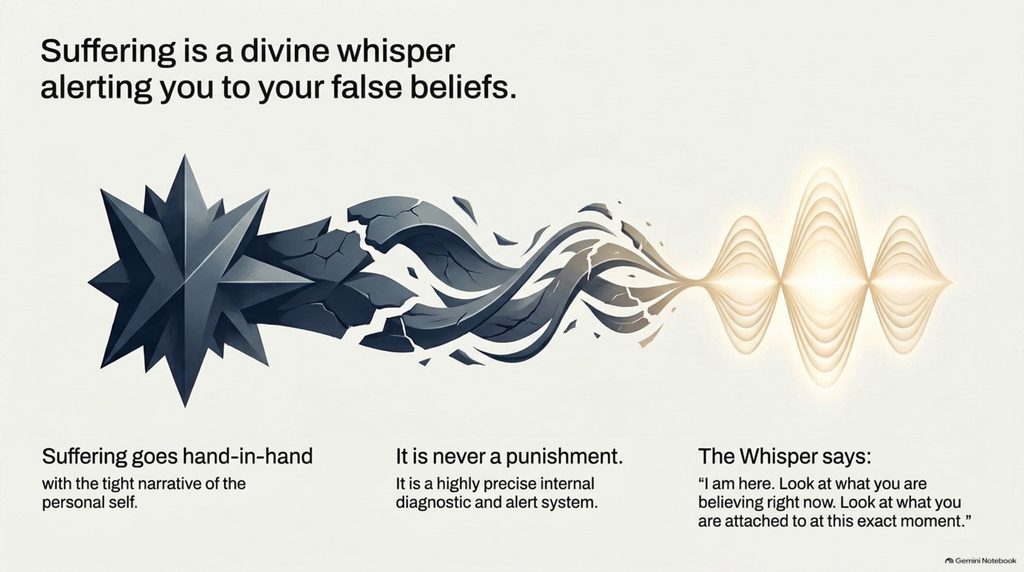
So that’s the personal self narrative.
What goes hand in hand with that is suffering.
And suffering is a divine whisper telling you, “Okay, I’m here. I’m here. I’m here. I’m here. I’m here. I’m here.
Look at what you’re believing. Right? Look at what you’re believing at this moment.”
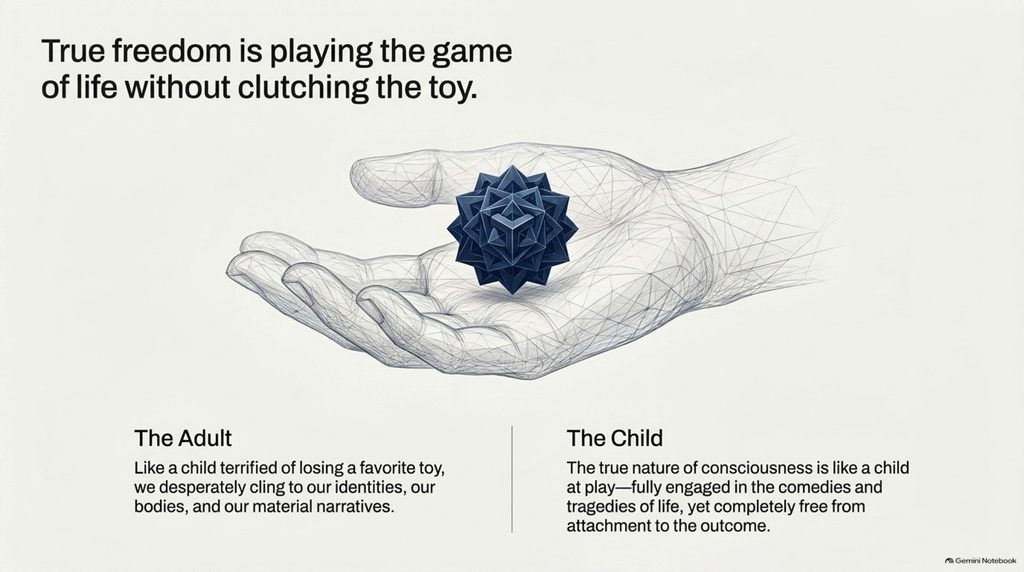
You know, like when we are kids, we like our toys.
We are attached to our toys, our doll or our little car.
We don’t want to let it go.
Uh-huh.
Yeah.
Yes.
“What could I be?”
And yet the child plays without attachment, which is so wonderful.
Yes.
That’s true.
There is also freedom in the children.
Yeah.
Yeah.
So I guess it’s just about opening the heart, Matthew.
Yeah, absolutely. Opening the heart.
Opening the heart—the path of love.
Yes.
Love and compassion.
Trádúceme en español.
Very beautiful.
Yes.
Hola, Rubén.
Hola, hola.
¿Cómo está, Rubén?
Gusto.
Mucho gusto, Rubén.
Bien, bien. Por aquí.
Gusto verte.
Espero que todo esté bien.
Jenny me traduce para yo poder entrar en armonía.
Si, si, Rubén.
Tú necesitas aprender un poco más inglés.
Ajá.
Yeah. Nice to see you, Rubén.
Okay.
Okay, bye bye.
Thank you.
Okay.
Any questions?
Very lovely to be with you all.
Always so sweet—a gathering of love, love of truth.
So beautiful.
Thank you all.
We love you.
AI Summary
Awareness and self-inquiry
Date: Sunday, November 1, 2026
Duration: 43:02
Key Points
- Self localizes in the face
- Awareness is nowhere and everywhere
- Perception appears in one space
- Identification creates contraction
Overview
| Concept | Detail |
|---|---|
| Self location | Often felt in face |
| Awareness | Nowhere and everywhere |
| Perception | All appears in one space |
| Senses | Instruments, not perceiver |
| Contraction | Object within awareness |
| Space and time | Appear within awareness |
| Body identity | Recurring dream character |
| Suffering | Reveals current belief |
This discussion examines awareness, the sense of self, and how identification with body and mind creates the feeling of being a separate person.
Self location
The first thread looks at where the sense of self seems to sit in experience and why it often feels stronger in the front of the body.
| Face location | Common seat of self-sense |
|---|---|
| Front sensations | Often feel more personal |
| Back sensations | Can feel less open |
The sense of self often appears in the face or behind the eyes because perception is physiologically oriented forward. A different quality between front and back sensations is normal and does not need fixing.
- Let the felt self release from its usual sensation.
- Allow its boundaries to expand.
- Include more of experience than the familiar self-feeling.
- Use this as a repeatable practice.
Releasing identification
The main practice is not to perfect a sensation pattern but to stop pinning identity to a local contraction.
The natural state is empty of identification and all-inclusive at the same time. Everything experienced has the same reality: consciousness.
Core shift: The body sits on the chair; awareness is not confined to the body.
When attention turns toward the limited self during meditation, that creates a chance to notice the self-sense and let it dissolve.
Awareness is nowhere and everywhere, and the limited self is only an event appearing within it.
One field
The inquiry “where am I?” leads to the recognition that sensations, sounds, and even images arise in one undivided field.
A sensation in the feet and the sound of a voice appear in the same space. With enough attention, visual images also appear in that same placeless field.
- Awareness is the single space in which all perceptions appear.
- The limited self also appears in that same space.
- Fixation creates the belief “I am this structure.”
That fixation hides the simpler fact that thoughts, sensations, memories, and sounds all arise in awareness without defining it.
Awareness and perception
A later thread clarifies the relation between awareness and the senses.
What is clear: Awareness uses the eyes and brain as instruments for perception.
Common confusion: The instrument gets mistaken for the perceiver.
The binocular example makes the point: using binoculars to see a bird does not make the binoculars the seer. In the same way, using the visual system does not make the eyes or cortex the perceiver.
- Awareness perceives; the senses are tools.
- What is perceived does not define the perceiver.
- Perceived objects are impermanent.
- Awareness remains unaffected by their appearance and disappearance.
Awareness does not need perception in order to be. It perceives freely, but its being does not depend on any object showing up.
Contraction and habit
The feeling of contraction belongs to the field of experience, not to the nature of the self.
A contraction can be seen as a tiny object appearing within vast freedom. Once seen that way, it can be invited to relax and open into the space around it.
- Treat contraction as an appearance, not identity.
- The habit is identification, not mere distinction.
- Sound and sensation can differ without one being “more me.”
- The division between “me” and other perceptions is artificial.
The old habit says, “I am inside this line of sensations.” Direct inspection reverses that: sensations appear within awareness.
Space and time
The discussion also turns to how space and time themselves show up in awareness.
Space appears within awareness through perception, and time appears there as memory and narrative. The teaching distinguishes ordinary story and absolute reality without collapsing one into the other.
- The mind carries continuity, story, and personal history.
- Awareness itself is outside time and completely fresh.
- Hold both levels together rather than clinging to only one.
Body and dream
A question about why awareness seems tied to the same body brings out the role of identification.
In deep meditation, the personal body identity falls away, so the question of what connects awareness to a specific body loses force. The repeated return to the same character belongs to narrative continuity, not to a real bond limiting awareness.
- The waking person is compared to a recurring dream character.
- Daily life has more stability than a night dream.
- Stability still does not prove that awareness is the character.
The recurring “Patrick” or “Magdi” dream changes over time, but those changes do not define consciousness.
Self and love
The closing themes tie self-inquiry to suffering, compassion, and the heart.
The separate self is a mental story that cannot stand alongside universal being. Body, mind, and world arise in formless awareness, while the personal narrative adds birth, time, control, and purpose.
- Suffering exposes the beliefs being held in that moment.
- The personal self narrative goes together with suffering.
- Opening the heart supports this recognition.
- Love and compassion belong to the path.
Children illustrate a freer mode of being through play with less attachment, and that freedom points back to the same openness.