
Meditation
Transcript
Welcome, everyone.
Lovely to be with you.
It’s just FYI this meeting starts with a guided meditation
and then it’s open for questions and conversation.
I’ve enabled the waiting room because on a couple of occasions
we had some visitors that wanted to party.
They were joining the wrong party.
I hope we won’t have to deal with this again.
I’m going to have to put a couple of people out.
Right now we have ten people waiting in the waiting room,
so I’m not going to open the waiting room.
Let me see if there’s anybody that we know.
As a general recommendation, it’s probably better to come a few minutes
before the beginning of the meeting because I’m going to activate the waiting room
just a couple of minutes after the meeting starts
and probably won’t be admitting people.
Just sit comfortably
and invite yourself to do what you rarely do,
which is to completely let go.
Without concern about what this meaning is about,
what are you going to get out of it,
where are you going, where are you coming from—
all of that you can let go for now, for this period of time together.
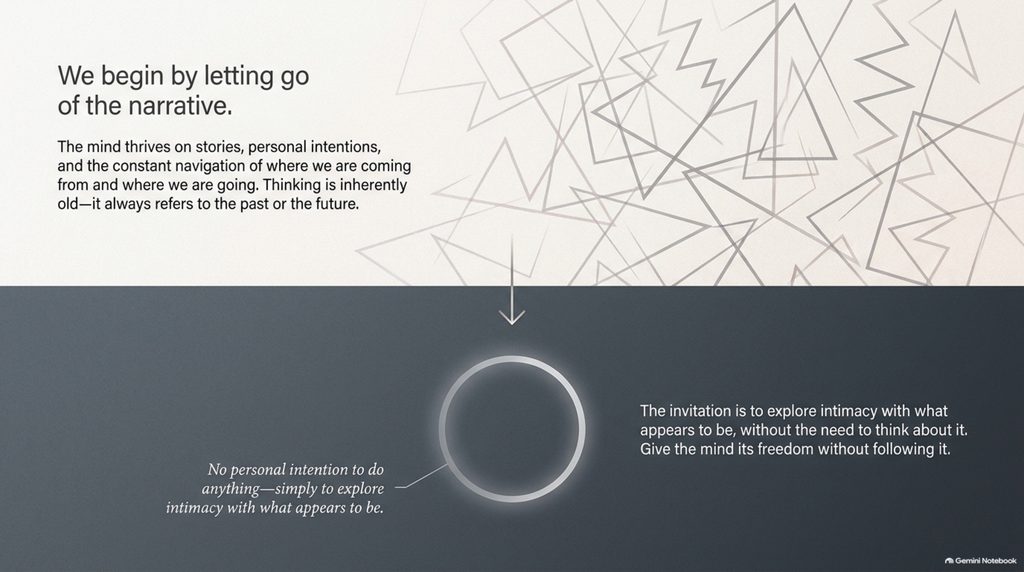
We’re not interested in each other’s stories or my own personal story.
I’ve been living with my own personal story long enough.
We’re interested in a different type of meeting, a different type of connection,
which is readily available when we invite ourselves to let go of the mind for a while.
Meaning, let the mind be.
Give it its complete freedom without following it,
without an interest in the past or the future.
Notice whatever sensations are arising in your body
or are there in your body space.
Take your time with it.
No personal intention to do anything—
simply to explore intimacy with what appears to be.
There is no need to think about it.
The invitation is to be without the need to think about things
because thinking is old.
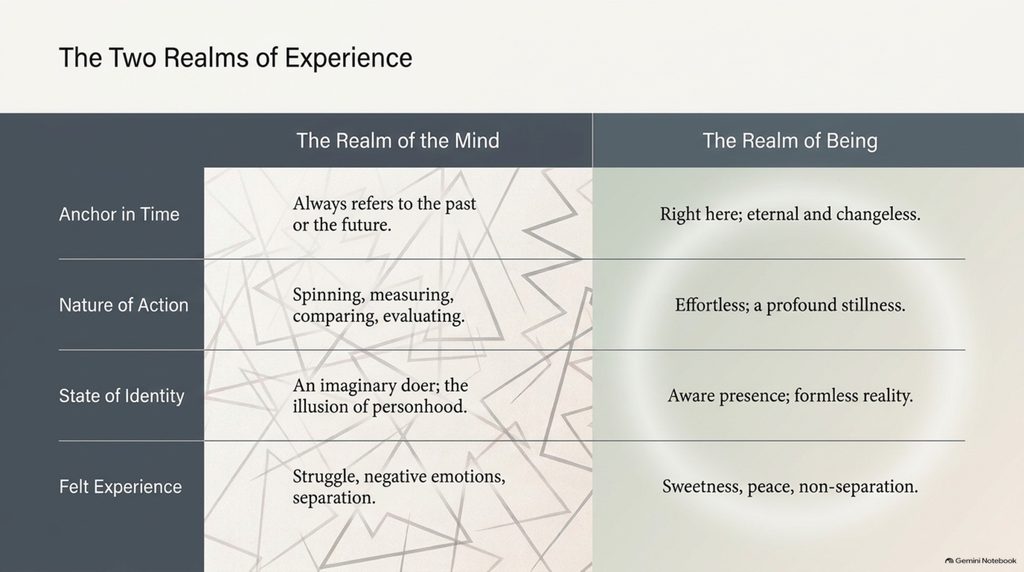
Thinking always refers to the past or the future,
while being is effortless.
Being is right here and has no personal intention
because in beingness there is just that—
a profound stillness which is not separate from what appears to be.
This stillness, this aware presence,
as the real you, what we refer to as the self.
Sometimes we refer to this beingness, awareness,
as truth or reality
because it is formless, changeless, eternal.
Notice the gentle breath of the body, so sweet.
There is no separation when the mind is quiet.
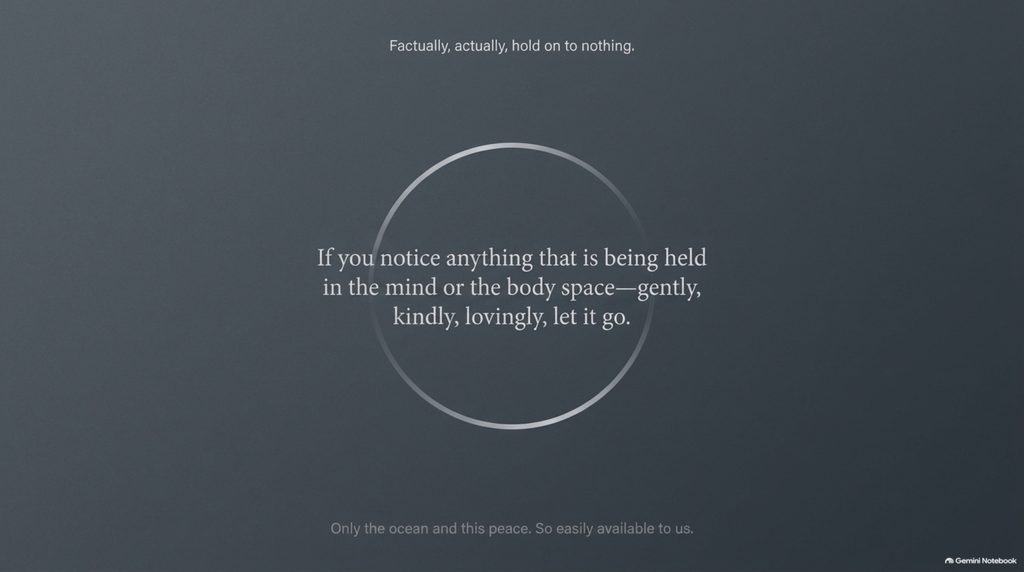
Only the ocean and this peace.
So easily available to us.
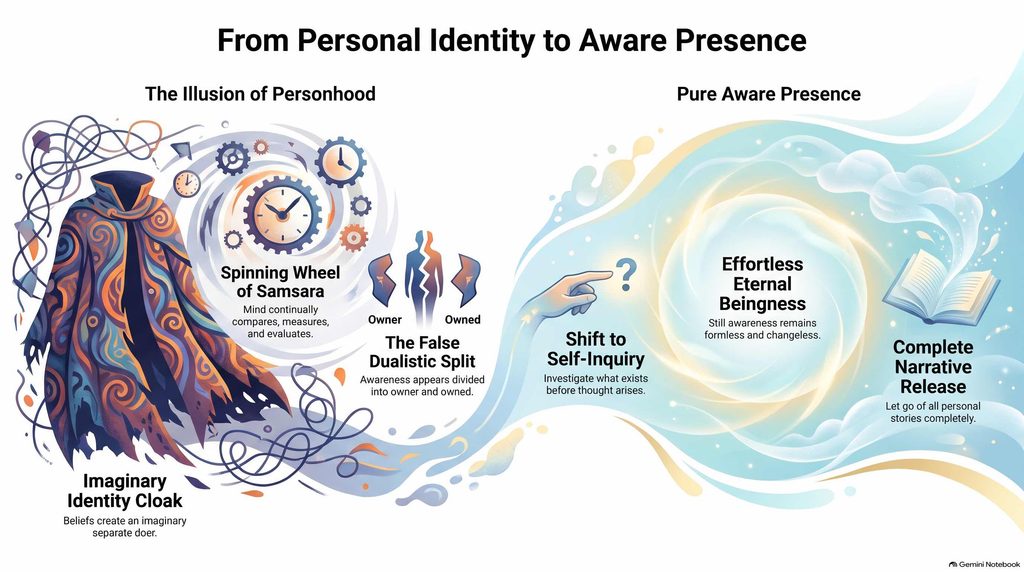
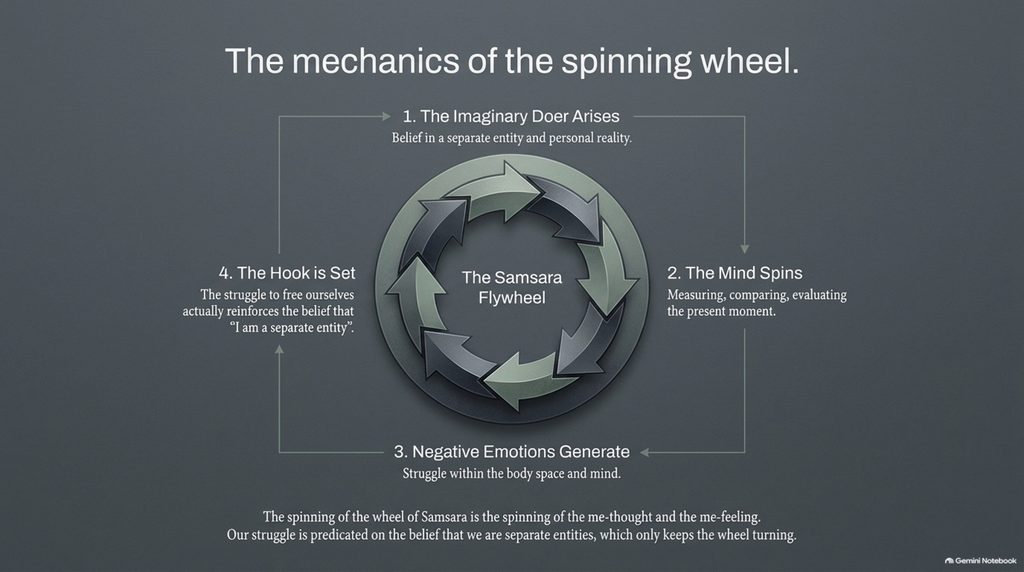
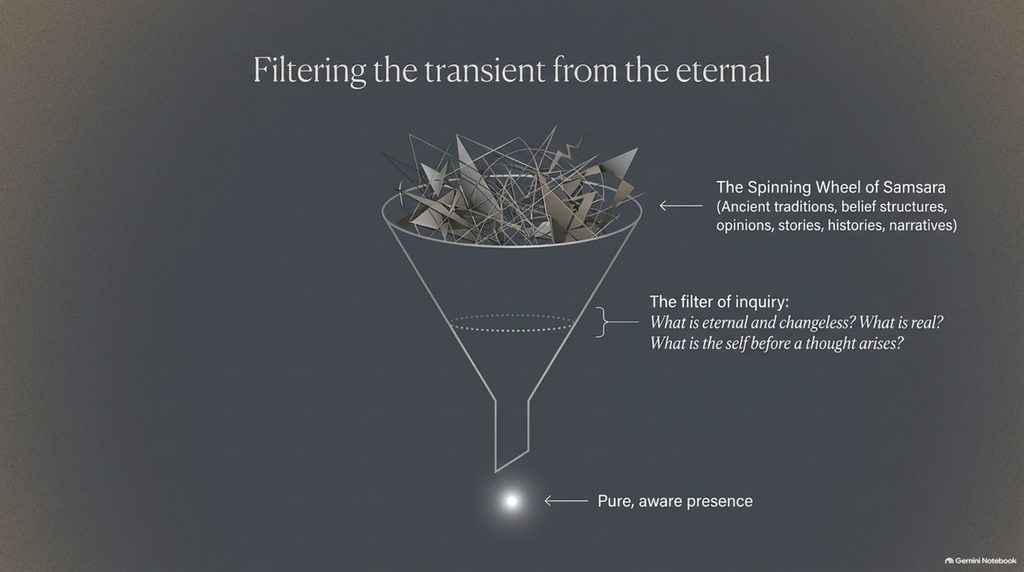
When the wheel of samsara is spinning,
suddenly out of our ancestry, a personal me, an imaginary doer.
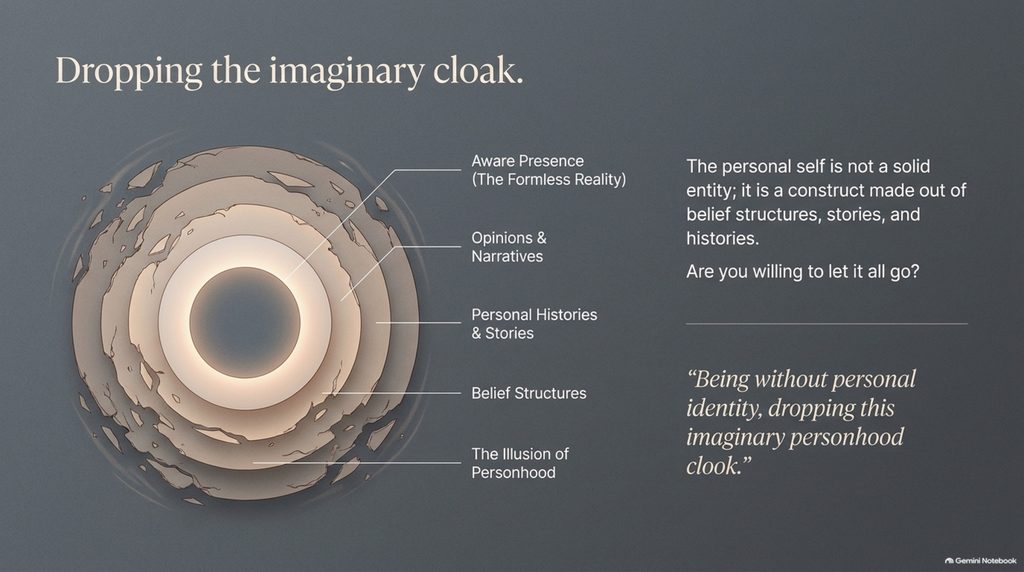
The illusion of personhood arises in this vast stillness,
imagining that it is that which is real.
And the mind starts spinning, measuring, comparing, evaluating.
And within the body we experience this sense of personal self and me.
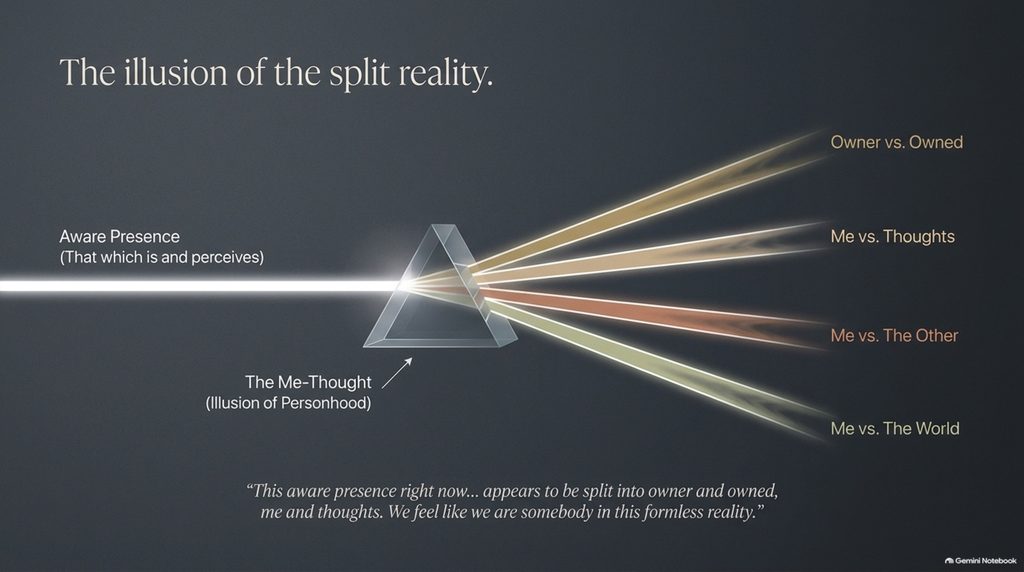
We feel like we are somebody in this formless reality.
This aware presence right now, that which is and perceives,
appears to be split into owner and owned, me and thoughts.
Thoughts that arise out of the belief that there is a personal reality—
the me thought arises in many different forms
with accompanying negative emotions within the body space and the mind.
The spinning of the wheel of samsara is the spinning of the me-thought and the me-feeling,
me and the other, me and the world.
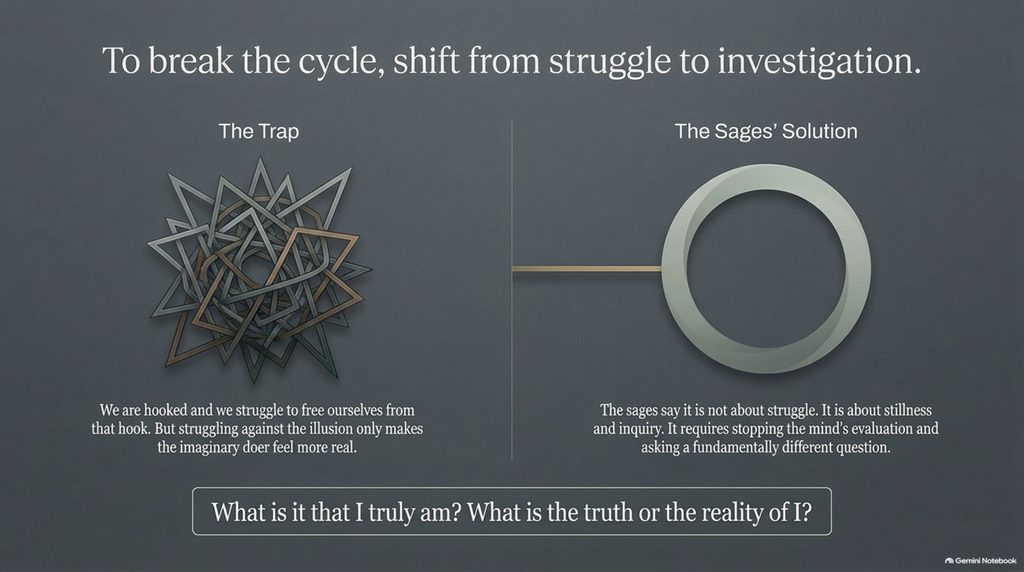
We are hooked and we struggle to free ourselves from that hook.
Our struggle is predicated on the belief that I am a separate entity.
So the sages say, it’s not about struggle, it’s about stillness and inquiry, investigation.
What is it that I truly am?
What is the truth or the reality of I?
As the wheel of samsara is spinning,
the answer is this person an imaginary entity
made out of what? In this moment, what is it?
What is it that is eternal and changeless?
What is it that is real?
What is the self before a thought arises?
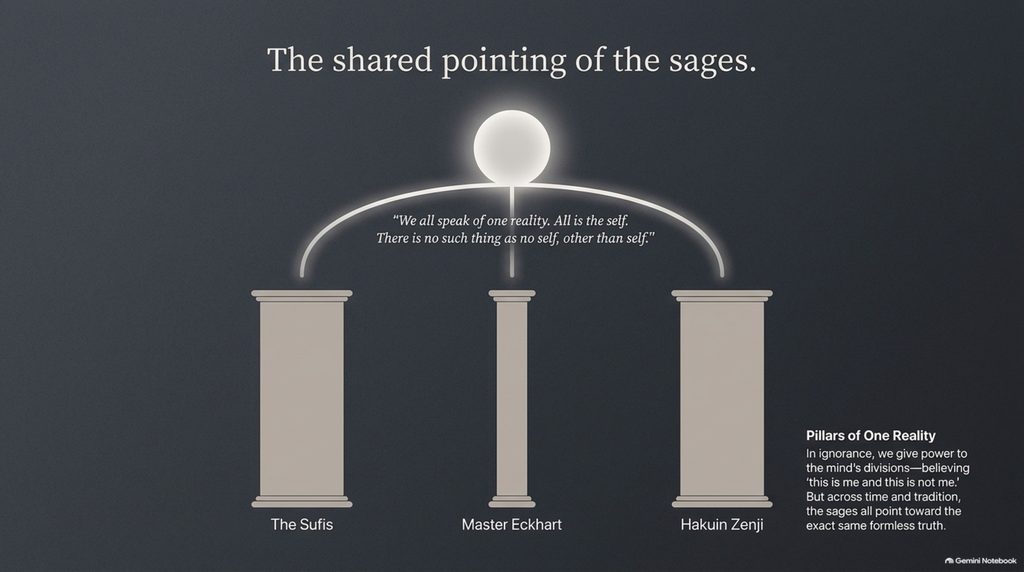
In ignorance we give power to the mind, ancient traditions and belief structures.
This is me and this is not me.
When all the sages, the Sufis, Master Eckhart, Hakuin Zenji—
we all speak of one reality.
All is the self.
There is no such thing as no self, other than self.
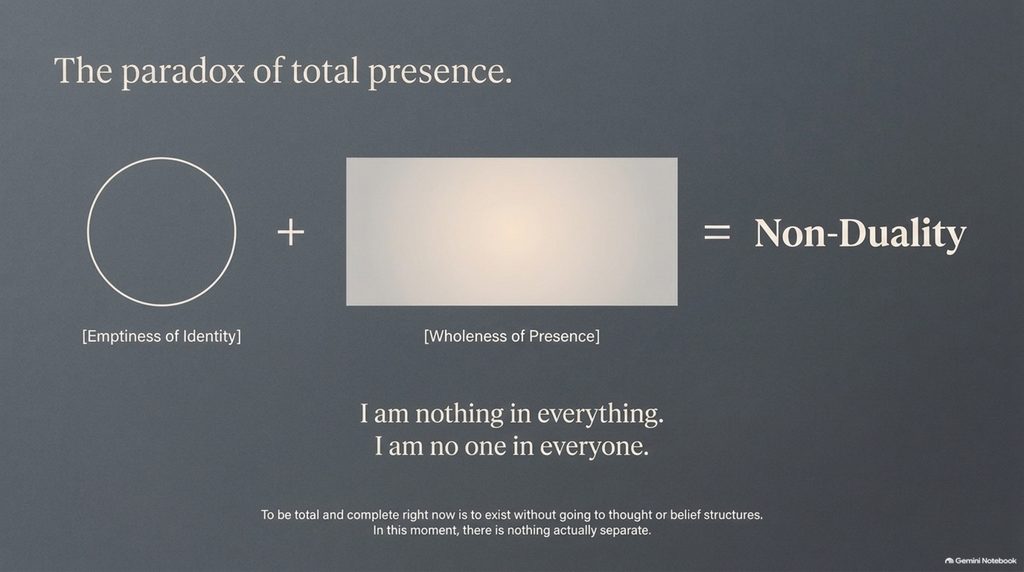
What is it to be total and complete right now,
without going to your mind, without going to thought?
Is there anything actually separate in this moment?
If you don’t go to thought, if you don’t go to belief structures.
The personal self is made out of belief structures, opinions, stories, histories, narratives.
Are you willing to let it all go?
I’m holding on to nothing.
I am nothing in everything.
Being without personal identity, dropping this imaginary personhood cloak.
I am no one in everyone.
Factually, actually, hold on to nothing.
If you notice anything that’s being held, gently, kindly, lovingly, let it go.
Thank you.
Satsang
Transcript
So if we can gently come together.
If there are any questions you would like to explore, you’re welcome to raise your hand or use the icon at the bottom of the screen.
Hi, George.
Hello, Magdi.
Hello, everyone.
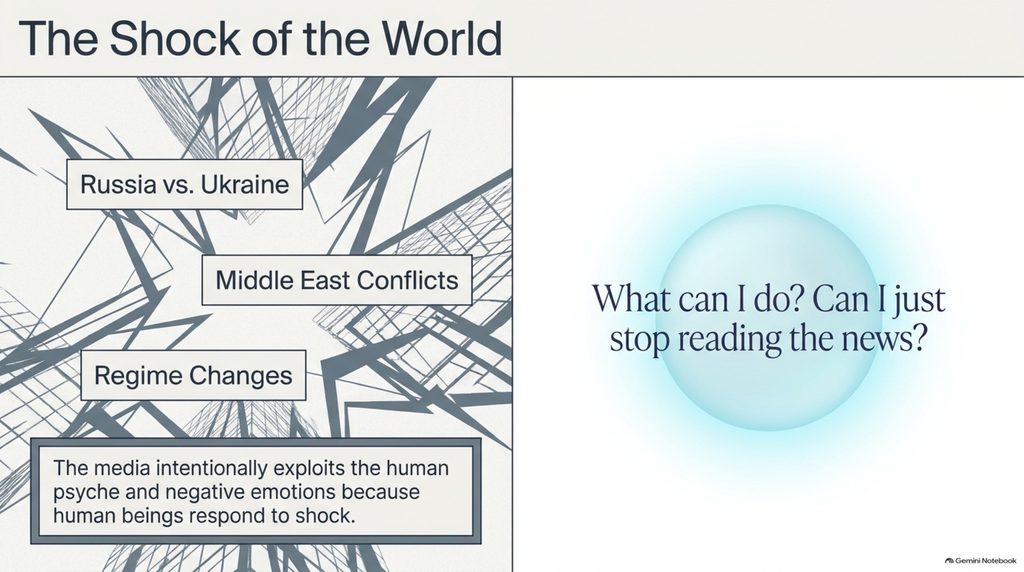
This morning, before this session, I read the news, which maybe turned out to be a mistake.
It seems people are killing each other everywhere throughout the world.
Russia attacked Ukraine many years ago.
For what purpose?
What would have been gained had Russia won?
Is it just the separate self of Putin?
I don’t know.
Look at the wars going on in the Middle East.
What’s the point?
Why are people killing each other?
There are wars in Africa, all over the place.
Trump attacked Iran, claiming that there was just going to be a simple regime change.
So I have two questions.
One is rhetorical and one is real.
Well, maybe they’re both real.
The first question is: why are people killing each other?
And my second question is: what can I do?
Can I just stop reading the news?
Yeah, maybe stopping to read the news may be a good idea if it’s something that disturbs you.
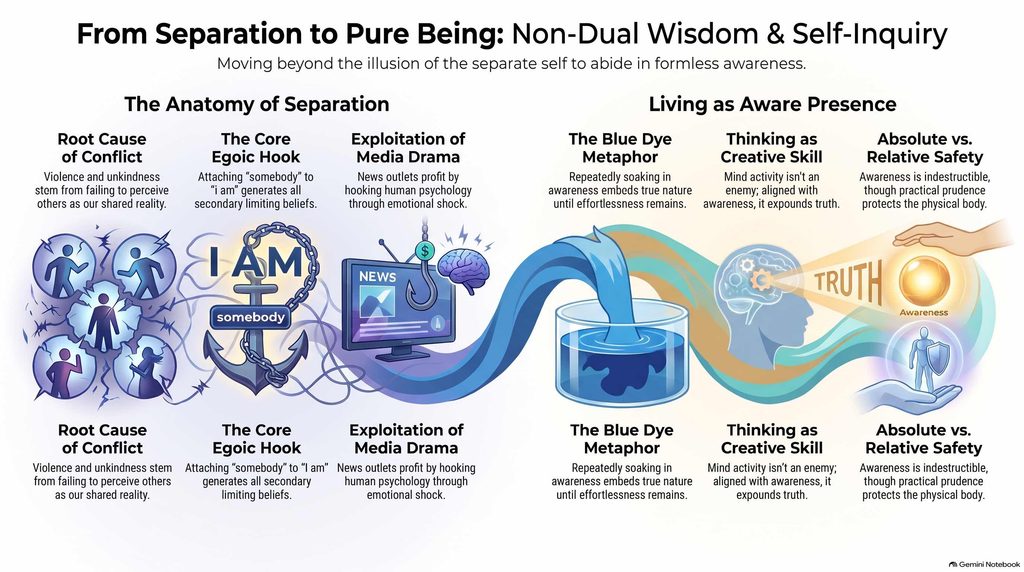
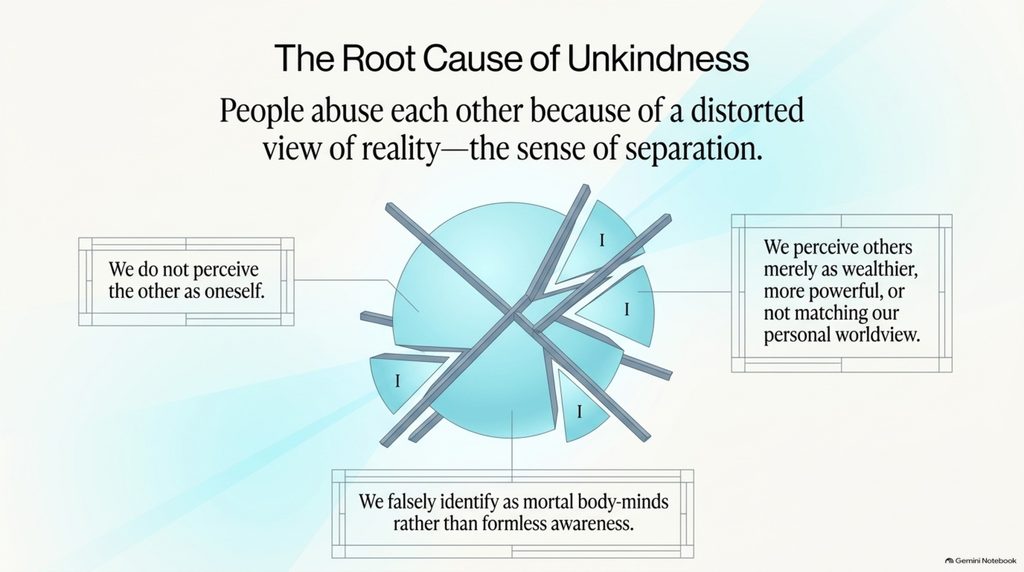
Well, I mean, people abuse each other and are unkind with each other because of the sense of separation.
We do not perceive the other as oneself.
We perceive another who is wealthier, another who is more powerful or less powerful, another who is not acting the way we want them to act, another who doesn’t match our view of ourself.
So that’s really what makes us being unkind and violent towards each other.
We don’t perceive each other as that one reality.
And it’s a distorted view, because we are not the body, we are not the form.
We are the self.
We are this formless awareness, this beingness.
But it’s only a few who have a sense of that understanding.
And it’s important.
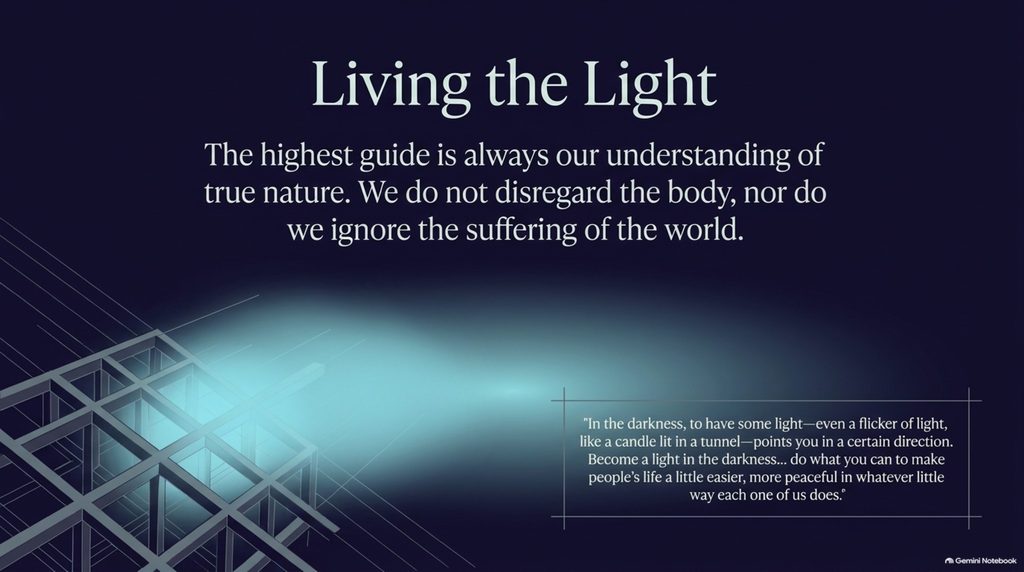
In the darkness, to have some light—even a flicker of light, like a candle lit in a tunnel—points you in a certain direction.
So for you who is interested in truth, who have been exploring the sense of separation, the belief that I am George, that I’m a person, that I’m a mortal body-mind, you’ve dug deeply into that.
And the understanding that, oh, this is just belief structures and thoughts and emotions and feelings that we somehow identify with.
So you become a light in the darkness.
What can you do about the violence in the world?
Is to live the light, live the wisdom.
Don’t give power to the falsehood.
Give power to truth, to reality, to that which is changeless.
And that is consciousness.
We are the same consciousness shining through various body-mind structures.
And of course, also in the world, you do what you can to make people’s life a little easier, more peaceful in whatever little way each one of us does.
Yes.
I guess I will perhaps stop reading the news and try.
With regard to the separate self, I have the knowledge that I’m not the separate self, but I have not yet embodied that.
And I will continue.
Keep in mind that the news exploits people’s emotions.
They know that human beings respond to shock.
It’s an art in itself.
Unfortunately, the media makes their livelihood out of exploiting the human psyche in a very negative way, you know.
So we get hooked into the drama and into the emotions.
They know how to pull those strings, you know.
Yes.
Thank you, Magdi.
Any questions?
Hi, Magdy.
Hey, Patrick.
Hello.
Hi.
Hey, I just have a quick question.
Over the past four or five years now, my practice has been to remember who I truly am when things in the world occur, or when my mental state is affected.
I often bring up this quote: suffering arises to show you where you’re still attached.
And so that’s been my practice—to live as a human and constantly remind myself of what my true nature is.
I’m just wondering, is there ever a point in time where your default position is knowing your true nature, and you have to remind yourself that you’re a human being and to act like one?
Don’t worry, the human being is deeply, deeply rooted in our psyche.
You will never need to remind yourself of that.
Two things, Patrick.
First, in terms of your practice to remind yourself that you are the self, you are this formless awareness, you are that invisible reality which is, knows it is, and perceives and knows it perceives.
Besides reminding yourself of that, in your daily life, you will find sometimes that something is not clicking right.
You’re not feeling right.
There’s something bothering you.
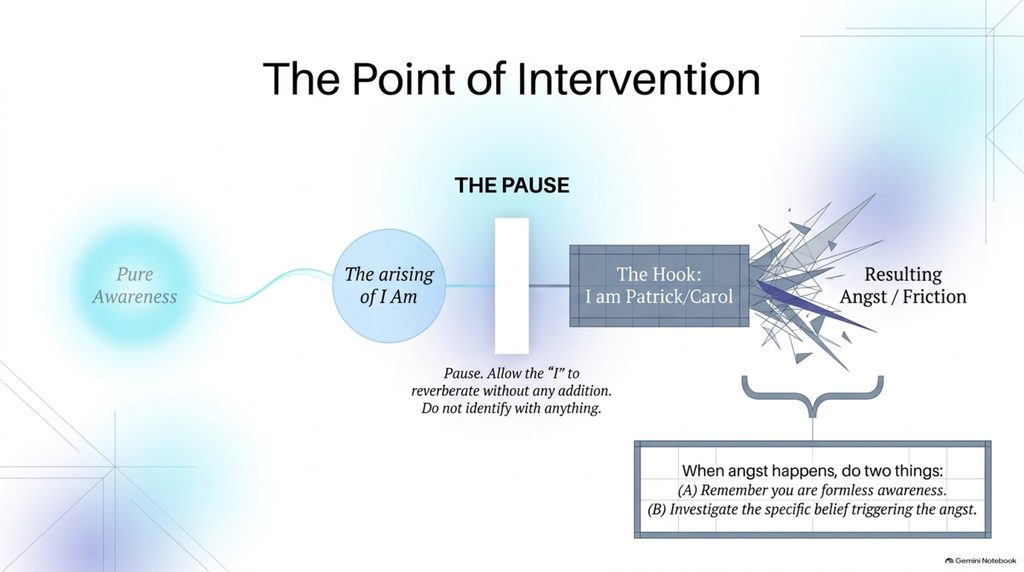
It could be a small thing or a bigger thing, whatever.
Then you can turn your attention not to, “I am this formless awareness perceiving this discomfort or this angst,” which is true, but to explore: what is this angst about?
What’s triggering this angst?
And you will find that this angst is due to the belief that you’re Patrick in that moment—that “oh, I’m Patrick, I am Patrick, and he or she is doing this to me, or the world is not responding to me in a certain way.”
So there are two directions, you know.
One direction: yes, I am the self.
But also notice, more and more and more, that whenever you are experiencing the sense of separation, it’s because a belief in being a separate entity, being a person, is arising at the time.
And you know that that’s a belief.
So it’s sufficient to be aware that, “Ah, that’s what’s going on.”
This doesn’t mean that in an instant the angst will dissolve.
Sometimes it may, but it may take a different direction, a little bit more time.
But this is an important direction to explore.
The other thing about being established in the self: the answer is yes to your question.
The more you soak in the self, the more the self soaks into you, as a way of speaking.
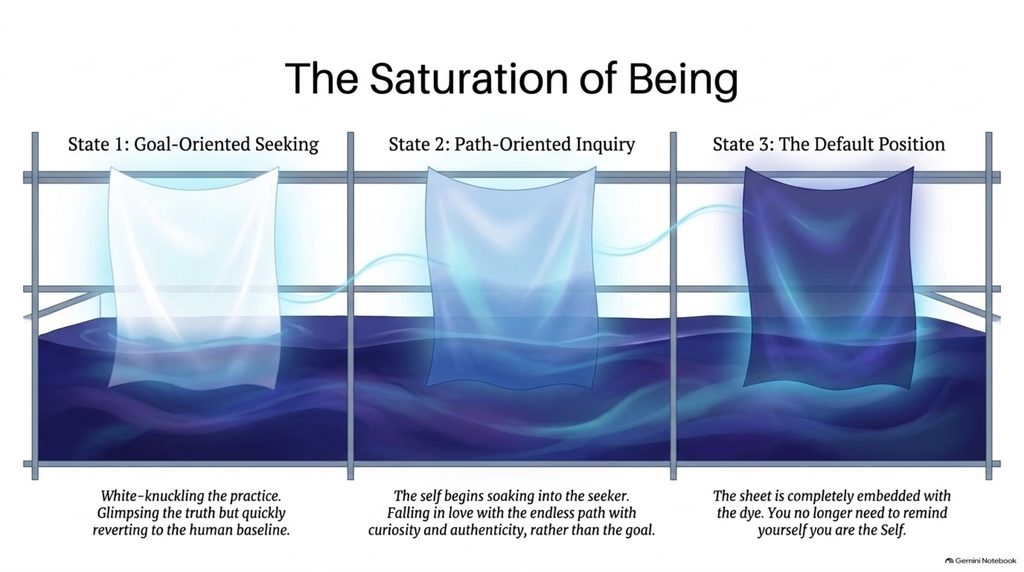
There is a metaphor of dyeing a white sheet into blue dye.
So you dip the sheet into the blue dye once, there is a little blue in it.
But in order to really get the blue completely embedded in the sheet, you have to soak the sheet in the dye quite a few occasions.
At some point it’s no longer necessary.
The sheet is blue.
So yes, the answer is yes to your question.
Initially when we are on the path, we are goal-oriented.
We want to become enlightened, we want to be established in the self.
And over time, this interest in the goal sort of becomes less and less pronounced.
And instead, we are no longer in love with the goal.
We are in love with the path, which is an unending path.
Why project an end?
We are right here, right now, living this experience.
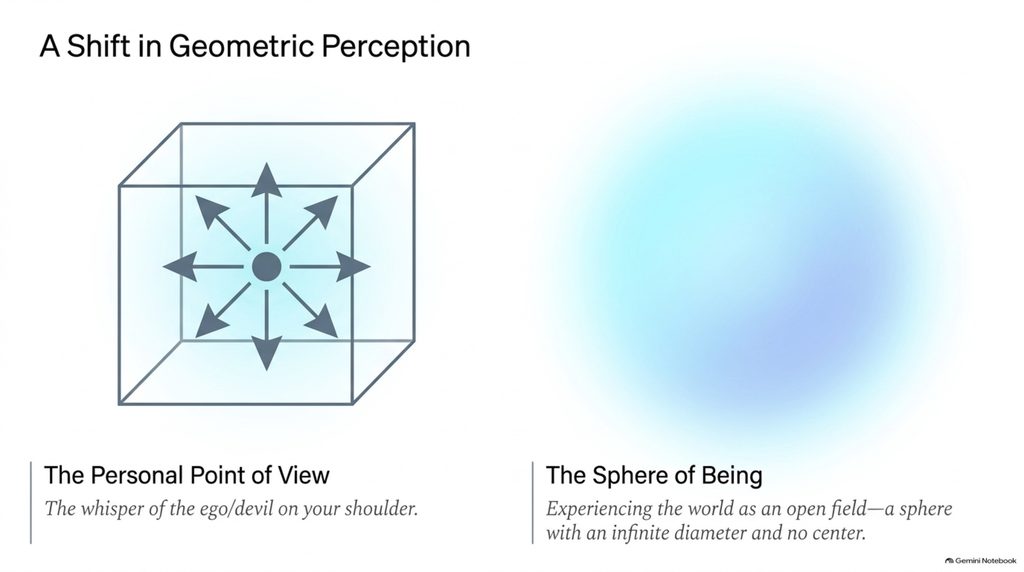
So there is a love of the inquiry, an interest in the inquiry, an interest in exploring how to shift this tendency to experience the world from a personal point of view to perceiving the world and the body and the mind from an open, no center, no personal center.
The metaphor that is given is about a sphere—a sphere that has infinite diameter and no center—experiencing the world that way.
Very good. Thank you, Magdi.
And you’re right. I agree with you that the goal orientation has diffused, right?
And sometimes the ego comes in and says, “Well, that’s why you’re not making progress, because you’re not practicing, you’re not white-knuckling it, so to speak.”
And so, yeah, just enjoy the path, the place of the path that you are currently on.
Yes, yes.
With curiosity and authenticity.
Absolutely, and love.
You know, the ego is always misdirecting us, you know.
They’re always referring to you as a person.
It’s like the devil on your shoulder, right?
Always whispering in your ear like, “That’s important, remember that.”
I love God’s whisper.
Thanks again, Magdi.
Good to see you, Patrick.
You too.
Hi, Carol.
You need to unmute yourself.
Hi.
The thought that came up as you were talking was about beliefs—believing that you’re a separate person.
And of course then I am thinking, where does this belief arise from?
It doesn’t come floating through the ethers.
An expanded sense of self isn’t going to create this separate self.
So where is this belief in the separate self originating? That’s what comes to mind for me.
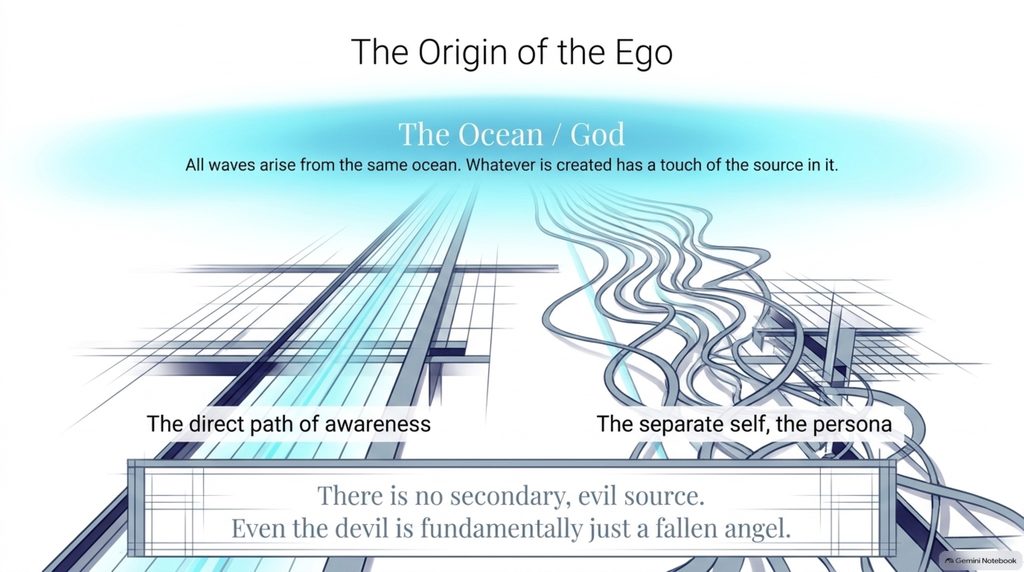
Yeah, I mean there is only one source, which is the self.
All waves arise out of the ocean.
Where does a wave arise from?
It arises from the ocean.
What is the reality of the wave?
The reality of the wave is the ocean or water.
So the sense of separate self is not a tragedy because God is a loving God.
It’s a creative God.
So whatever God creates has a touch of God in it.
So the sense of separation arises from the source.
There is only one source.
Like you look at the rivers.
There are infinite streams and rivers—some big, some small—but they all arise from the source up in the mountains.
It trickles and then it takes many different directions.
Some rivers are very wiggly and some others go straight to the ocean.
But they all come from this source.
So your question is an important question because there is the belief that there is something else besides the reality, besides God.
There is another source—the evil, the devil.
And there is God and the devil.
No, no.
In fact, the devil is just a fallen angel.
So it’s an angel that fell out of God’s grace and became the devil.
I think in the Christian tradition I may be wrong, but something like that.
So it’s not like there is actually a devil.
The devil is an angel, a fallen angel, but it’s still an angel.
Other than the belief in a separate self, I’m thinking about all the other beliefs that I have that keep me under the illusion of being a separate self.
And I can see myself going down that path and I just have to laugh.
Here I am again.
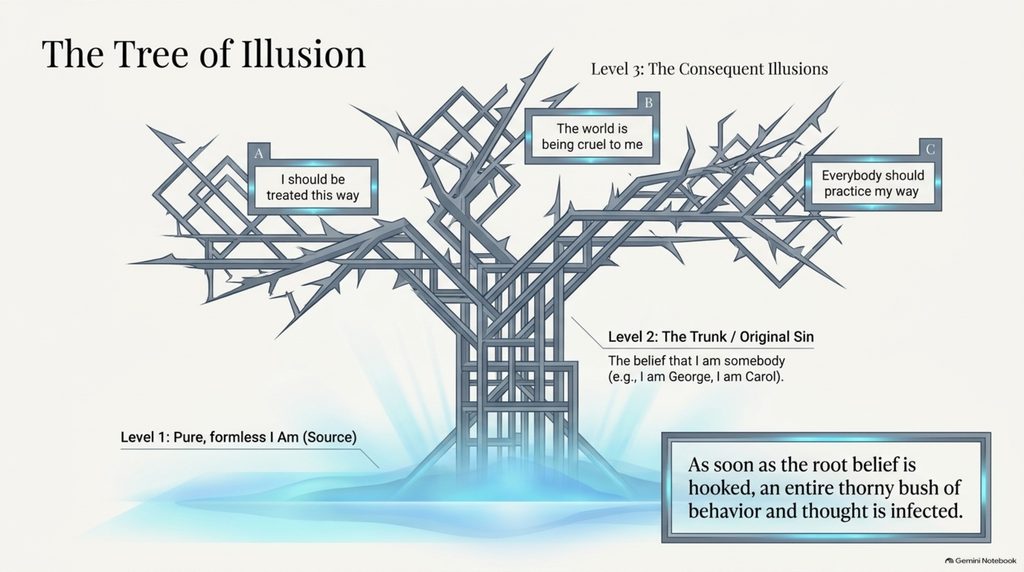
Yeah, as soon as the root belief is on board—which is that I am somebody—there is the I am, but the belief is somebody.
We attach somebody to the I am.
As soon as that hook is on, as soon as that belief is on board, the many other beliefs would follow like when you plant a thorn seed.
A trunk of the thorn arises, but then it becomes a bush.
It grows into many different branches and thorny, wiggly branches.
So the root, the original sin, the root belief in ignorance is: I am somebody.
And then what follows is: I should be treated this way, this should not happen to me, the world is being cruel to me.
And I believe that everybody should be practicing the Dharma.
I believe blah blah blah blah.
There is the I—the false I, the me—that then is constantly infecting the mind, infecting thoughts, and infecting behavior.
So you need to go to the root cause, the root belief, which is that I am Carol or I am a sister, a mother, whatever.
And you go to your direct experience.
It’s always in the moment, right now, where the mind is absent.
Because in the now there is no mind.
Mind only exists in time, in the impression of time.
And because there is no time in fact, there is no mind in fact.
But although there is no time and no mind in fact, in samsara, in the realm of ignorance, there is the impression that reality is mind, that reality is time.
And so there is a sort of focus of attention on the mind, on emotions and feelings, on the world.
So we seek worldly riches, and on the body we seek perfect health.
That’s the erroneous direction because we are giving importance to something which is not real.
So when you say “I,” pause.
Allow the I to be without any addition for a moment.
Just I.
Allow it to reverberate, to reveal itself.
Don’t identify yourself with anything, right?
That’s helpful.
Thank you.
Easier said than done.
Yeah, initially it is.
But just a little at a time, you know.
We erode.
We just keep nibbling at it.
Thank you, Carol.
Good to see you.
Hello, Lynn.
Hi.
Okay, let me see what’s happening.
We had a conversation once about how the experience of the body changes the more you’re less identified with it.
And you made a statement that you hardly ever go to the doctor anymore.
And I’m worried about you because this cold can’t be a cold.
It’s lasting too long.
It’s none of my business, but you could end up with walking pneumonia.
I had that once, and you have a low-grade fever, and it persists, and it wears down your immune system.
And I wonder if you have a fever.
This is what’s on my mind.
I’m sorry.
Thank you, Lynn.
No, it’s okay.
I don’t have a fever, and I do have a follow-up appointment.
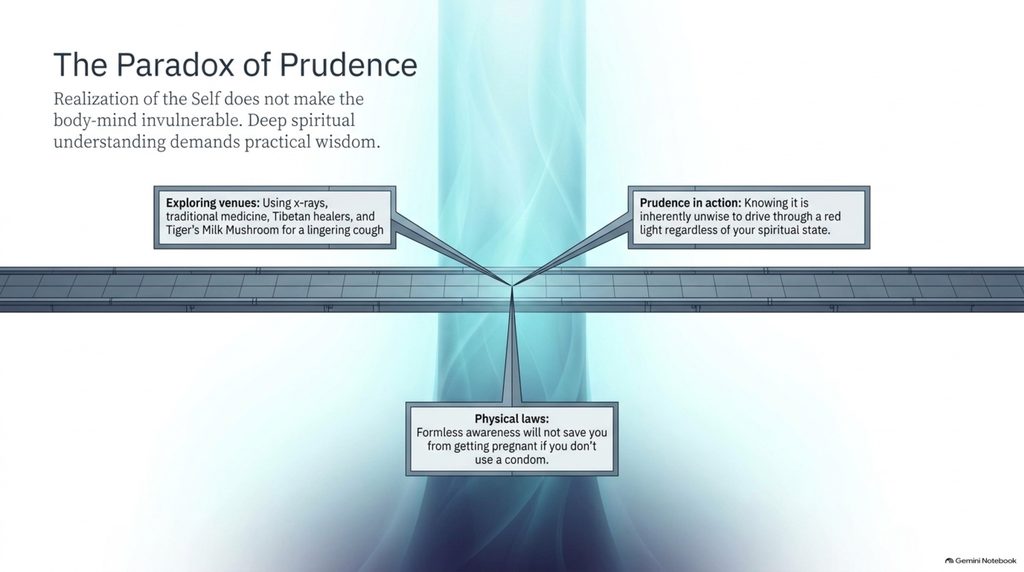
They did do an x-ray of my lungs not too long ago, and it came out to be negative.
But I’m following up.
And it’s getting better.
There’s still a little bit of a cough, but it’s getting better.
Good, good.
Yeah, so thank you for your concern.
I just wanted to make sure you hadn’t gone too far off the deep end to forget about your body.
No, I am not.
I don’t disregard the body when there are certain things that require my attention.
I seek assistance.
Also lately, I went to a Tibetan healer as well.
I mean besides going to the traditional path, I’m also exploring other venues to help out.
I’m glad.
Good to see you.
Any questions?
Thank you.
Thank you.
Jackie wrote here: Tiger’s Milk Mushroom Supplement took away my cough from her.
Thank you, Jackie.
Never heard of it.
Tiger’s Milk Mushroom Supplement.
Okay, I’ll look it up.
But I’ve been using what you recommended, Maria.
It’s been helpful.
Actually, you should be fine soon because I just prayed for you.
Thank you, Olga.
I feel better already.
No, but seriously, I mean I don’t mean this in a dismissive way.
I don’t want to trigger anyone.
Thank you.
Thank you, Holger.
Yes.
Yeah.
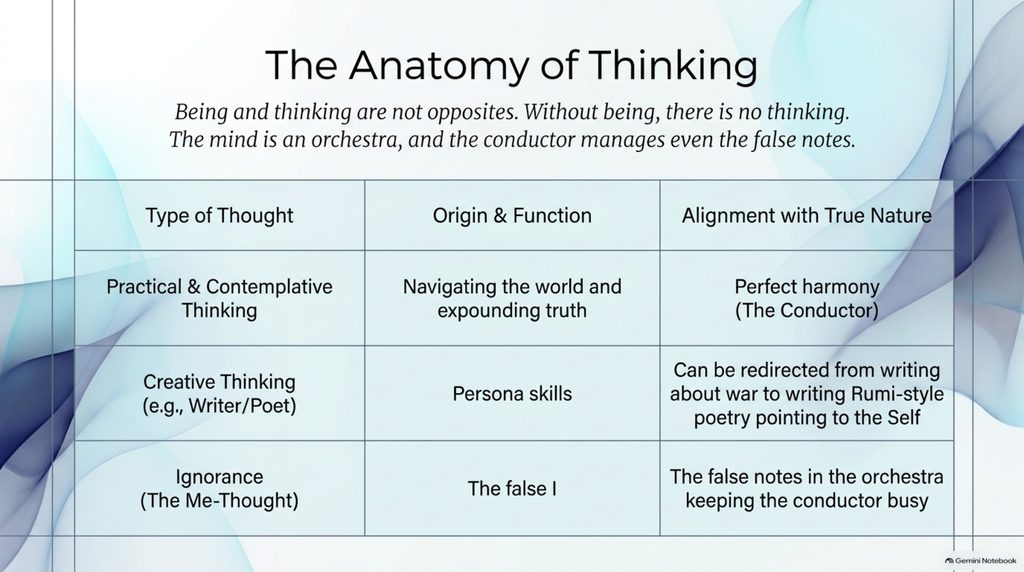
On a practical level, so there is being and thinking, we could say?
Yeah, there is being and thinking.
Yes, we could say that.
Yeah, being is not disturbed by thinking.
Yeah, okay.
Yes, no, go ahead.
But then yeah, but then it turns all again into thinking.
I mean, it’s just interesting to look at what’s actually there.
Yeah, what am I?
Just to look—that’s good enough, isn’t it?
I don’t need to come to a conclusion.
I cannot.
Yeah, you know, the thing about being and thinking is that there should not be to set them as opposites, because it’s all one.
So thinking is there.
There is practical thinking, creative thinking, contemplative thinking.
There is thinking out of ignorance—meaning thinking the me thought, the me belief.
Now, they’re all available for us.
You know, the contemplative thinking, creative thinking, and the me thought is also available for us as part of the orchestra.
I mean, in the orchestra there is somebody or part of the orchestra that plays the false notes, so it keeps the conductor busy making the corrections.
So without being there could be no thinking.
I mean, yes, they’re interwoven.
Yeah.
So the reality of all thought is being—meaning the self.
I mean, that being, this aware presence, presence and being and aware knowingness.
Yes.
Yes.
For some reason I’m just too stubborn.
I just always go back habitually to thinking instead of just embracing or enjoying or trusting the being.
So that’s my only…
You know, it could be that that’s part of your personality, that your persona has a great ability to thinking, greater thinking ability than others, or has a tendency to conceptualize, to create, to think.
That’s not the problem.
Actually, it’s a skill set for the person, a personality skill.
That as you are on the path of awakening, then this skill set becomes very useful in the direction of expounding the truth or creating certain thinking structures that pertain to truth, that can be helpful in that direction.
I don’t know if I’m expressing myself clearly enough here.
It sounds very good.
I like it.
Yeah.
I like it.
So I just got reintroduced to being.
For some reason I lost track of it.
I got so much lost in my thinking, thinking, thinking, that the simple fact of this moment, the isness of this moment, just got overlooked for decades.
Well, now they can come together, you know.
Beingness can come and can permeate thinking and direct thinking in the right direction.
But whatever skills that we have that belong to the organism, to the body-mind structure, is not a fault.
It’s a skill that can be directed in a different direction.
Like, for example, a person who’s very good with words, a poet or a writer that is very skilled writing novels about wars and love stories and so on—that’s his skill.
As they become more established in the true nature, in the self, then they start writing Rumi-type poetry or stories that are inspiring others to also look in the direction of the self.
God is a drama queen.
Yeah.
What an amazing thing.
I mean, there’s one source and all of this diversity, all of the bliss and all of the struggle comes out of this one source.
Yeah.
So we are always safe.
I mean, it doesn’t really matter what appears.
What is the we that is safe?
Yeah.
The source, being.
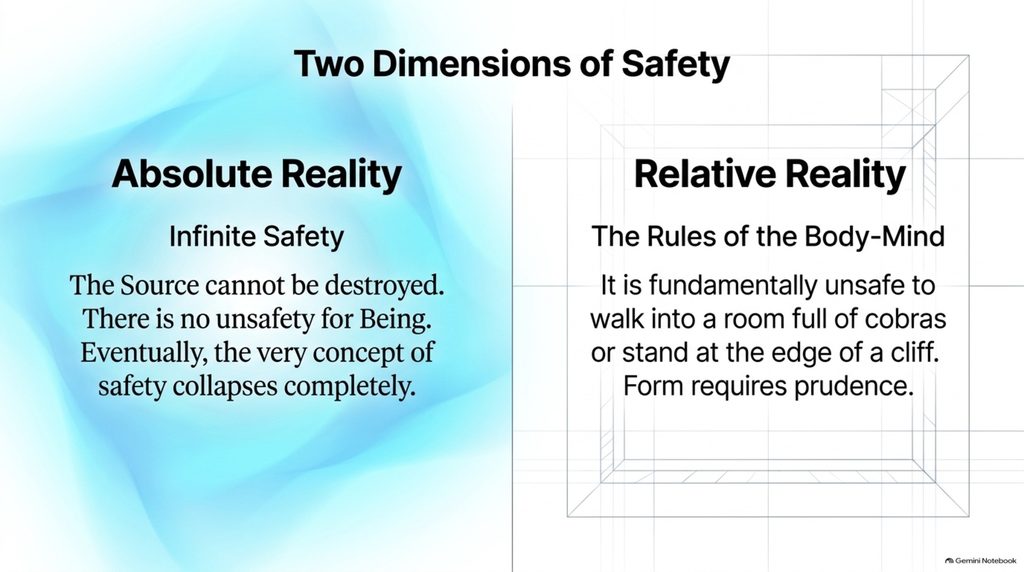
The source cannot be destroyed.
I mean, the source is.
There is no unsafety.
Yes.
Yeah.
The safe, unsafe—and at some point the whole of that collapses.
But yeah, we’re essentially safe.
I understand what you’re saying.
Thank you.
I’ve also heard there is no safety for a separate self.
Again, we’re saying the same thing.
Absolute safety and no safety they meet.
The whole thing collapses.
Absolute safety has no opposite.
And no safety.
Not no safety as opposed to safety.
Absolute no safety is the collapse of the whole concept of safety because safety is a concept.
Well, you know, safety applies.
Yeah, it’s a concept that applies, that has its place, its role when it comes to the body-mind.
You know, it makes sense that it’s unsafe to walk into a room that is full of cobras.
It’s unsafe to get too close to the edge of a cliff.
So it has a relative meaning.
But when we are talking about the self, when we’re talking about reality, the concept of safety collapses.
But we should know when to apply safety and when it has no significance.
It’s important to be prudent in life and make decisions that are prudent and wise.
And the most guide is always our highest understanding about our true nature.
But still, it is not very prudent to drive through a red light.
In other words, just because you have a deep understanding doesn’t mean that from moment to moment you can’t relapse into maybe an action, maybe running the red light, that can—that’s not prudent.
Yeah, no, it’s not.
There is no relapse from the realization of the self.
But the realization of the self doesn’t mean that now the body-mind becomes invulnerable.
It won’t save me from getting pregnant if I don’t use a condom, for example.
I got it.
A very fitting example here.
You could add that to your repertoire.
Thank you.
Sorry for me.
Perfect.
We all got it.
By the way, for some of you, just a reminder that lately I’ve been starting the meeting at 10 o’clock instead of 11.
So just make a note of that.
Some of you showed up late.
I’m not sure I’m sending notice to everybody.
Maybe we have a habit.
Any questions?
Somehow I have a thought of sometimes all of us getting together in person somehow.
We’ve been meeting virtually for quite a while.
I feel like I know all of you, but still it be nice to hook up sometime.
Anyways, just a thought.
Thank you all for your loveliness.
So enjoy your day and see you soon.
Thank you, Magdi.
Thank you.
Thank you.
AI Summary
Meditation and Nondual Inquiry
Date: Sunday, November 22, 2026
Duration: 75:14
Action Items
- (Speaker A) Look up tiger’s milk mushroom supplement
- (Speaker D) Continue exploring the separate self
Key Points
- Separate-self beliefs shape suffering and conflict
- Inquiry explores discomfort without forcing its disappearance
- Thinking can serve awareness rather than oppose it
- Self-realization does not remove bodily vulnerability
Overview
| Concept | Detail |
|---|---|
| Separate self | Belief generates comparison and difficult emotions |
| Violence | Connected to perceiving others as separate |
| Discomfort | Can reveal a belief in personal separation |
| Root belief | “I am somebody” underlies further beliefs |
| Thinking | Practical and creative thought can serve inquiry |
| Safety | Body remains vulnerable despite self-realization |
| Health | Cough improving; lung X-ray was negative |
The meeting explored nondual awareness through meditation and conversation.
Meditation
Sit comfortably and let go of expectations and personal stories. Allow the mind freedom without following it; notice bodily sensations and the breath without trying to change them.
There is no separation when the mind is quiet.
Effortless being is described as aware presence: formless, changeless and inseparable from what appears. The sense of a separate person brings comparison, judgment and difficult emotions; samsara is the movement of “me” thoughts and feelings.
Rather than struggle to become free, inquire into what is real before thought arises. Let go gently of what is held, including personal identity.
Separation
Speaker D asked why people kill each other and what can be done. Speaker A connected violence and unkindness to seeing others as separate rather than as the same formless consciousness.
Disturbing news: Consider stopping reading it if it causes distress; news can draw people into emotional drama.
Live the understanding of shared consciousness and help make others’ lives easier or more peaceful in whatever ways are possible. Speaker D distinguished knowing this from embodying it and committed to continuing the exploration.
Inquiry
Speaker F asked whether awareness can become the default. Speaker A said it can, while ordinary human conditioning remains deeply rooted.
Two directions support the practice:
- Recognize awareness as the self.
- Explore discomfort and its trigger.
- Notice the belief in being a separate person; discomfort may not dissolve immediately.
Repeated immersion in the self was likened to soaking a sheet in dye. Over time, the pursuit of a goal can give way to love of inquiry and a less personal perspective.
Belief
Speaker G asked where separate-self beliefs originate. Speaker A described all appearances as arising from one source, like waves from the ocean, and rejected a separate source of evil.
The root belief is “I am somebody”; further expectations and grievances grow from it. Pause with “I” without adding an identity, and return to direct experience. Mind and time were described as impressions rather than ultimate reality.
Thinking
Being and thinking are not opposites: being is the reality of every thought. Speaker B described habitually returning to thinking and overlooking the immediacy of being.
| Practical thinking | Serves everyday activity |
|---|---|
| Creative thinking | Can express or illuminate truth |
| Contemplative thinking | Supports exploration |
| Me-thought | Arises from belief in separation |
A strong ability to think is a skill, not a fault. As understanding deepens, that skill can serve inquiry and inspire others.
Embodiment
Speaker H expressed concern about Speaker A’s persistent cough. Speaker A reported no fever, a negative lung X-ray, improvement, and a follow-up appointment; a Tibetan healer was also consulted alongside conventional care. Speaker A will look up the tiger’s milk mushroom supplement shared by Jackie.
Safety has a practical meaning for the body-mind, but the concept does not apply to the self. Realization does not make the body invulnerable, so prudent decisions remain important.
Meeting
Meetings have recently started at 10, rather than 11. Arrive a few minutes early: the waiting room is activated shortly after the start, and late arrivals may not be admitted. Speaker A also raised the possibility of meeting in person, without making a plan.