
Meditation
Transcript
So invite yourself to welcome.
Close your eyes if you like,
and just allow yourself to be.
Sit comfortably and turn your attention to the body,
how it feels, how it is resting,
whichever way it is resting.
Whatever sensations are appearing within your body.
Let it be.
There is pure awareness,
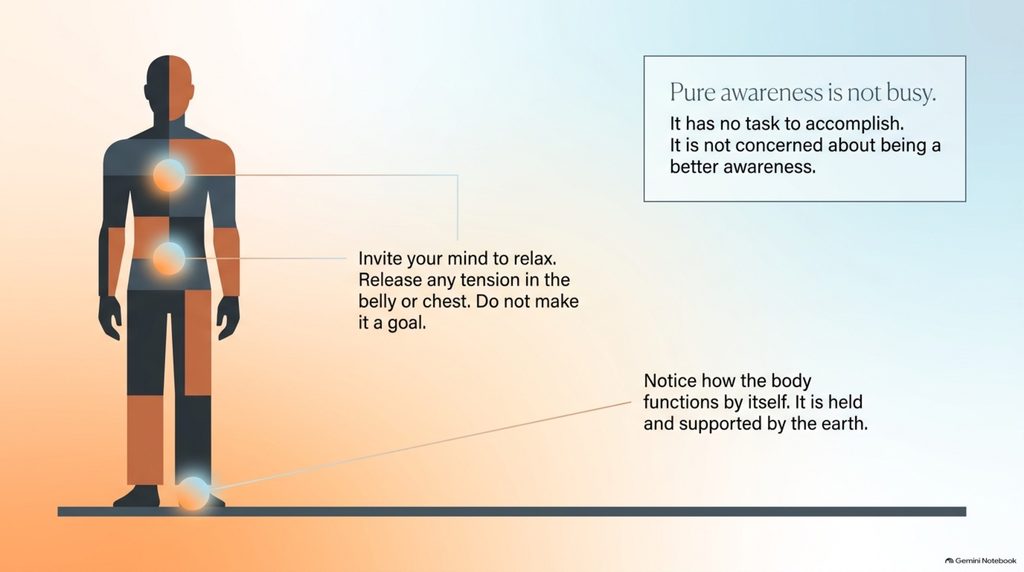
which is not busy.
It has no task to accomplish.
No worries. It is not concerned about being a better awareness, a healthier awareness.
It is not of the realm of the body-mind,
yet it is there, fully on board, fully present.
So relax. Be comfortable. Let things be as they are.
You don’t need to remember anything.
You don’t need to achieve anything.
A gentle inhalation, a gentle exhalation,
simply noticing how the body is functioning by itself, of itself.
And it is held by the earth.
Bodies supported by the ground.
It is somehow rooted in the ground.
You can turn your attention to your belly.
If there is any tension in the belly or in the chest,
invite yourself to relax this tension.
Don’t make it a goal. We don’t need any goals,
but to simply be available for the relaxation,
for the deep release into this simple presence,
where for a moment we are not a man, we are not a woman.
We are just this pure, simple aware presence.
Invite your mind to relax.
This mind that is so used to activity, so used to movement,
invite it to relax.
When the mind is relaxed there are no issues.
It’s peaceful.
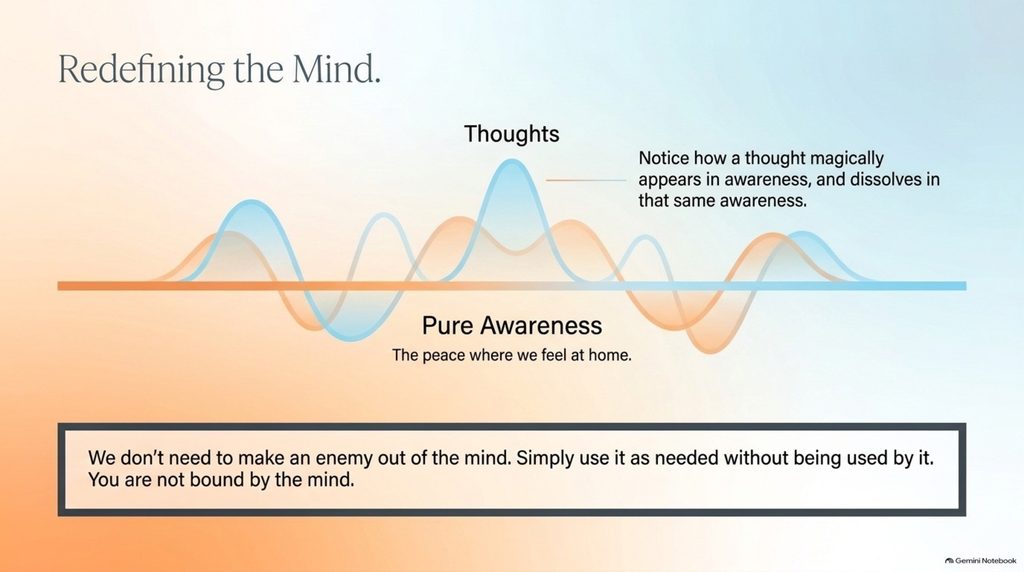
And this peace is that which we love.
It is where we feel at home.
We don’t need to make an enemy out of the mind,
but simply use it as needed without being used by it,
so that it can be a tool for you whenever you need it,
but you are not bound by the mind.
Notice right now how a thought appears.
It appears somehow magically in awareness and dissolves in that same awareness.
Maybe a lot of thoughts appear and disappear,
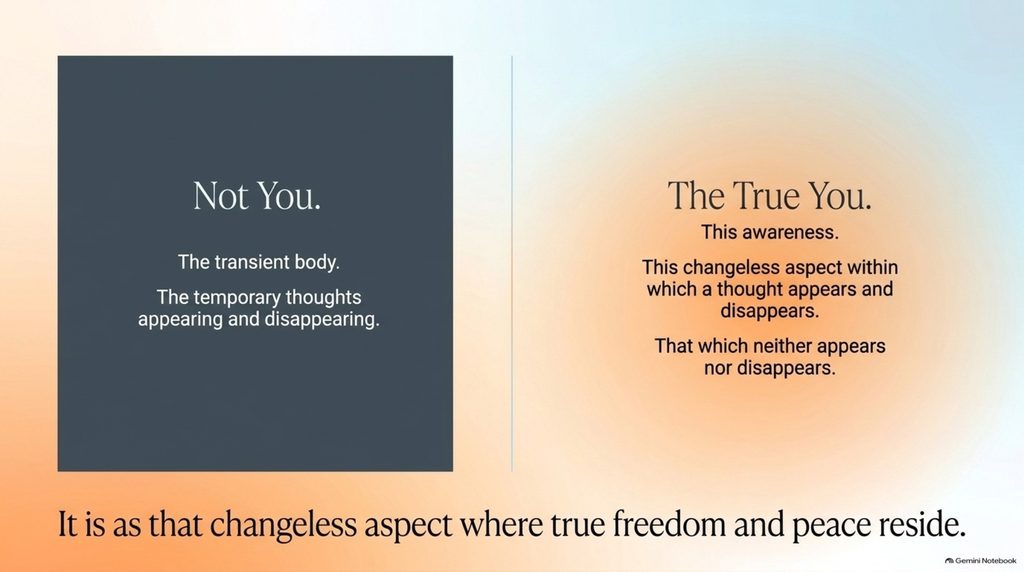
but you—not you, the body.
Not you, the body.
You. This awareness. This changeless aspect
within which a thought appears and within which a thought disappears.
That. The true you.
Neither appears nor disappears.
And it is as that where the freedom, the true freedom, the true peace resides.
Notice how this peace gets seemingly disturbed whenever there is a thought that appears about me—
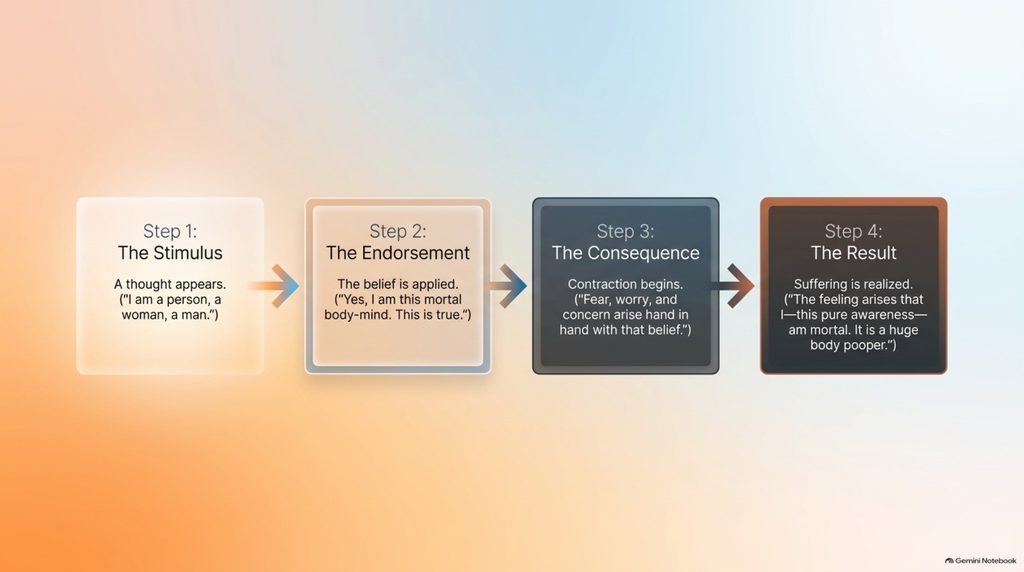
a person, me a woman, me a man.
When a thought appears that defines you as a person, as a woman, as a man,
as a mother, a daughter,
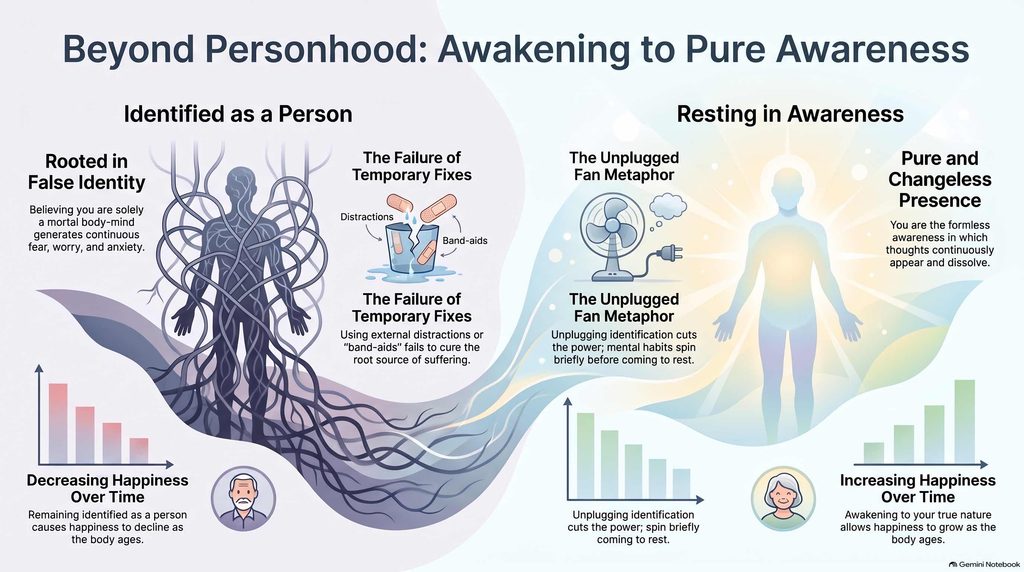
that thought which says you are a mortal body-mind,
whenever that thought appears and it is believed to be true—
“Yes, I am this man, this woman. I am this mortal body-mind”—
then fear, worry and concern arise hand in hand with that belief.
And it is felt that I—I meaning this reality, this awareness—
the feeling arises that I, this awareness, is mortal.
It’s a huge body pooper.
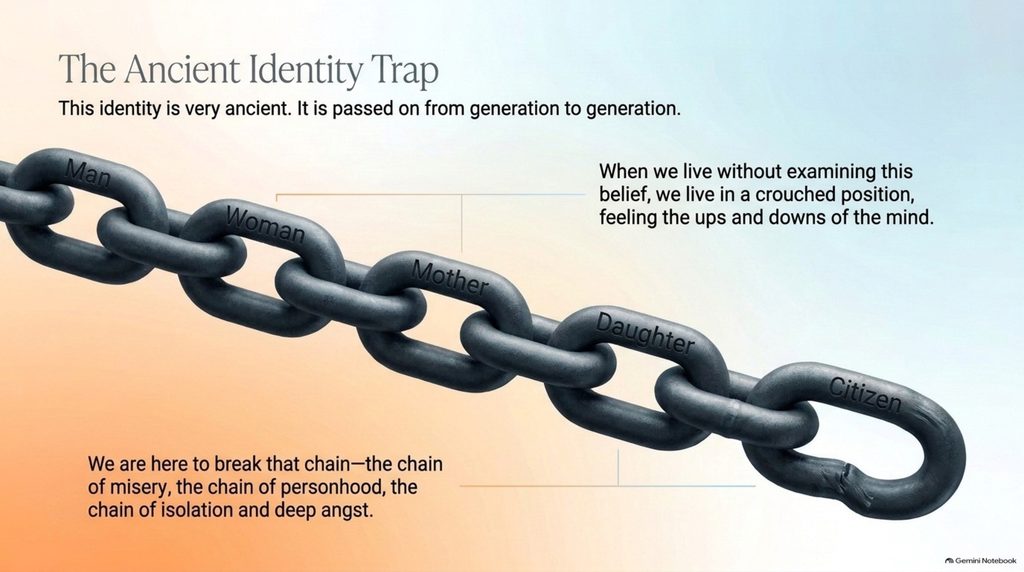
And when we live without examining this belief, we live in a crouched position,
feeling the ups and downs of the mind.
It is fundamental for whoever is serious about true peace and true happiness
to explore this belief, to look deeply into this identity that I am a woman or a man.
This identity is very ancient. It’s passed on from generation to generation.
And we are here to break that chain—the chain of misery, the chain of personhood,
the chain of isolation, this deep angst within our belly, within our heart.
In this moment, without referring to the past, without referring to the future,
this moment. What are you truly?
Are you ready for this question?
What am I truly?
And if you’re not ready for this question,
you may still be holding on to “I am this person”—
unhappy at times, happy at other times.
I’m still holding on to “I am a person. I am a woman, I am a man,
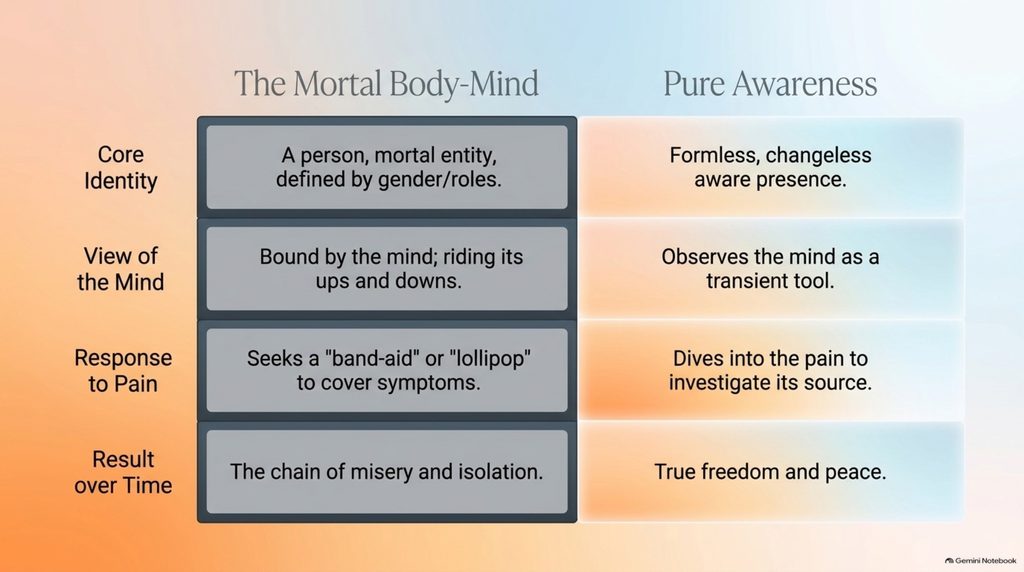
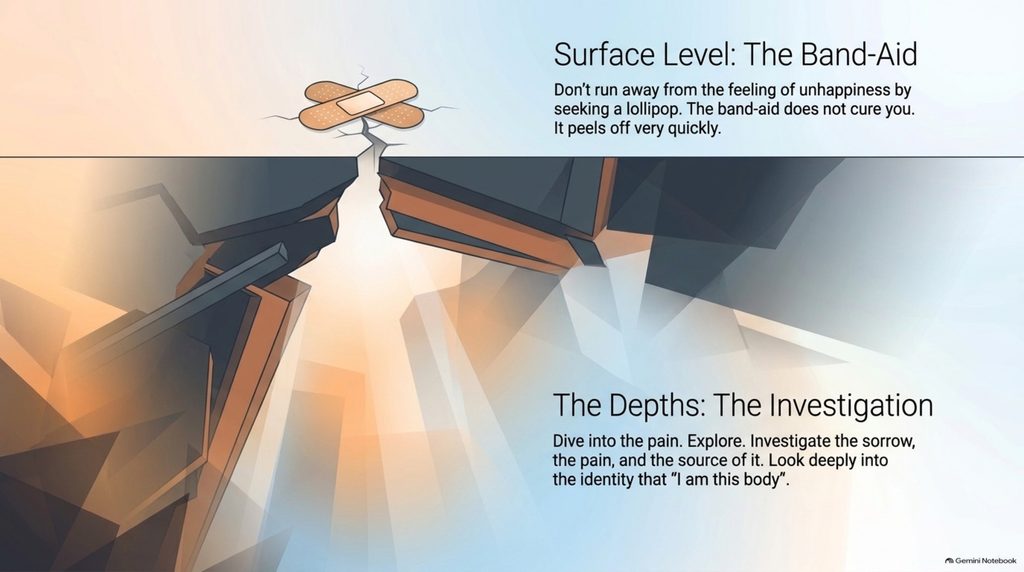
and I need a band-aid. Give me a band-aid so I can feel better.”
This band-aid does not cure you. It peels off very quickly.
So today I was going to talk about this question:
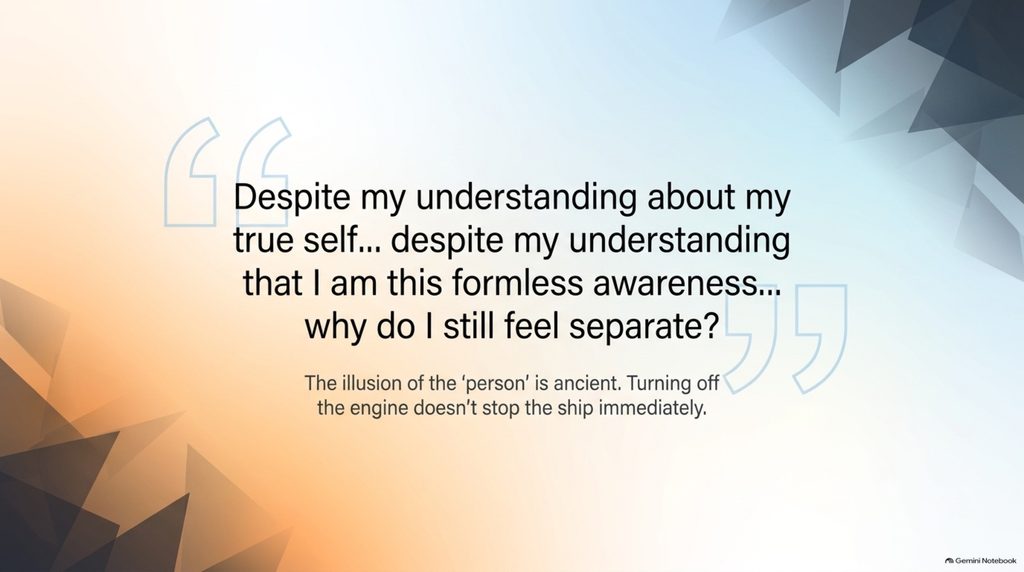
Despite my understanding about my true self, despite my understanding that I am this formless awareness,
which is already a very deep understanding,
I still feel separate. I still feel separate.
Well, you know, we’ve been identified as a person, as a son, as a daughter,
as a member of a tribe, as a citizen of a nation for a very, very long time.
And when you turn off that engine—the engine of identification—
the ship does not stop right away.
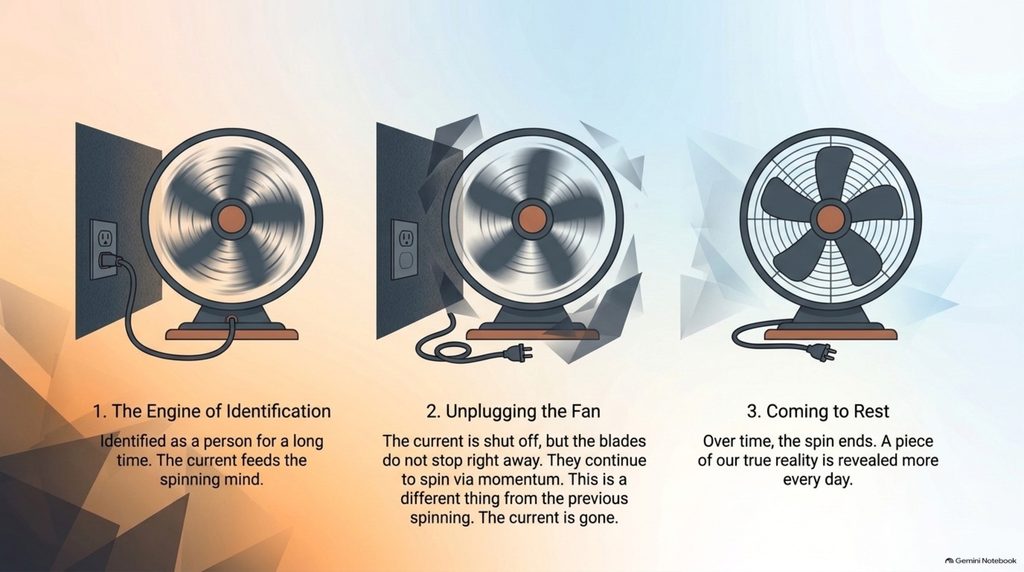
It’s like the metaphor of the fan.
When you unplug the fan, the blades of the fan do not stop right away.
They continue to spin for a while, but it’s a different thing from the previous spinning.
Before there was a current feeding that spinning.
Now the current is shut off.
So in time this spin comes to a rest,
and a piece of our true nature, of our reality, is revealed more and more and more every day.
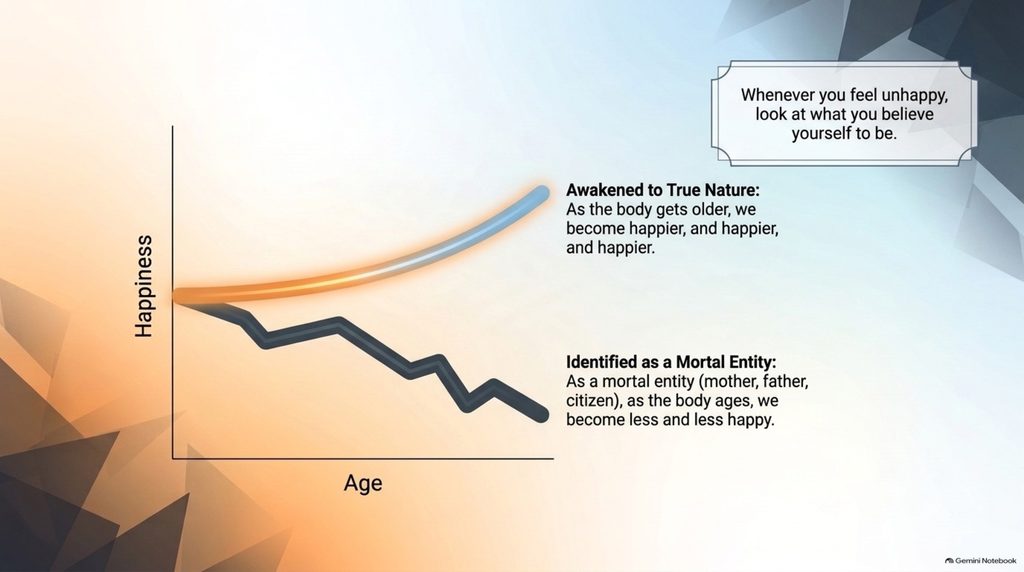
It is said that when we awake to our true nature,
as the body gets older we become happier and happier and happier.
But when we are identified as a person, a mother, a father, a grandmother, a grandfather,
as a mortal entity, as the body ages,
we become less and less happy.
Whenever you feel unhappy, take a look at what you believe yourself to be,
because that belief—”I am this”—is spinning in the mind,
but it’s creating all sorts of trouble and confusion in the mind and the body.
The body expresses this confusion via various painful contractions and disease.
Don’t run away from the feeling of unhappiness by seeking a lollipop.
Dive into the pain. Explore. Investigate the sorrow, the pain, the source of it.
Don’t make use of the be. Simply be for now.
Thank you.
Satsang
Transcript
So you’re welcome to open your eyes.
Whatever questions you may have,
whatever issues you may have,
whatever sharing you may have,
whatever interests you may have
that you want to explore—
please go ahead.
There is a raise hand icon at the bottom of the screen,
or just raise your hand,
or simply unmute yourself.
Hi, George.
Hi there, Magdi.
I want to ask about mortality.
You mentioned the body and mind are mortal,
and you implied that awareness is not.
It seems to me—and this is where I’d like some clarification—
if the body and mind are mortal,
they have died,
and then awareness carries on,
won’t that be just like deep sleep?
I mean, there will be no sensations,
no I at all?
That would be true if you’re assuming
that awareness is limited to a body-mind.
So when the body-mind dies,
there are no sensations, no perceptions.
But you don’t need to make that assumption.
Why would you make this assumption?
Okay, but I still think—
let’s look at awareness.
It was present before I was born.
Is that correct?
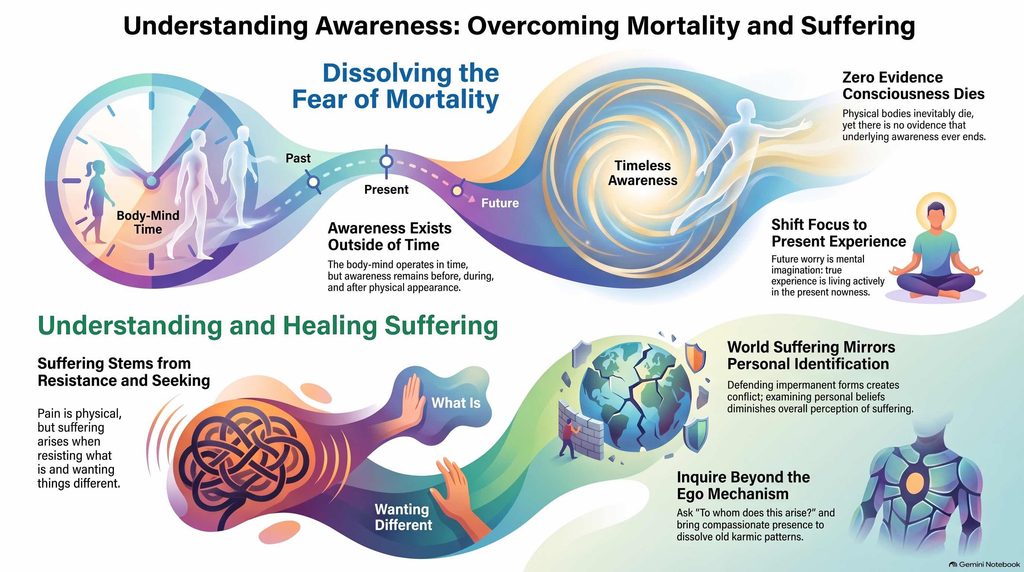
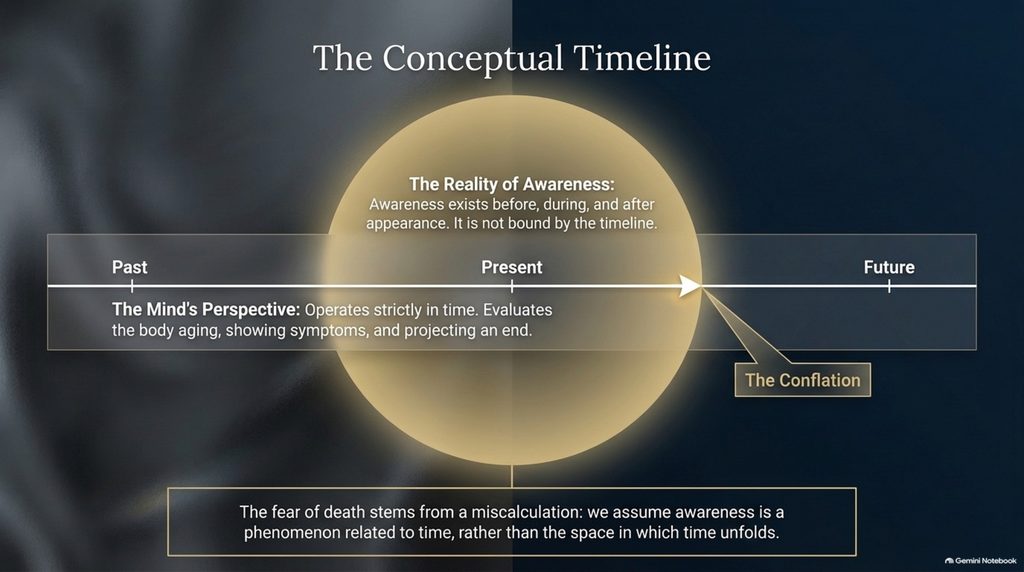
Well, awareness is before appearance, during appearance, and after appearance.
In a relative sense, you could say that awareness was before the body-mind.
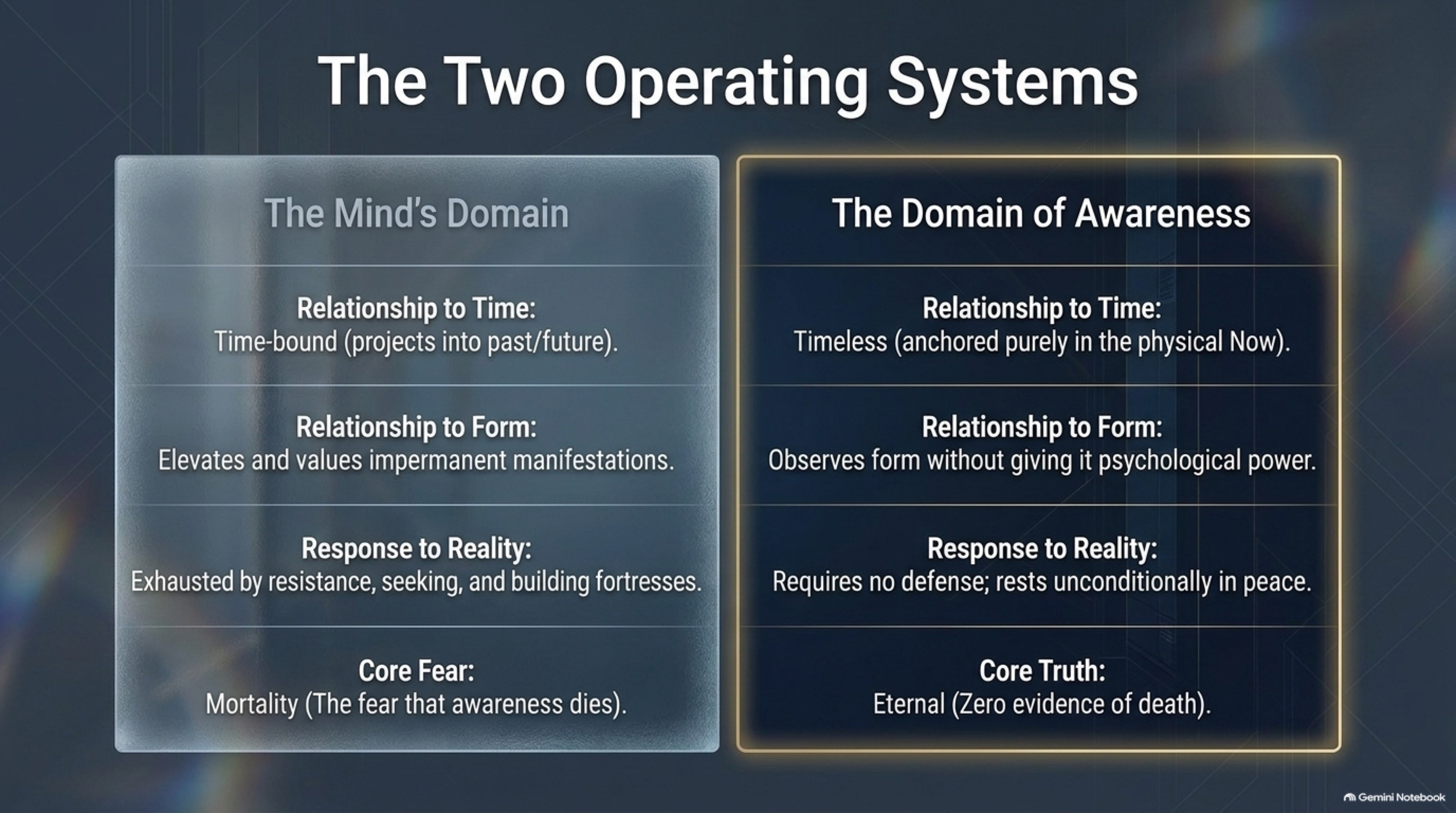
But the thing to understand is that awareness is not in time.
You are conflating the realm of perceptions, which exists in time,
and awareness, which is not in the realm of time.
But I would grant you a yes answer to that question.
Okay, yes, you’re right.
I am looking at awareness with respect to time.
So from the mind’s perspective, mind operates in time—
past, present, and future.
It looks at awareness as a phenomenon,
some sort of magical phenomenon that’s related to time.
So it says: okay, well, when time ends
upon the death of this body, will awareness also experience…?
That’s a conflation.
How do I resolve that conflation?
What is the core question?
Okay, here’s the question:
I’m getting old.
The body-mind is getting old.
The body is showing symptoms that it won’t be around very much longer.
That’s the mind.
The body doesn’t show systems that it won’t be lasting too long.
The body shows systems of pain or breathing issues.
So you’re talking about the body-mind.
Yes, the body-mind.
I’m talking about blood tests.
So now I don’t know how to ask.
I’m obviously concerned.
Why?
Two things.
Number one is the dying process may not be very pleasant.
Well, you don’t know anything about this.
I’ve seen other body-minds die.
Imagination.
You’re just sharing imagination with me.
It’s like a kid who’s afraid of the boar
because the boar is very scary.
Okay, what else?
I don’t know what else I can say.
There is fear and concern here.
The main concern is: I am going to die.
Yes.
It’s nothing with the body,
with scary, with painful—
all of that is mind, is imagination.
The main core issue is: I’m going to die.
And that’s the question that I often invite you, invite us,
to take a look at.
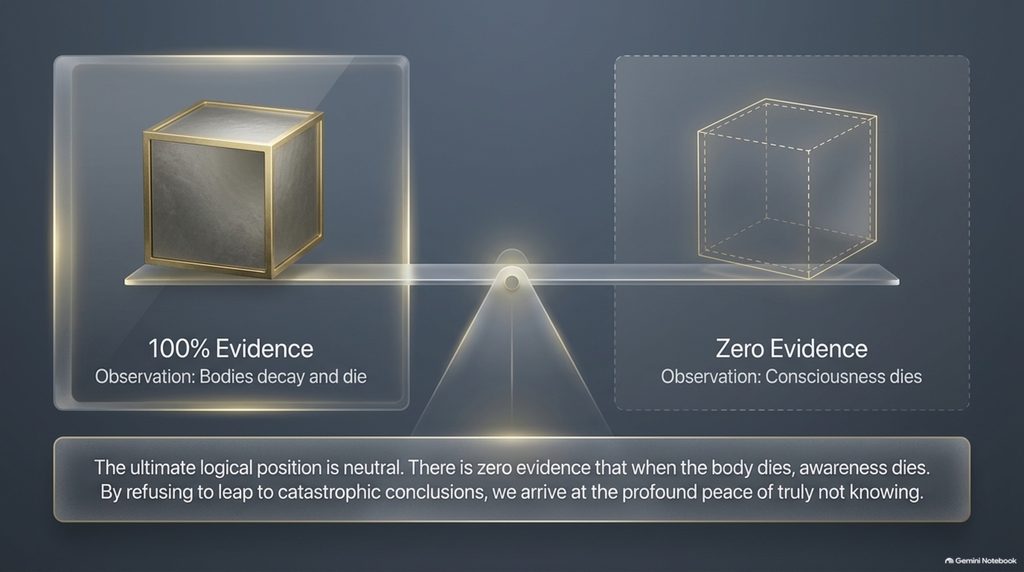
On what basis? What is the evidence
that when the body dies, you die?
I have no such evidence,
but I also have no evidence of the contrary.
Okay, so remain not knowing.
If I don’t know something
and I’ve investigated it, I don’t know.
It could be 50-50 either way.
So I don’t lean one way or the other.
I’m not jumping “yes, yes,”
nor am I going “oh my God, oh my God.”
I’m in a neutral position.
Okay, but I don’t see it as 50-50.
I see it as 90-10.
Well, then we need to talk some more.
How come it is 90-10? Tell me.
No, I don’t know. I just picked those numbers out of thin air.
I don’t really mean that.
The main question, George,
that you need to take a look at and own—
that understanding that I have investigated
over and over and over—
is the belief that when the body dies, I die.
And I’m coming to the conclusion I really don’t know.
I truly don’t know.
You looked into that question.
What is the answer for you?
There’s been a lot of evidence that bodies die.
There is zero evidence—
not 20 or 50, zero evidence—
that consciousness dies.
Oh, that’s interesting data.
Very interesting data.
And this awareness,
which has zero evidence that it dies,
is this awareness.
This ordinary awareness.
So rather than look at the theory,
I’d like to know your experience.
How does it look to you?
You’re getting older.
But how does the prospect of the body dying look to you?
How do you relate to it?
What is your emotional reaction to it?
It’s clear that at some point in time this body dies.
This experience is not something that is available to the mind,
because all experiences are available to awareness.
This moment, this experience right now,
is a moment of pure awareness
taken on the form of a conversation.
So the thought about the body dying
is not such a significant event.
There’s no worry and concern about it.
I’m more busy living right now.
I’m more busy doing what needs to be done
and enjoying what I can enjoy,
resting whenever the body needs to rest.
So I’m too busy with that right now.
There is no worry and concern about the future.
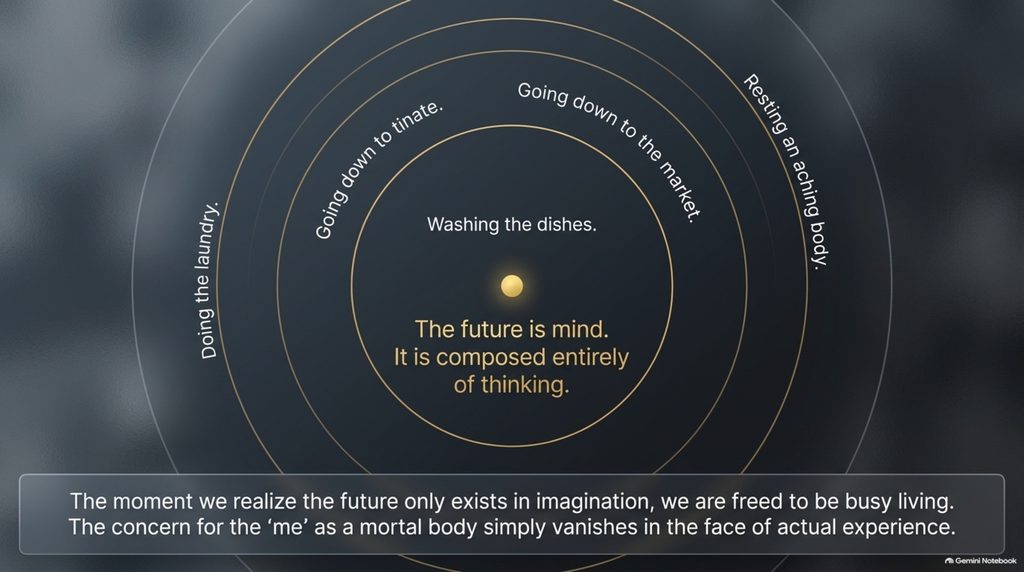
It’s important to understand—really understand—
that the future is mind.
It is composed of thinking.
Our actual experience is not the future.
Our actual experience is this life,
this beingness:
washing the dishes,
doing the laundry,
going down to the market,
making sure that we continue to move the body around
to keep it a little less achy.
But this concern about me—me as I am the body—
me is absent.
That’s the magic.
Okay, thank you, Magdi.
Okay, good to see you, George.
Hi, Paul.
I’m going to request that you put an email address in the chat again
that we could—
I’m sorry, can you repeat that, Paul?
Would it be possible to put an email address in the chat
that we can do again?
Sure, let me see.
Okay, done.
My question is:
there is pain or suffering in the universe.
Sometimes to help us get closer to awakening
and things like that, but why is there so much suffering in the universe?
There’s an insane amount of suffering.
How do you measure suffering?
By pain, being aware of pain.
But how do you measure it?
There is pain right now.
How do you measure pain right now?
A qualitative presentation.
So you have like a chart—a 0 to 10—
and then you have dates.
Yesterday, day before, day before, day before.
So there is a chart.
That’s how you measure the pain in the world?
In January the pain level was 82, in February was 79?
How do you measure the level of suffering or pain?
What is your methodology?
Okay, forget about that.
Let’s go somewhere else.
How come there is suffering?
Let’s forget about “so much.”
I got stuck on the word “so much.”
How come there is suffering?
So you tell me.
I’m asking you: how come there is suffering?
I don’t know.
One thing that people say is that we can learn from it.
No, no, no.
Do you suffer?
Simple question.
Yes, my body and mind suffer.
Yes, you suffer.
Tell me about your suffering.
What makes you suffer?
Can you recollect what makes you suffer?
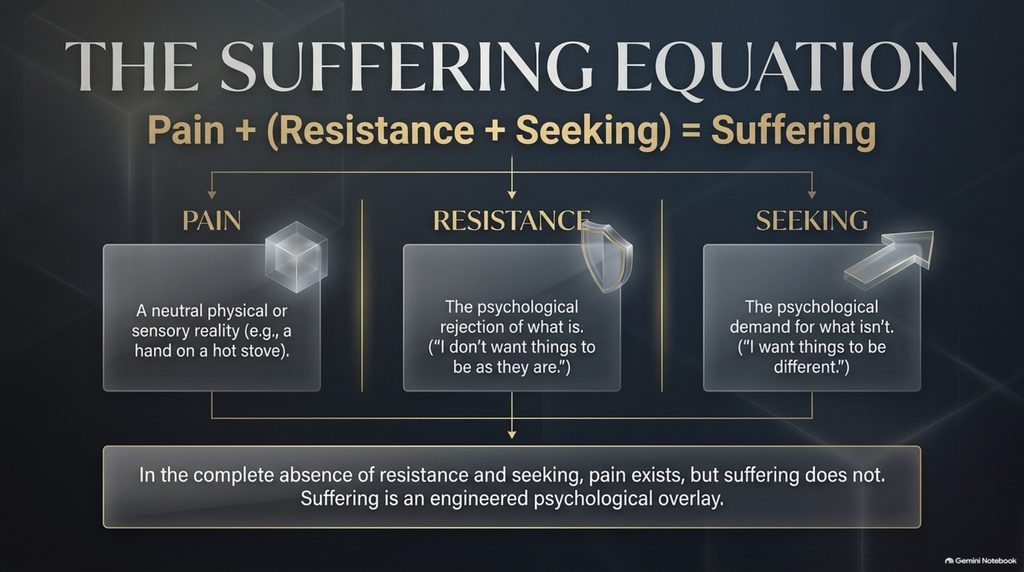
Like if I put my hand on a hot stove or something.
No, that’s pain.
That’s not suffering.
Okay, well, we suffer because of resistance and seeking.
We don’t want things to be as they are.
We want things to be different.
So there is a resistance to how things are,
and there is seeking—we want things to be different.
If we’re not wanting things to be different
and we’re not resisting things as they are,
would you say there is suffering?
Well, we still have to deal with this world, right?
I mean, we still have to go to the market, do some shopping.
We’ve got to cook the beans and rice.
We have to go to work.
Yeah, but I’m talking about suffering
in the absence of resistance and seeking.
So in the absence of resistance and seeking, there is no suffering.
Now, why do we resist and we seek?
Why do we?
We resist because we want to protect something important.
We want to make sure that something that we value
isn’t getting hurt, isn’t getting damaged.
So it’s something that we’re trying to protect.
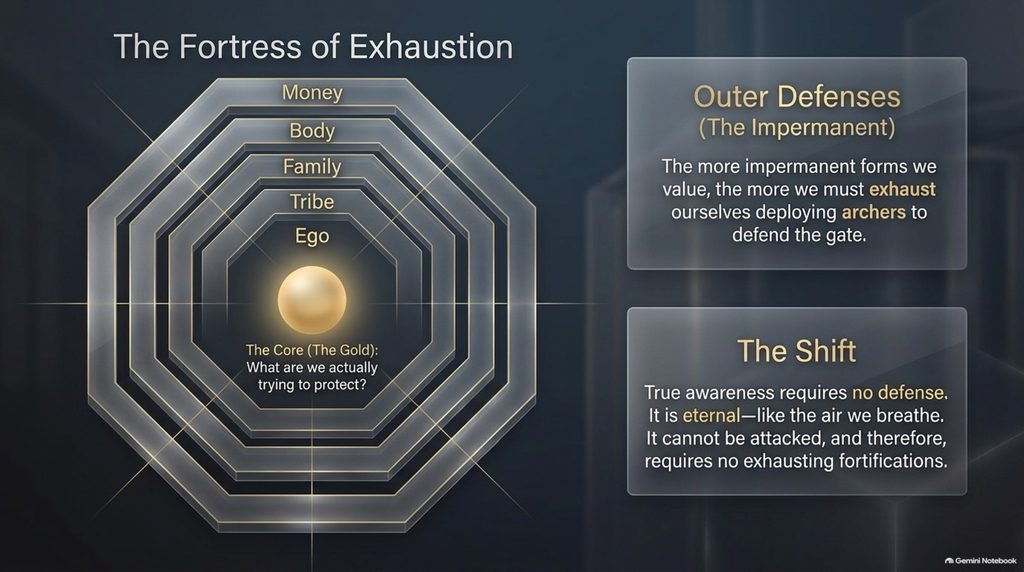
We have like a castle,
and inside the castle we have one ton of gold.
So we resist anybody that comes close to the gate.
We have our archers that we try to defend.
We resist anything getting close to our castle, to our fort.
We resist when there is an attack because why?
Because we want to protect the gold.
So ask yourself: what is it that you’re trying to protect?
Trying to protect stuff that’s not just pure awareness—
that’s your sensations and stuff.
But I still don’t understand why there’s so much suffering.
Well, the more stuff you have to protect,
you’re going to protect so many things.
It’s exhausting.
Imagine you don’t need to protect anything.
You wake up, you just go with the flow.
The more we value things, things that are impermanent—
because that which is permanent, you don’t need to protect it
because it’s eternal, that which belongs to everybody.
That’s the air that we breathe, as a simple metaphor—
maybe a naive metaphor.
You don’t need to protect it.
You inhale, you exhale.
So the more you’re confused about what really matters,
you think that your body matters,
you think that your money matters,
you think that your mind matters,
you think that your family matters,
you think that your tribe matters,
you think that your car matters.
Whatever you think matters—
that’s what you’re protecting.
That’s where you’re identified with as being important, as being valuable.
What makes it valuable?
You.
You want it. You want it to be valuable.
So what is it that you don’t understand, Paul?
It seems like a little bit of suffering would be one thing,
but a crazy amount of suffering—
maybe not from an absolute sense you’re suffering,
but from a duality perspective you’re suffering.
So I don’t know why it should be so intense.
Turn your attention to your own suffering.
This is where the answer will come to you.
When you examine your belief structures,
what you identify yourself to be—
you believe yourself to be a man,
you believe yourself to be Paul.
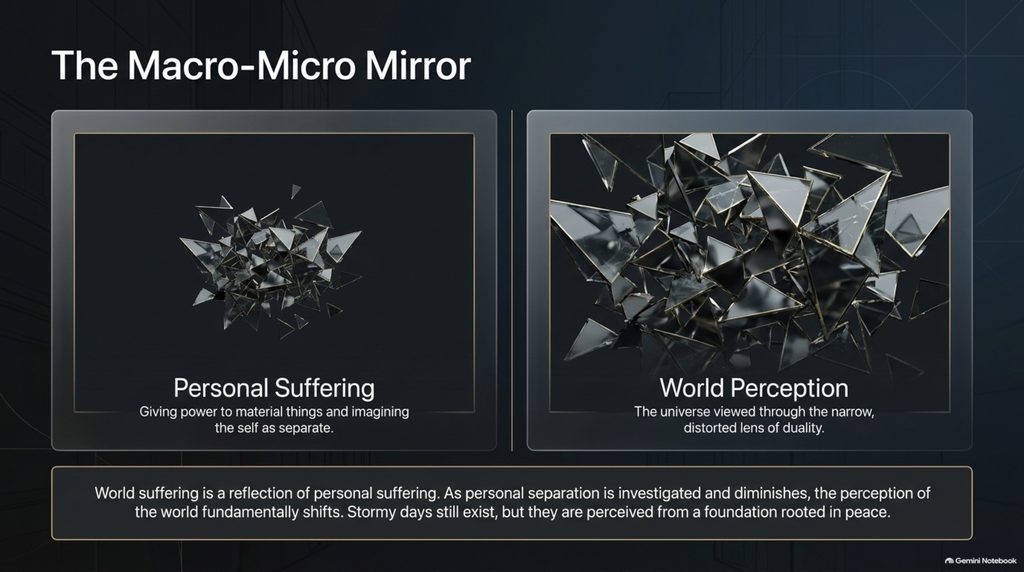
When you give power to material things,
when you give power to things supposedly outside of yourself,
when you’re imagining yourself to be separate—
this is where you get the answer to your question.
This is where the world’s suffering diminishes with your own suffering.
So there is a lot of suffering in the world
because you are suffering.
You are experiencing separation,
and so you’re perceiving all of this—
all what’s happening in the world—
from the narrow perspective of duality.
So world suffering is simply a reflection of personal suffering.
When you turn your attention to the personal suffering
and you investigate the personal suffering,
you can arrive at a place where the suffering diminishes.
And as the suffering diminishes, your perception about the world
and your perception about suffering in the world also shifts.
You will still perceive sunny days and stormy days,
but you will not be perceiving them from the same perspective.
You will be perceiving them from a different place
where you are no longer giving reality to that.
Rather, reality is rooted and based in peace.
Okay, thanks.
Okay, Paul.
Any questions? Anything you’d like to explore?
Yes, Paul.
So it’s a Zen thing that somebody asked:
does a dog have Buddha nature?
And I forget—I think he said “mu” or something.
So I’m still curious: does a dog have the capacity of a person?
But it might still have pure awareness.
I don’t know, what’s your take on it?
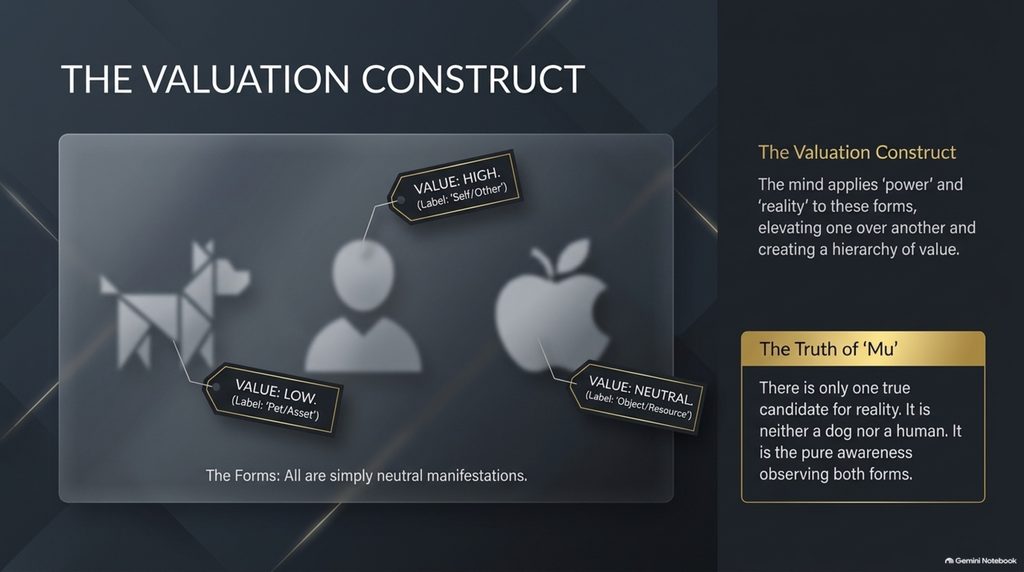
You’re giving power and reality to dog.
Dog is a form, is a manifestation.
A human body is a form, a manifestation.
A snail is a form, a manifestation.
A fig, an orange, an apple is a manifestation.
You’re giving power to form.
There’s only one candidate, one true candidate for “mu.”
It’s neither a dog nor a human.
Thanks.
So many of you have that video turned off.
I always enjoy seeing you.
Hello, Holger, Kunal.
Yes, thank you.
I enjoy seeing you during the meeting.
Hey, Patrick. Rokus, hello Mackie.
Hey, hello, Holger.
I really enjoy your sharing, your meditation,
and when you invited us to explore the pain, the misery.
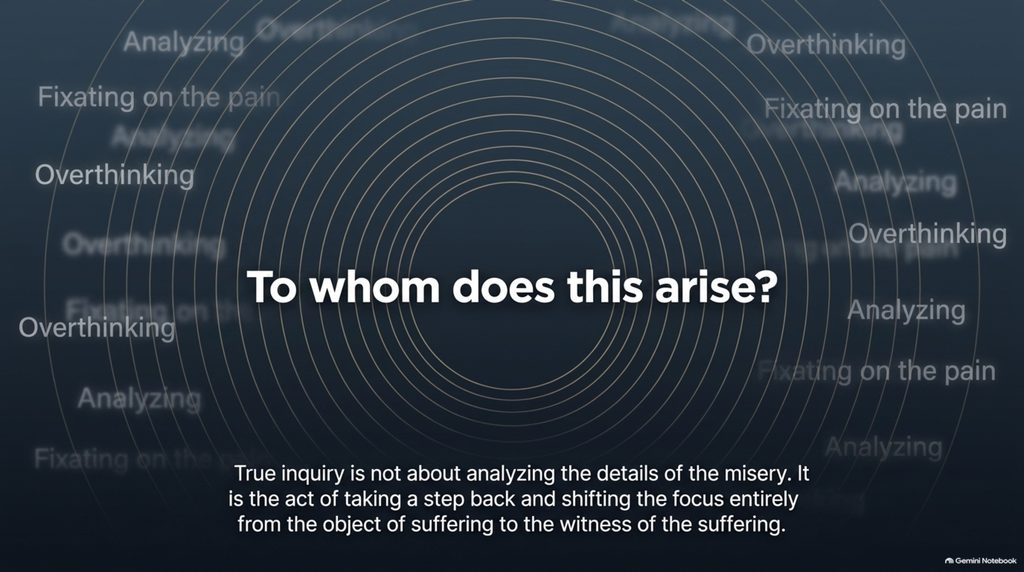
It’s so easy to get lost in thinking and then analyze, blah blah blah.
But in a way, the way I understand it,
it’s being aware: to whom does this feeling arise?
So it’s not about actually bothering with the pain.
On one level, I don’t bother with the pain,
but I’m taking a step back and I’m just looking:
actually, to whom does this arise?
Yes, yes. I think that’s a very good question to ask ourselves.
We have to be a little bit careful
because in some cases there is a question:
to whom is this suffering arising?
And the answer may come: oh, it’s arising out of the mind.
It’s arising to nobody.
Which is true.
But we can go deeper.
The reason why we can go deeper is because
in spite of the understanding that it’s happening to nobody,
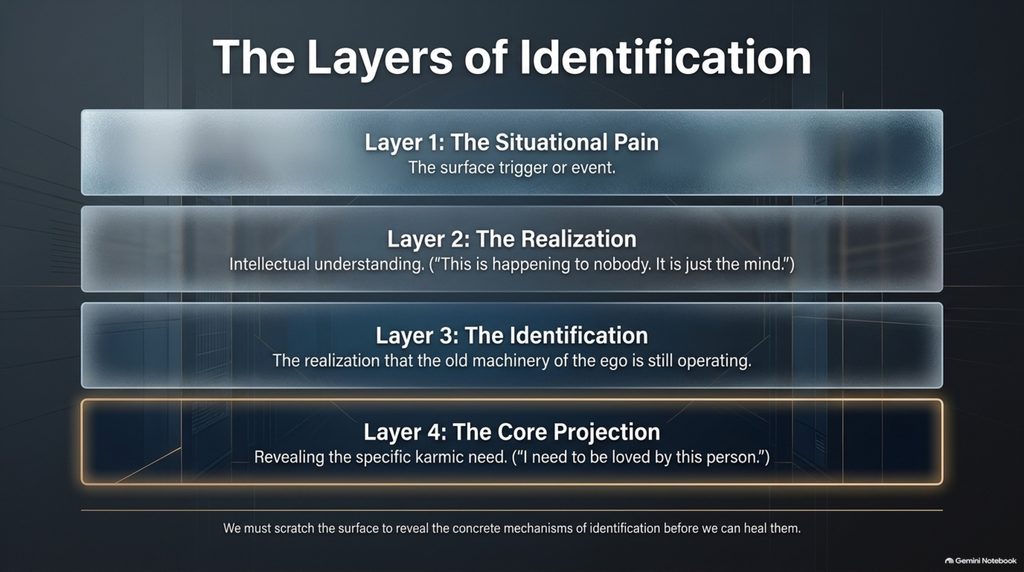
the mechanism of identification is still there.
So it’s helpful to scratch a little
until we find those aspects of ourselves—
the identification aspects of ourselves—
that in that moment are operating
and are appearing as suffering in the body, in the mind.
And when we scratch the surface and we come upon a projection
like “I want to get fulfillment from somebody else”
or “I need to be loved by this person, I’m not being loved,”
there is something more concrete that is revealed to us
in our suffering.
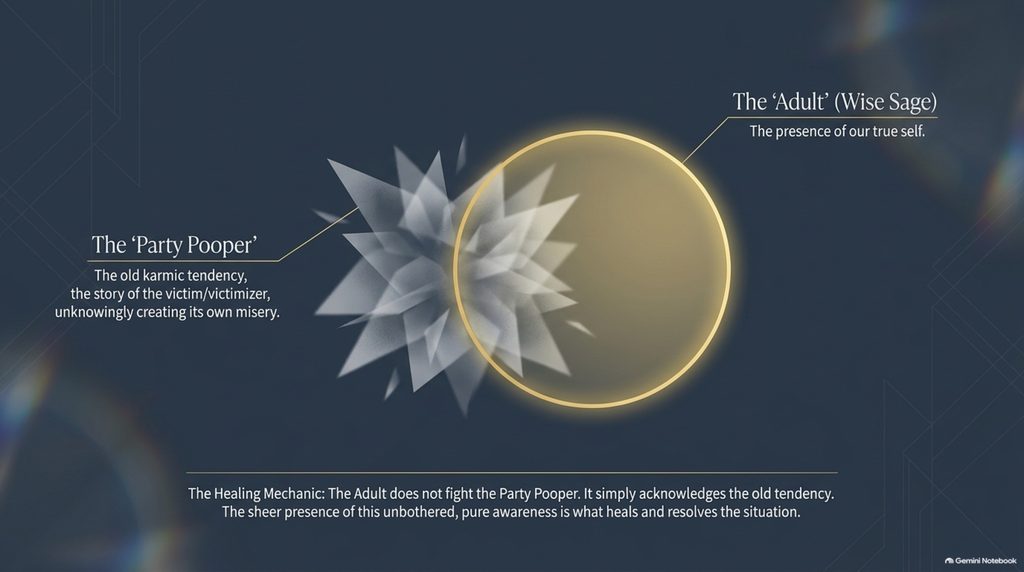
We are seeing an old mechanism.
And what’s also helpful beyond that
is to also experience that there is,
besides this specific old karmic need to be fulfilled by somebody—
there is also within ourself, as our true self,
the wise sage, that aspect of ourself—
which is not really an aspect of our true self—
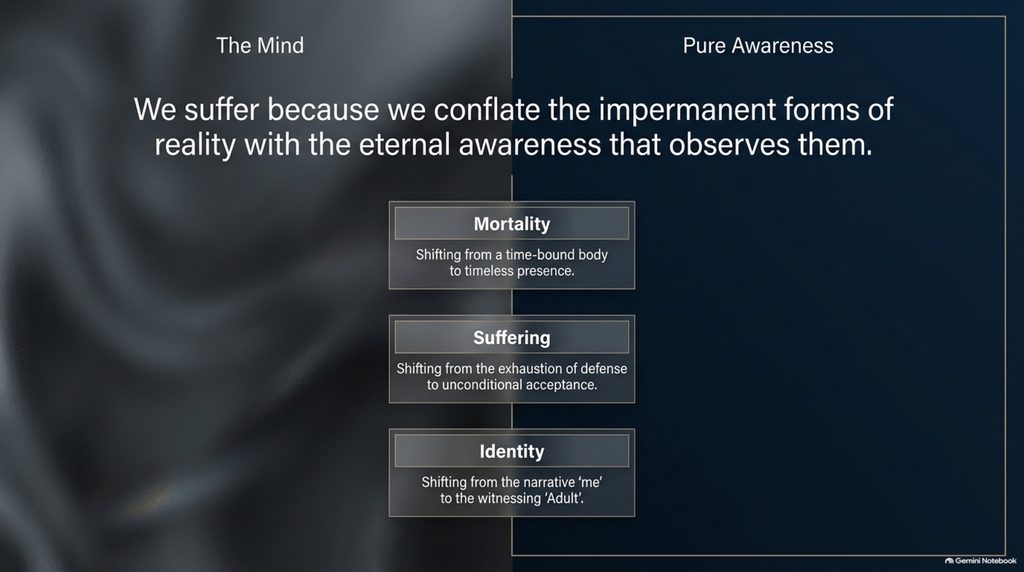
which is this awareness, this adult.
I like the term “adult”—
that can acknowledge this old tendency
that leads to the suffering
and that can heal it by its presence.
So on one level, I don’t need to bother with the mechanism
because it takes care of itself in a way.
On one level, that’s wonderful, yeah.
If in your experience just a question—
to whom is it arising?—
and that in itself heals and resolves the situation
and brings, reveals, unveils our true peace,
that’s wonderful.
Yes, yes.
Yeah, that’s good.
It’s so beautiful when you use the word “party pooper.”
It obviously tickles me. It’s nice.
It’s so true, it’s so amazing—
how I create my own misery unknowingly.
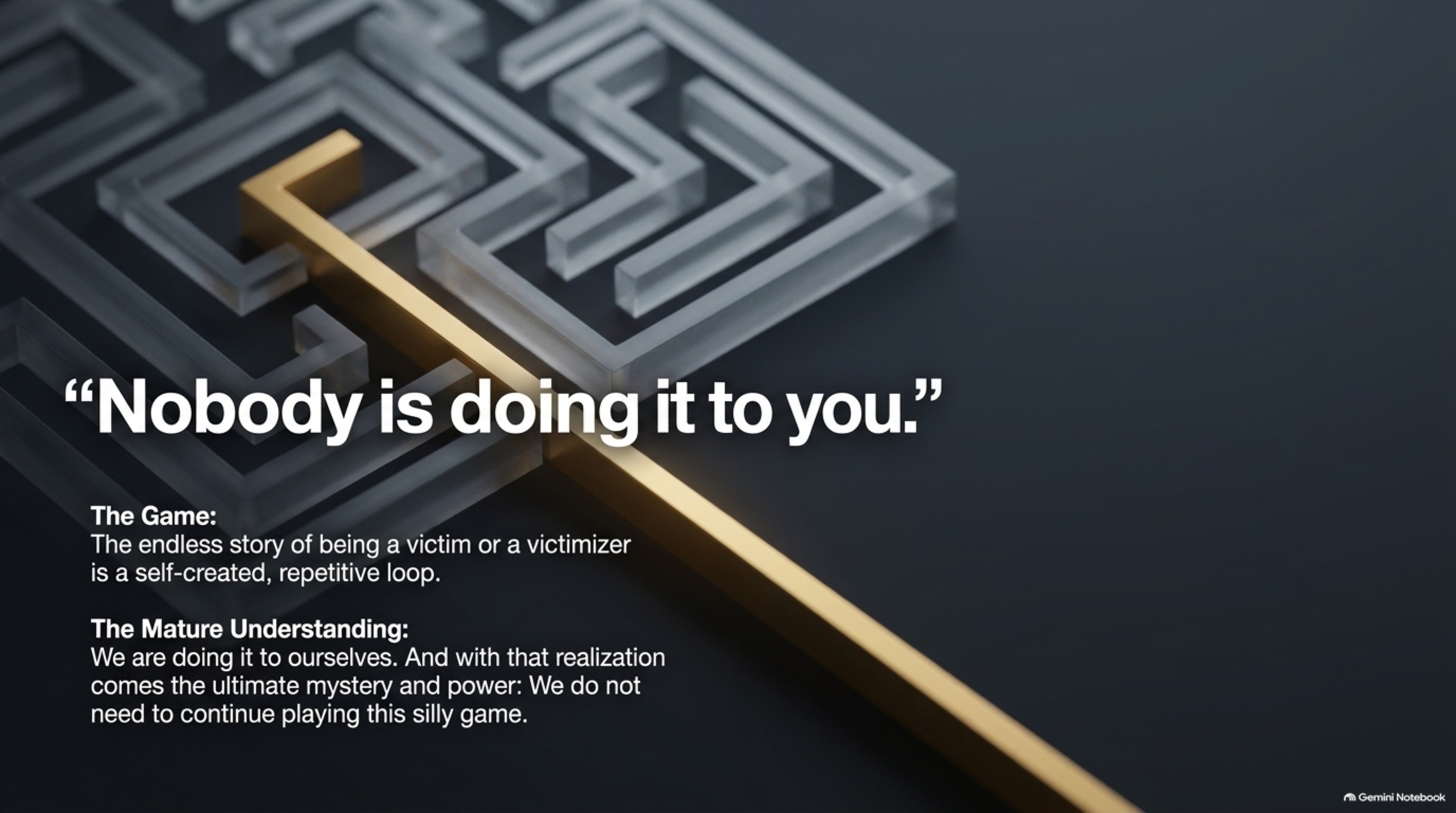
Yeah, it’s an old thing, you know.
This identity, this story that’s been going on
and on—me, this victim or a victimizer.
You have to take a look at it.
Yeah, nobody’s doing it to you. You’re right.
It’s just here. One could say I’m playing the game,
or I’m doing it to myself.
I mean, that’s a mature understanding.
Yes.
And then you ask yourself:
well, wait a minute, do I need to continue playing this silly game?
What a mystery.
And thank you, Magdi, for your patience and continuity
in sharing and inviting us to come back again and again
to this clarity.
It’s wonderful. It’s priceless. It’s precious.
Thank you.
Yeah.
Well, wishing you all a happy Sunday,
a happy day, rest of the day—
moment by moment, precious beingness, precious nowness.
Yes, thank you all.
Thank you, Magdi.
Hope you feel better soon.
I know it’s been so long, Patrick.
I’m so tired of it.
Oh my goodness, I don’t know.
I’ve got like medicine, all sorts of medicines here.
I keep drinking this.
Yeah, thank you.
It’s getting better.
All right, see you. Take care, guys. Thank you—
and girls, all of you.
Love you.
AI Summary
Awareness and suffering inquiry
- 2026-10-18 @Magdi-Badaway
Key Points
- Awareness is outside time
- Thoughts arise and dissolve
- Suffering comes from resistance
- Investigate personal identity
Overview …
| Concept | Detail |
|---|---|
| Awareness | Not in time |
| Thought | Appears and dissolves |
| Fear | Follows personal identity |
| Separation | Old spin continues briefly |
| Death inquiry | No evidence consciousness dies |
| Suffering | Comes from resistance and seeking |
| Protection | Defends valued impermanent things |
| Healing | Investigate personal suffering |
[[2026-10-18]] This session guides attention from body and mind toward awareness, then uses questions on death, suffering, and identity to test that view.
Settling
The opening meditation turns attention to immediate experience without any goal. The body rests by itself, supported by the ground, and attention can soften around the belly, chest, and breath.
- Relax the body without making relaxation a project.
- Let the mind rest instead of trying to achieve or remember anything.
- Stay as simple aware presence rather than as man or woman.
Peace is treated as already present when the mind is not driving experience.
Awareness has no task to accomplish.
Mind
The mind is not rejected here. It serves a practical role when needed, but identity with it creates disturbance.
| Mind | tool when needed |
|---|---|
| Thought | appears and dissolves |
| Awareness | changeless context |
- A thought appears in awareness and disappears in the same awareness.
- The true self does not appear or disappear with thoughts.
- Fear begins when a thought defines identity as person, body, mother, daughter, man, or woman.
- Believing that thought brings worry and concern.
The inquiry asks what is truly present now without reference to past or future. The inherited identity of personhood is described as an old chain to be broken.
Separation
Understanding awareness does not instantly end the feeling of separateness. Old identification can continue for a while after its basis is seen through.
- The fan metaphor explains the delay.
- Unplugging the fan stops the current first.
- The blades keep spinning for a while.
- Identification can continue after its fuel is gone.
- True nature becomes more evident over time as that spin settles.
Aging is framed in two different ways. Waking to true nature brings more happiness as the body grows older, while identification with the mortal body brings less happiness.
Unhappiness check: When unhappiness appears, look at what is being believed about identity.
Mortality
A long exchange examines whether awareness dies with the body-mind. The reply separates awareness from time and from the body-mind assumption.
- The deep-sleep conclusion only follows if awareness is assumed to be limited to the body-mind.
- Awareness is said to be before, during, and after appearance, yet not in time.
- The fear of death centers on the belief I am going to die.
- Imagination adds stories about a painful dying process beyond what is actually known.
The practical answer is to remain in genuine not knowing when evidence is absent. The discussion also draws a distinction between what is evident and what is not. - There is a lot of evidence that bodies die.
- There is zero evidence that consciousness dies.
- Actual experience is this present life, not the imagined future.
The personal report given is simple: the body will die at some point, but concern stays low because attention stays with living, resting, moving, washing dishes, laundry, and going to the market now.
Suffering
The suffering discussion shifts from cosmic scale to direct experience. Pain and suffering are treated differently.
- Pain is not the same as suffering.
- Suffering comes from resistance and seeking.
- Without resisting what is and wanting it to be different, suffering is absent.
The reason for resistance is protection of what is valued. The castle and gold image points back to the things identity tries to defend. - The more that must be protected, the more exhausting life becomes.
- Impermanent things generate defensive struggle.
- What is truly permanent does not need protection.
World suffering is answered through personal suffering rather than theory. As personal suffering is investigated and diminishes, perception of world suffering also shifts.
Inquiry
Several questions are offered as working tools, but they are not treated as slogans. They help only when they expose the active mechanism of identification.
- Ask: what am I truly?
- Ask: to whom does this suffering arise?
- Go deeper when the quick answer hides a live pattern.
- A pattern may involve wanting love, fulfillment, or validation from someone.
- That concrete mechanism can then be seen and healed.
A mature turn happens when suffering is no longer blamed on others. The note ends by pointing to an inner wise adult presence that can acknowledge old tendencies without feeding them.
Form
Later questions apply the same teaching to other forms. A dog, a human, a snail, and a fruit are all treated as manifestations rather than separate realities.
- Form is not the final basis of identity.
- The only true candidate for Mu is neither dog nor human.
The closing guidance returns to simple presence and to the value of meeting each arising moment without adding a personal story.