
Meditation
Transcript
Hello everyone.
I am slightly under the weather, so we’ll do our best.
So, welcome.
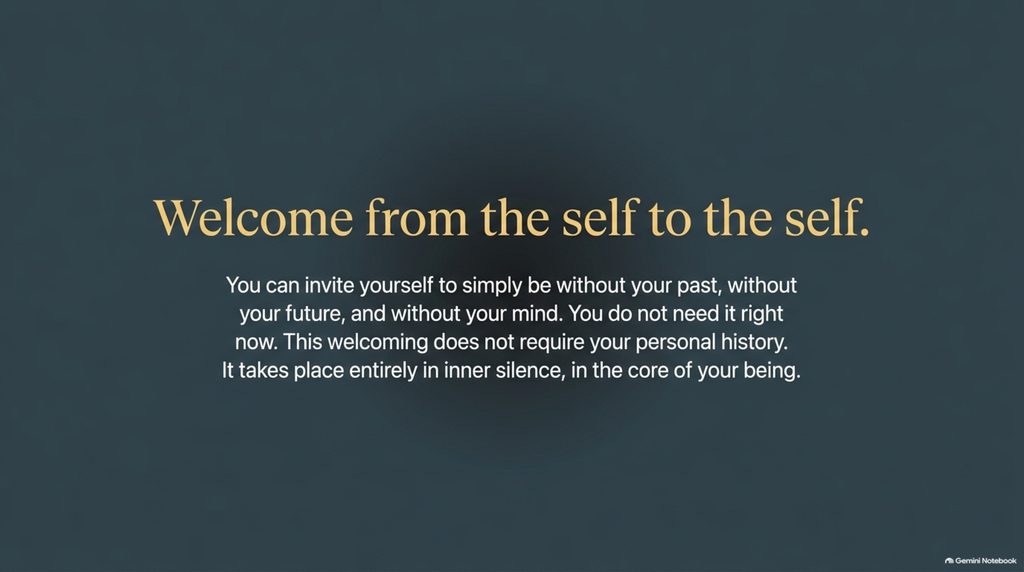
This welcoming is from the self to self.
It is not welcoming of personal histories.
To say welcoming that takes place
in our inner silence,
in the core of our being.
So you can invite yourself to simply be
without your past and without your future,
without your mind.
You don’t need it right now.
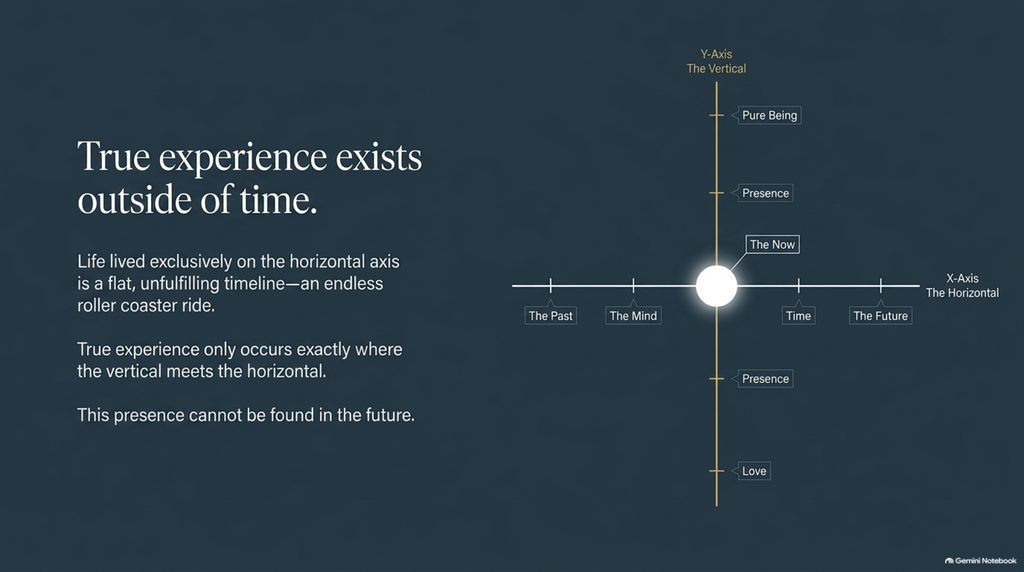
Because your true experience
is always in the now,
it’s always in this presence,
which is not in time.
This is where the vertical and horizontal meet—
the horizontal being our mind,
and the vertical being our love.
Because our life without love
is not a fulfilling life.
And you cannot love somebody else.
You can only love.
And in loving, you are the love.
There is no separate you or separate other.
So we are all looking for the jewel,
for the causeless peace,
for the end of the roller coaster ride.
It cannot take place in the future.
It takes place now and requires your understanding.
Your understanding cannot be based on a belief.
It can only arise out of your direct experience,
which right now is the experience of being—
presence, awareness.
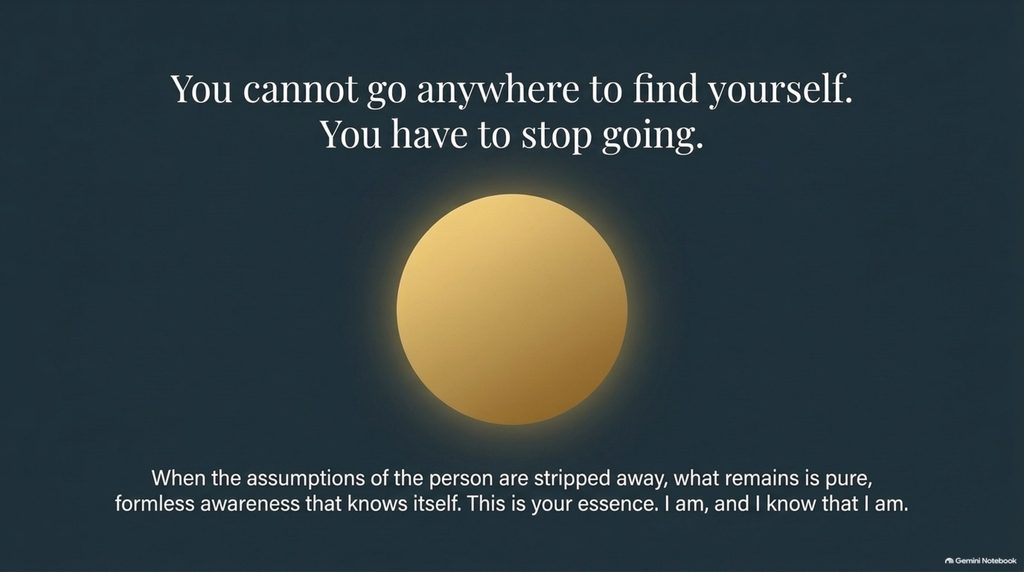
You cannot go anywhere to find yourself.
You have to stop going.
And you cannot stop going,
looking for yourself,
until you understand what the self really is,
which is your direct experience,
which is the experience of being.
We are so habituated to seek something else.
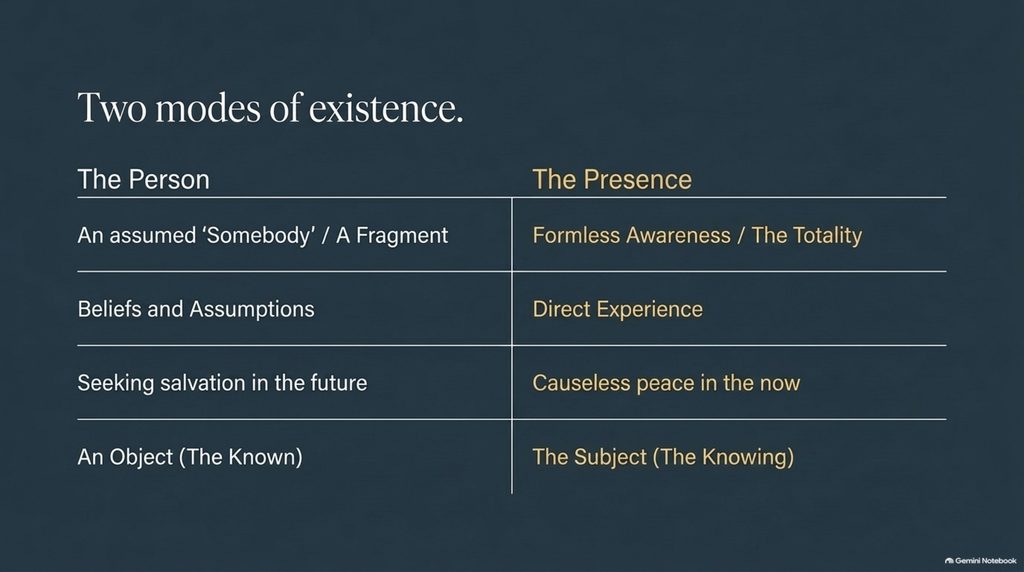
And we do so because we assume ourself.
We have assumptions about ourself,
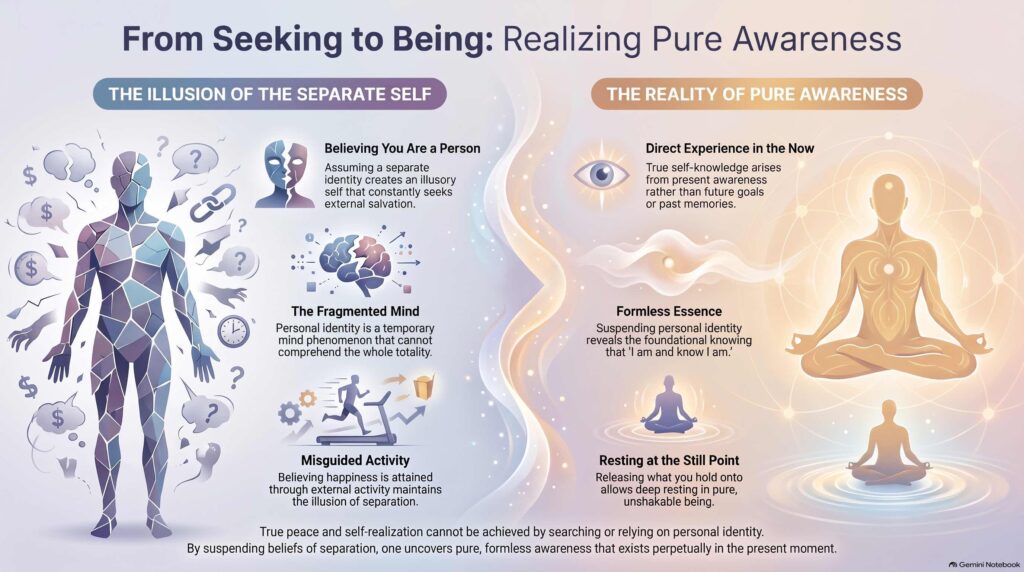
beliefs that we are a person.
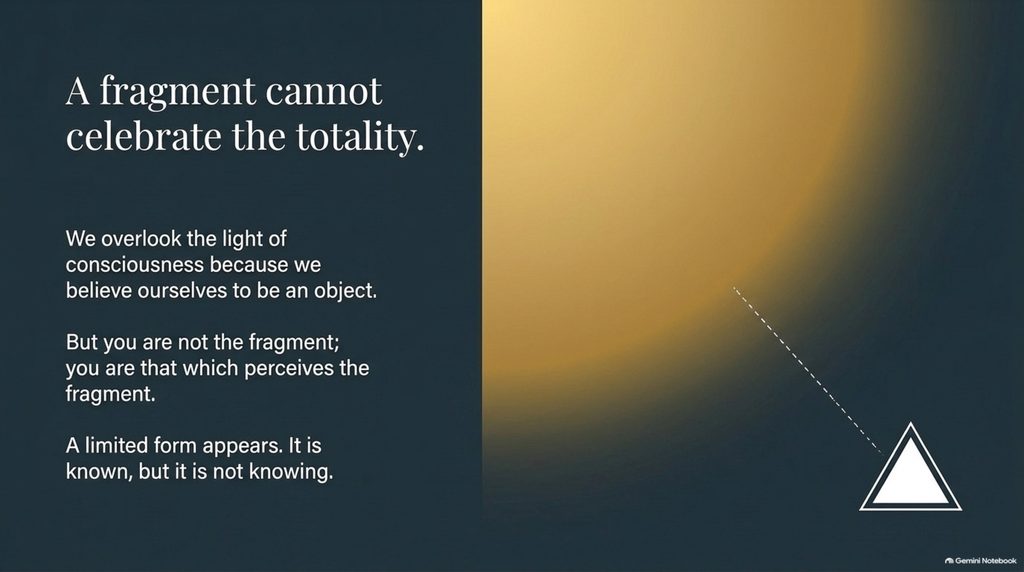
We overlook awareness.
We overlook the light of consciousness.
And we believe ourselves to be an object,
somebody that needs salvation.
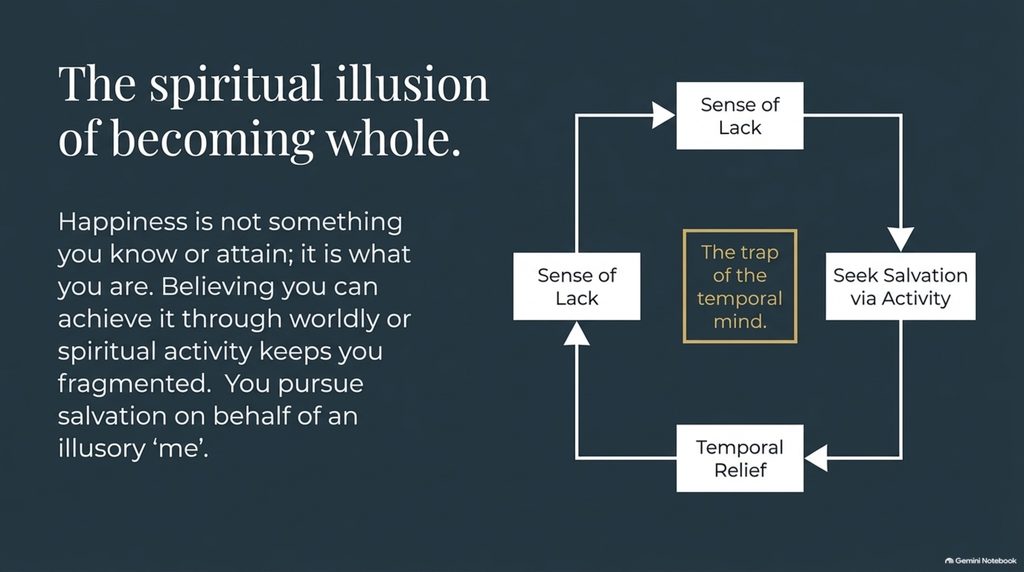
And so we pursue salvation on behalf of the illusory me.
But in this moment, which is always the only moment there is—
what is the reality of separation?
What is the reality of “I am somebody”?
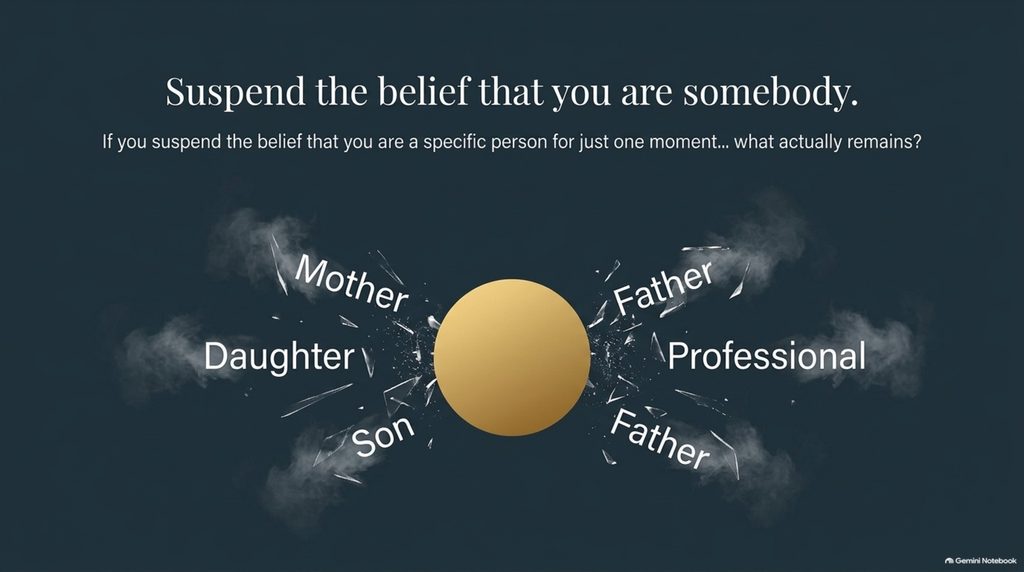
If you suspend that belief for a moment,
if you suspend the belief “I am somebody,”
a mother, a daughter, a son, a father—
what remains?
This pure, formless awareness
that knows itself.
I know I am.
Let’s say essence.
I am and I know that I am.
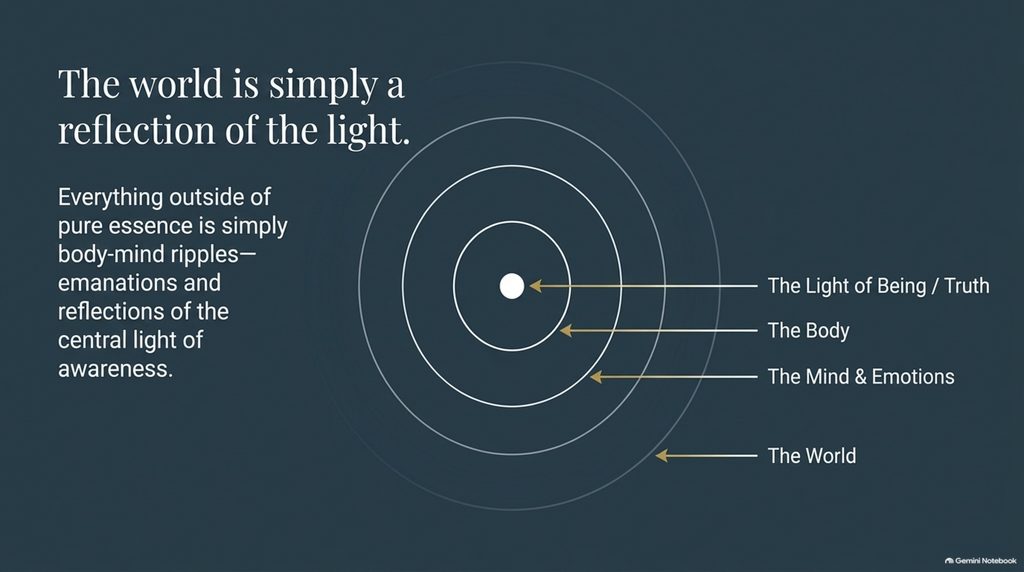
Everything else is the world—
body-mind ripples, reflections of that light.
Because the light of being, the light of truth,
the light of awareness is always inviting us
to awaken to it,
to awaken to ourself.
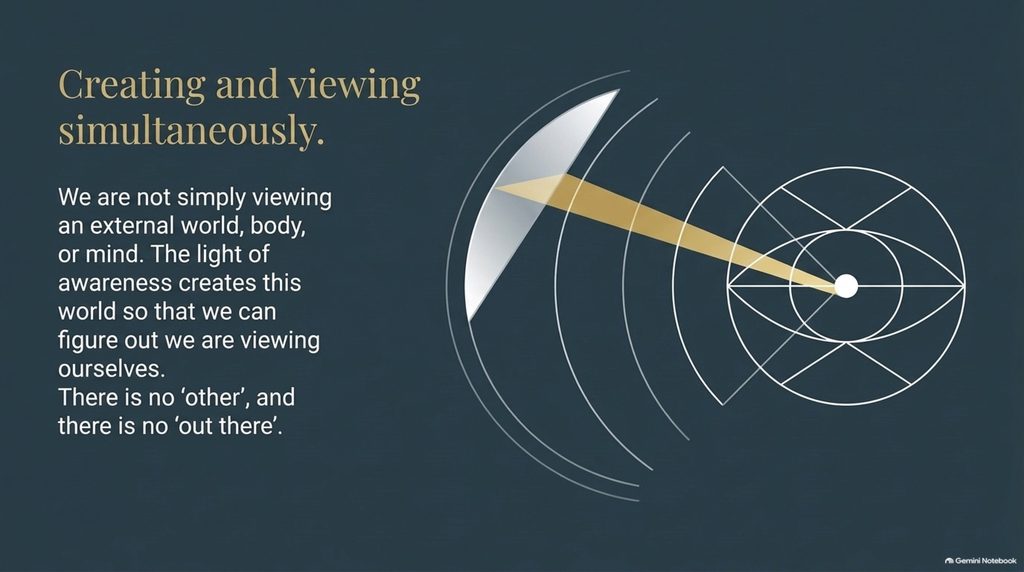
And it does so by shining directly onto our mind,
by opening our heart,
and by creating this world body-mind experience
for us to figure out that we are not simply
viewing the world.
We’re not simply viewing the body.
We’re not simply viewing the mind.
But we are viewing ourself,
creating and viewing simultaneously.
Because there is no other,
and there is no out there.
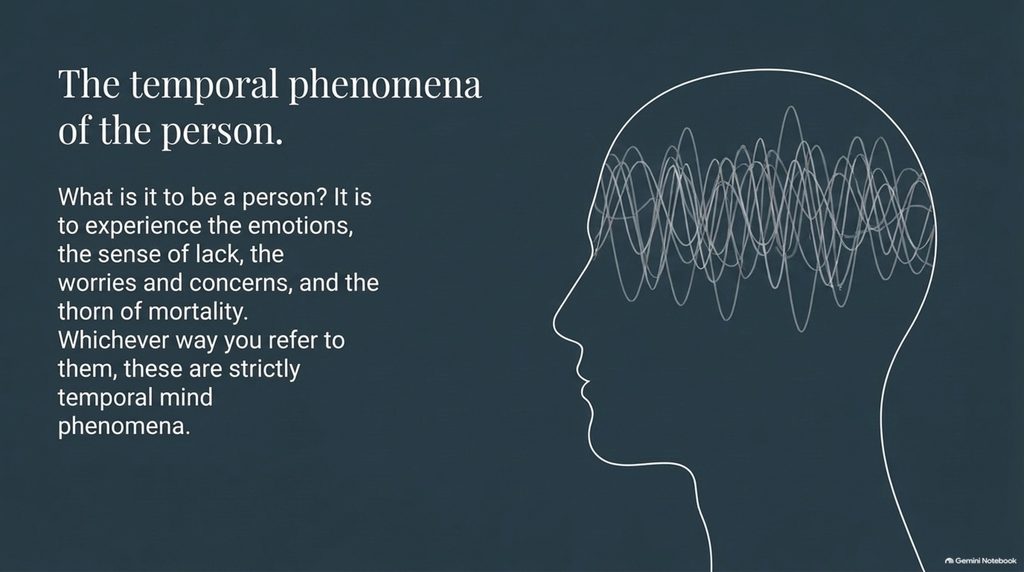
So, what is it to be a person?
To experience the emotions,
the sense of lack,
the worries and concerns,
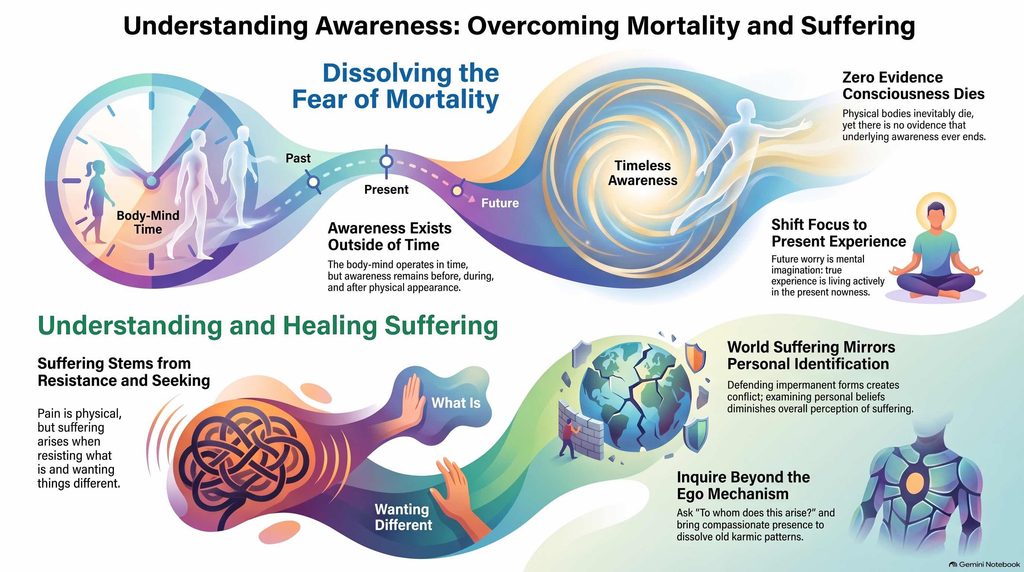
the thorn of mortality.
Because persons, whichever way you refer to them,
is a temporal mind phenomena.
How could a fragment celebrate the whole, the totality?
If there is a fragment,
there is something which is not a fragment
which experiences, perceives this fragment.
You are that which perceives the fragment.
A fragment is perceived and does not perceive.
A limited form appears.
It is known, but it is not knowing.
Happiness is not something you know.
It is that which you are.
But this happiness is failed by your belief
that you will get it through some activity—
maybe a spiritual activity or a worldly activity.
So in believing that you can attain this happiness
via a certain activity, you remain separate.
You remain fragmented.
And you continue to be under the illusory spell
that the fragment can become whole.
That is the illusion—
one could say the spiritual illusion.
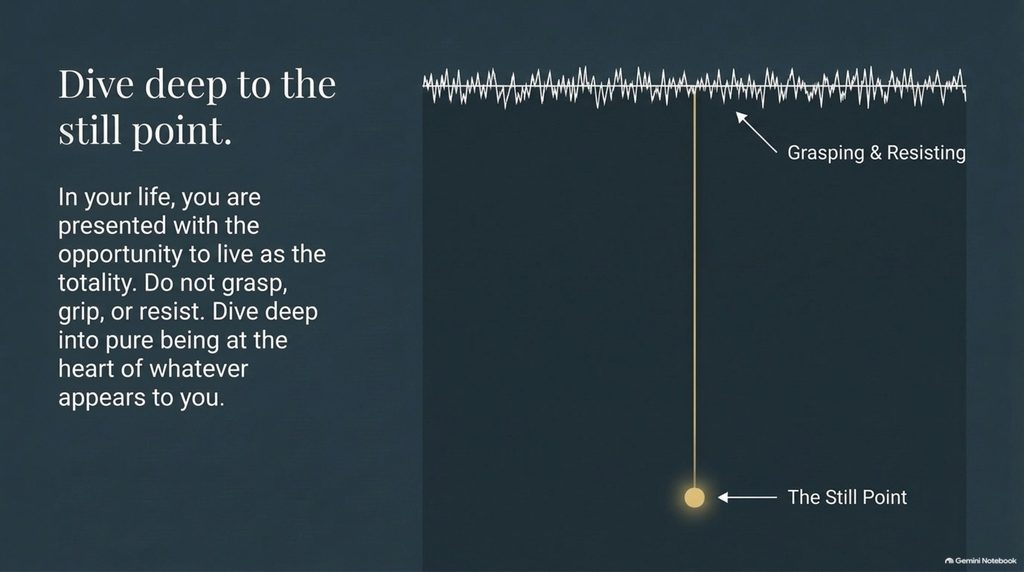
So in your life you are presented
with opportunity to live as the totality.
Not grasping, gripping, resisting.
Dive deep into pure being at the heart of whatever appears to you.
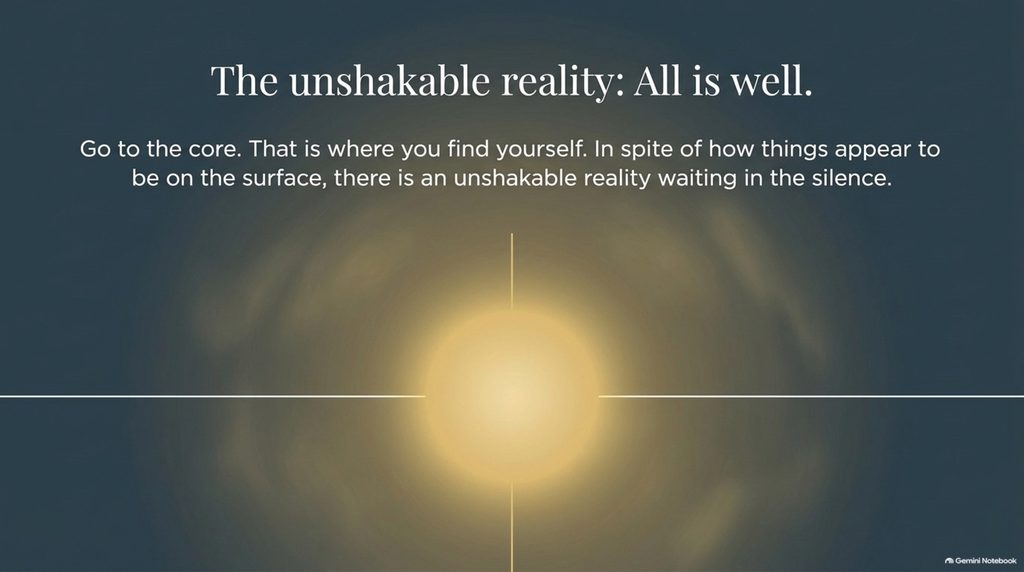
You go to the core, to the still point.
That’s where you find yourself.
That’s where you find that all is well.
In spite of how things appear to be,
this unshakable “all is well.”
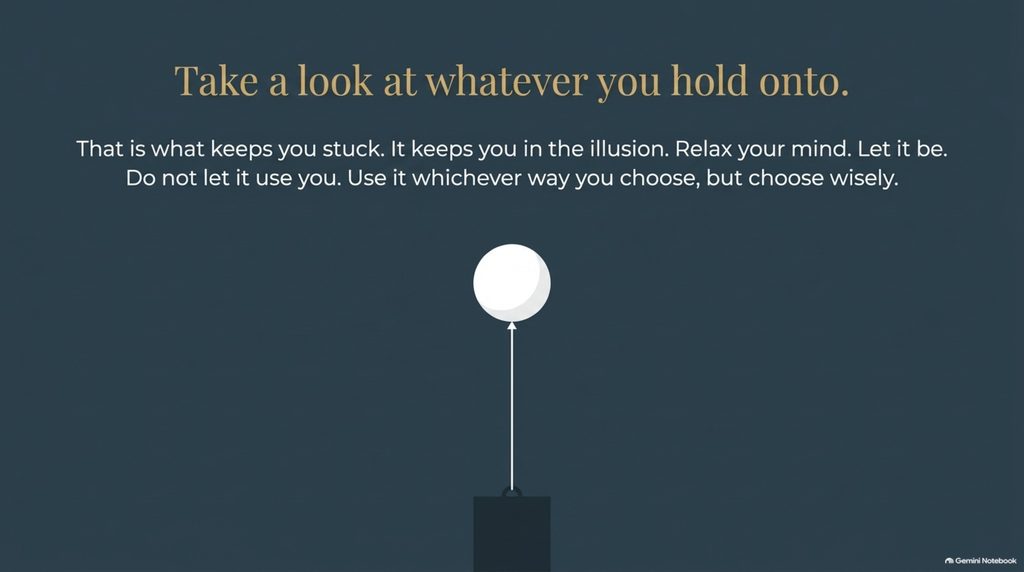
Take a look at whatever you hold on to.
That’s what keeps you stuck.
I don’t know what it is.
It’s holding on.
Keeps you in the illusion.
Relax your mind.
Let it be.
Don’t let it use you.
Use it whichever way you choose, but choose wisely.
Satsang
Transcript
Satsang
So you’re welcome to open your eyes.
Take whatever questions you may have,
Whatever comments you may have,
Whatever exploration you’re interested in.
Welcome to turn on your videos,
Because I always enjoy seeing you.
So, any questions?
Hi Magdi.
And in this moment,
I have no questions.
But I want to express my gratitude
For coming together
And being as one.
And also gratitude for the resonance I feel with your words
And the joy that comes from this.
Looking back on where I come from—
From confusion and pain—
The gratitude is even stronger
That it’s possible to come out of this.
All of my blessings to everybody.
Thank you.
Any questions?
Hello Maria.
Hi.
I’m also under the weather.
Oh, sorry to hear that.
Well, I so appreciate that you are holding the satsang
Even though you’re under the weather.
So this has been going on in my mind
About volition, free will, and intention.
Because so much is talked about.
You know, you go to a yoga class
And the teacher would say,
“Set an intention for this class
Or for this day.”
And it seems like that word is used a lot.
So the question comes up: what is that, and who is intending?
Yeah, I love the word intention.
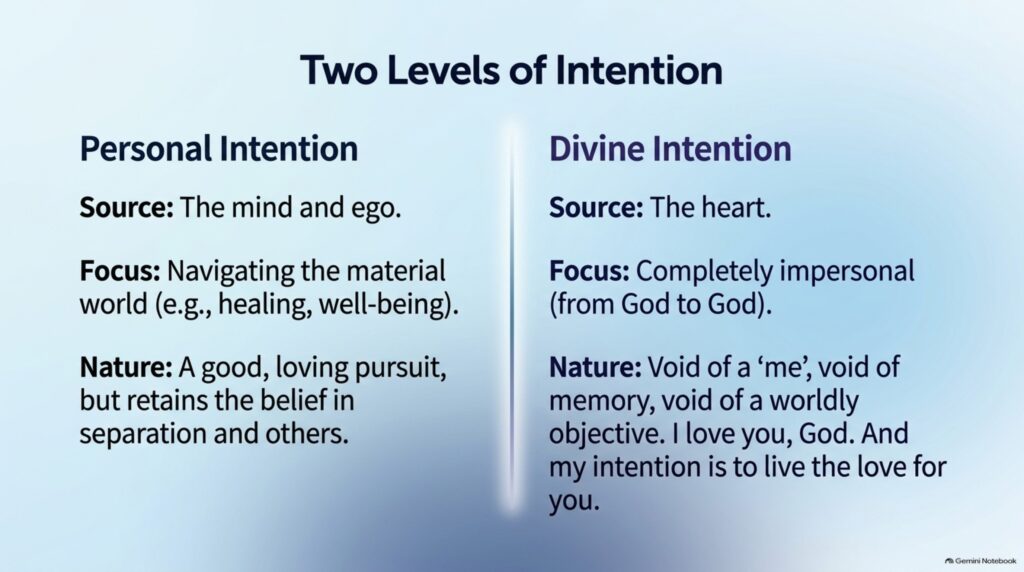
Pure intention is an intention that’s impersonal.
It comes to you from the divine.
It comes from your heart.
It does not come at all from your mind.
It does not have any personal aspect.
God’s intention is the true, true intention.
This intention has no personal objective.
And in its purest form,
It is the intention from God to God.
“I love you, God.
And my intention is to live the love for you.”
In this pure form of intention—that’s a high standard—
There is no world,
There are no others,
There is no you as a personal entity.
So this is a very high standard.
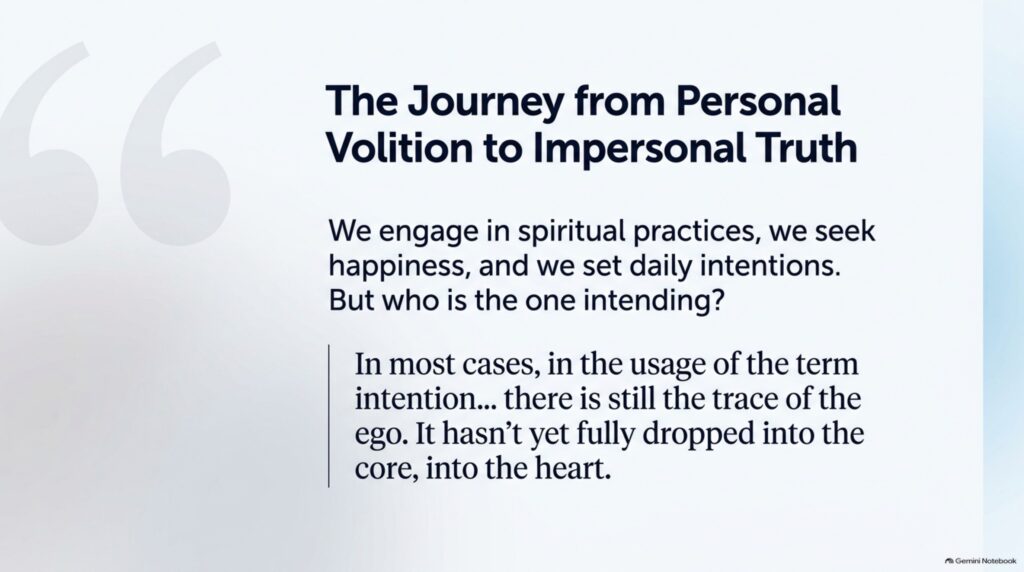
In most cases, in the usage of the term intention
In various traditions and practices,
There is still the trace of the ego.
There is still a belief in the material world,
In the material realm.
It hasn’t yet fully dropped into Brahman,
Into the core, into the heart.
So there is a personal intention—
A good, loving, personal intention.
And it’s okay. It’s a good thing.
But we need to go deeper.
And for some of us, the time to go deeper is now.
And for some of us,
We still feel the need to navigate personal intention—
A good personal intention for the world.
We’re not yet ready to let go of that
And embrace the only true intention.
So if your intention
Is completely void of a me,
Completely void of memory,
Completely void of a person intending,
Completely void of a world,
Completely void of others—
You’re getting hot.
In that sense, prayer circles for the well-being of the world,
Healing, chanting circles for Magdi getting better—
That’s all still containing the world and the other, correct?
Yes.
Because in truth, all is love.
It’s already a done deal.
You don’t need to direct the love.
There is no director or navigator.
It’s a done deal.
But you cannot accept that as a belief.
I never invite somebody to adopt a new belief.
No. Contemplate.
What am I truly? What is your reality?
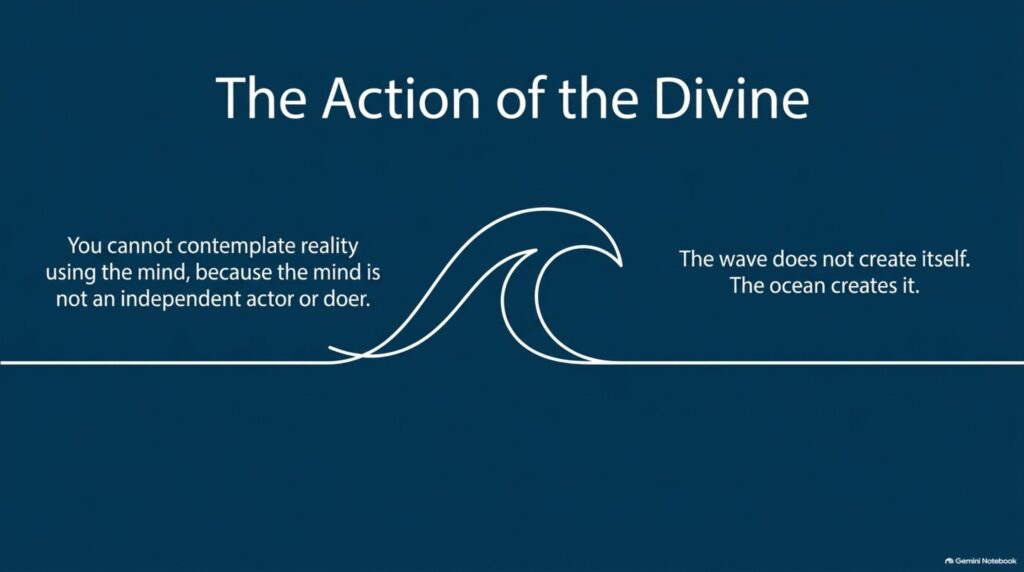
You cannot contemplate your reality
Based on the mind, memory, things you’ve heard.
Because the mind is not a doer, an actor.
It is an action of the divine.
In other words, the wave does not create itself.
The ocean creates it.
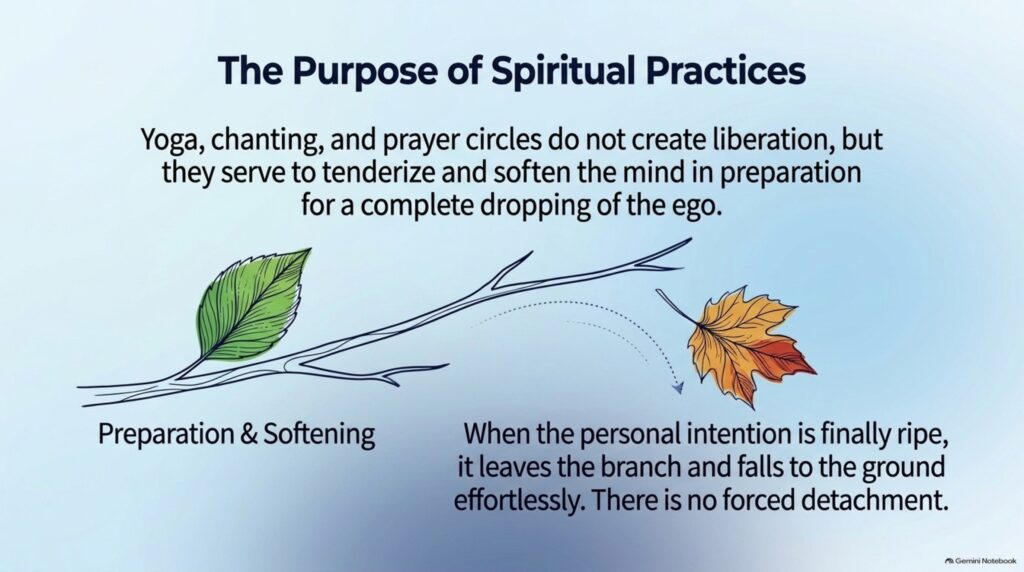
So at the core of prayer, prayer circles, and chanting,
There is still the sense of separation.
And in many traditions, it is spoken that these activities are a form of yoga.
They serve to prepare you for the big death.
They serve to prepare you for the complete dropping.
So I’m answering your question:
Is it the real deal? No, it’s not.
Can it be helpful and useful? Only you know.
Only you can tell if you are drawn to that path,
To these activities, to these traditions.
You are drawn to them.
But when you come to me and ask me,
You will get my answer.
And you do whatever you wish with it.
Sooner or later, whenever that is—only you know.
All of that is left behind,
Like a leaf leaves the branch in the fall.
There is no personal intention.
It’s ripe. It’s time for it to fall.
And it leaves the branch and falls to the ground.
It is said that certain mind activities,
For certain minds that are not ready for the final slaying,
Certain minds can be softened or tenderized via such practices.
You know that I don’t recommend any practice for anybody.
I just speak always about a variety of options.
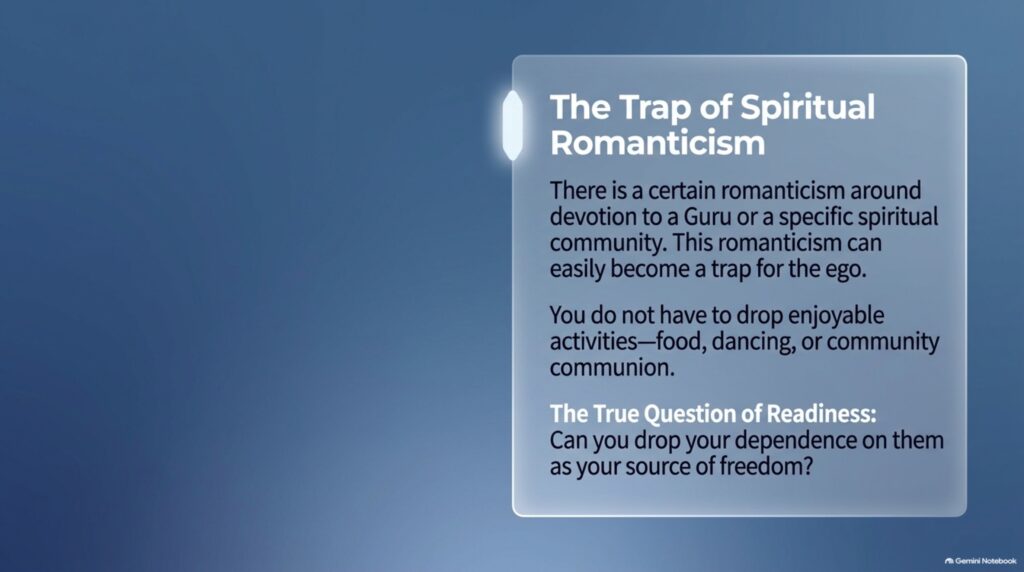
There is a certain romanticism around certain traditions,
And romanticism can be a trap for the ego.
Same with the devotion to the Guru—
There is a certain romanticism around the devotion to the Guru.
At some point, that also has to be transcended.
And because you come regularly to these meetings,
That means there is some readiness within you.
What remains is for you to own this.
But it’s fun, you know.
Sometimes we like to play.
Well, see, that’s the thing.
I mean, we are still in this body and this form,
And we enjoy certain activities.
So, you know, chanting is so joyful and beautiful community.
And then when we bring you in—
The question is: can you drop it? Not drop it.
Don’t drop it. But can you drop it?
Yes, of course. Of course.
But then, can I drop the delicious food I enjoy every day?
Can I drop dancing?
Can I drop, you know, it’s along those lines.
It just, you know—if I don’t see it as a religious practice,
It’s more as an enjoyable activity in communion with others.
Well, that was not your question.
I have no issue whatsoever with these activities
Being enjoyable, being sociable, being playful, being creative.
But that was not your question.
At least I thought your question was about the path.
Of course, enjoyment.
I enjoy food, music. Yes.
So, joy. Who can argue with joy?
If it’s swimming, hiking, chanting, yoga—
I’m talking about the traditional, the current yoga forms. Sure.
And going back to intention, Magdi:
Sometimes I question this thing that arose in me,
This kind of desire or a reaching forward for something.
Like the mind comes up and says,
“Is that a personal intention or is that God’s will?”
So if that thought arises,
Would it almost automatically say it’s most likely personal?
Well, you can take a look, you see.
Because everything that’s happening for you is happening internally.
If there is a certain aspect within yourself
Which is wanting something and can’t let it go
Or really needs it—
There’s a difference you can notice within yourself.
Maybe you need to develop that skill of discrimination,
Inner Viveka—of something which you are doing and enjoy doing
And it comes from a joyful intention.
Because in joy there is freedom.
There is no attachment in joy.
It’s just a childlike joyfulness.
So you can take a look and see whether, behind the scene,
There is a certain need or a certain sense of self,
A certain image that’s really important for you.
All that is available to you.
It’s important to have that inner way of looking
And bring the attention to the source of the intention.
You see?
And you do that with sincerity,
So you don’t fool yourself,
Because you’re not interested in fooling yourself.
You want to be honest.
And in terms of if you find yourself in a situation
Where you are really enjoying this sort of work
And somehow leading these sorts of activities—
You can also bring on board a certain contemplation
That invites a certain looking at the mind,
The images that it generates and nurtures.
Yeah, sure.
So we can just get deeper.
Bring intention, bring attention to the intention
With no tension.
Yeah, to the source of the intention.
The source of the intention has to be without tension, yes.
Right. An intention without tension. Yes, that’s a good one.
Good to see you, Maria.
Any questions?
Hi, Magdi, this is John.
Hi, John.
Yeah, I guess the question is—
Oh, your video is off, John.
Yeah, I have to have it off.
Okay, good.
Yeah, but thank you.
I think when you guys were discussing that,
I was just thinking that it reminded me of something someone else said,
And you may have said it as well.
But nonetheless, I was thinking of when somebody said something about happiness.
And they were talking about what they would say is true happiness, or pure happiness,
And rather than a temporary happiness.
And even though there’s nothing wrong with a temporary happiness,
It isn’t the so-called true happiness.
It’s happiness that I receive and then it goes.
So it doesn’t remain and reality remains.
So the only true happiness is God—
Let’s put it that way. Or the divine, or whatever.
So I was thinking it was interesting because I can understand that.
It doesn’t deny me happiness or other things in life.
But my intention, a lot of times, attention or intention,
Is more on that and getting something.
I don’t know, whatever it is—feeling love.
There’s nothing wrong with that.
And feeling like Maria said, community and all that.
I don’t see that as a problem.
That’s a part of the workings of what’s happening in the now.
But I was thinking it’s interesting.
I just wanted to say this and maybe have something to say about it.
I mean, I’ve watched it myself, and so
I have moments of peace that I didn’t work for,
Moments of serenity that I didn’t work for.
I call it the reality.
And so, and it doesn’t—
I’m more of that than the person, let’s say.
But I have to say that there’s a person that wants to repeat it, grab it.
You know, I hear them always talking about that in non-duality.
I hear that a lot of times with teachers and stuff.
But that’s there, and that’s okay.
It’s part of my path, I guess.
And I mean, it’s there, so it is.
But it’s just interesting that the mind, my mind can say,
“Okay, I like this, it’s this, it’s that. I like that.”
But I can’t even bring myself to chant for myself, cheer for myself, you know?
And that’s, I think, maybe that’s the personal thing.
I’m always dependent on others and this world, and yeah.
I’ll leave it there and let you go with that.
Thank you, Magdi.
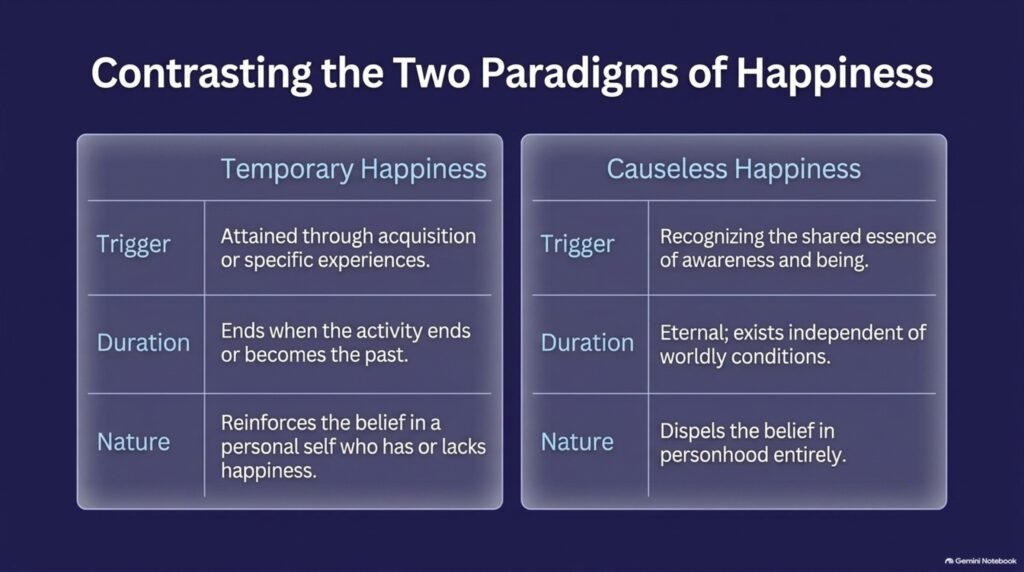
One thing you need to understand about happiness—
Temporary versus non-temporary happiness.
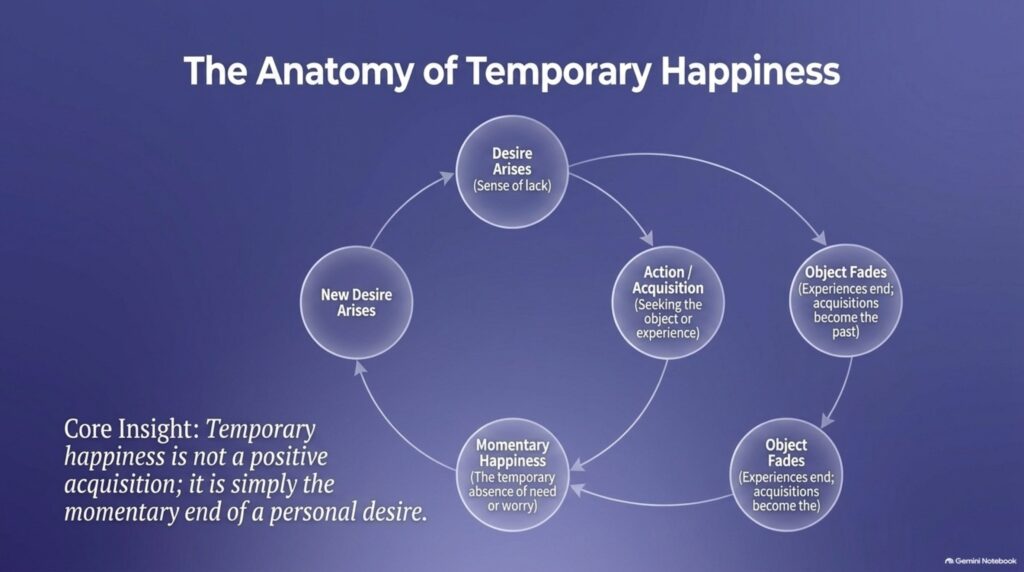
That happiness is, in a way, the end of desire, of personal desire.
The moment when your personal desire is fulfilled,
There is a moment of happiness,
Which is the absence of the sense of lack,
The absence of need, the absence of worry.
Unfortunately, our quest for happiness is based or affected
By the belief that happiness is attainable
Through certain activity, through certain acquisition,
Or through a certain experience.
And whatever activities we do, they come to an end.
Whatever acquisitions we attain, they come to an end.
Whatever experiences we attain, they become part of our past.
So happiness which is influenced by the belief
That it is attainable via certain activity,
Certain experiences, or certain acquisition
We can call it temporary happiness.
Because at the moment that you acquire that which you desire,
You are happy.
But your desire is not dead.
It just replaces the object of acquisition with another object.
So in terms of temporary and non-temporary happiness,
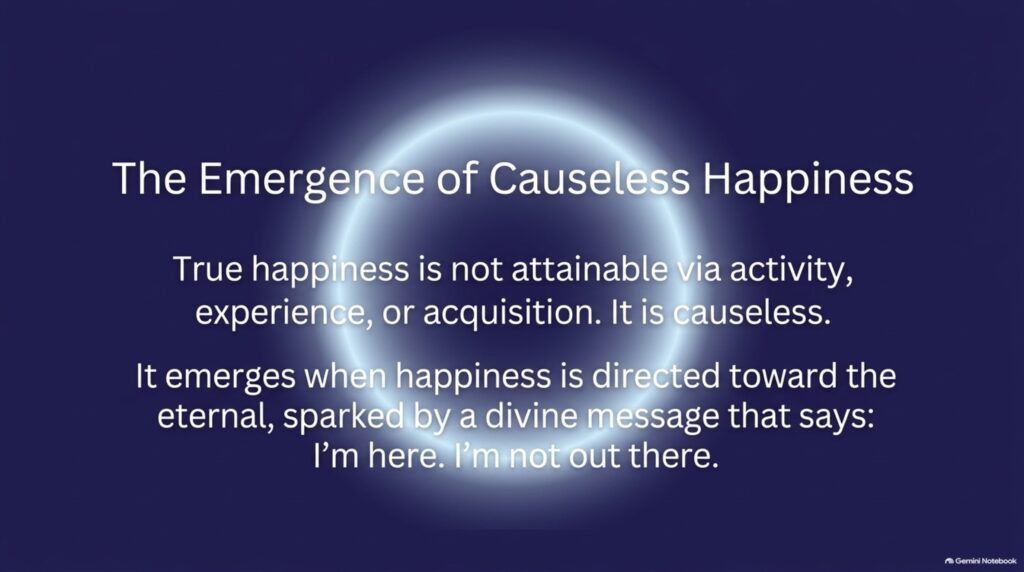
We use the term causeless happiness.
In a way, one could say it is a happiness that is directed towards God.
And you cannot direct your happiness towards God out of the mind.
You direct your happiness towards God
Because there is a message that comes to you—
A divine message that says,
“I’m here. I’m not out there. I’m here.”
And so when the objective of your happiness is God,
Is the eternal, and not something which is temporary,
Then you are in the right direction.
Of course, there’s a whole path to it.
What is the path of divine happiness?
And in a way, this is what these meetings are about—
About exploring the path of divine happiness,
Or causeless happiness.
And this path requires a certain preparation,
Which eventually leads you to Atma Vichara—
It leads you to the direct inquiry,
To the understanding, the path of understanding,
Which dispels the belief in personhood or personal self.
Now, in terms of “I need people, or I need help, or I need”—
If I heard you correctly—
We are tribal in terms of the body-mind.
The human tribe is a social tribe
And exists in interaction, in relationship,
In interdependence in various degrees.
But in our inquiry and investigation about causeless happiness,
We are not focusing on the human tribe.
We are focusing on reality, on truth, on the essence,
On that which is and cannot not be—
That which, above all, we share across the board:
Awareness, presence, being.
We don’t share it as different awarenesses or different consciousnesses.
No.
We share it as the same essence, the same beingness, the same consciousness.
So to be acknowledging our social needs is perfect.
It’s a true acknowledgement.
But not to be confused with the complete freedom of our essence,
The complete freedom of our being.
Yeah, yeah, thank you.
What I meant by it was probably the word dependence.
The dependence is something that I grew up with—
People call it conditioning—
From growing up and being told this and that and all that kind of stuff.
But dependent meaning that I don’t have that sense of freedom
And divine happiness and calmness and serenity on my own.
Of course, you cannot have it as a person.
The sense of serenity and the peace that we are speaking about
Is not something that you can have on your own or not on your own.
It is that which is, which we are, which you are.
Go ahead.
If you’re still referring to yourself as John,
You’re doing a wrong reference.
It’s not an appropriate reference.
It’s appropriate for you to refer to yourself as John
When somebody asks you, a policeman arrests you
And asks you for your name. You say, “Okay, my name is John.”
But in the context of our exploration,
Referring to yourself still as John is a wrong reference.
This is what I’m trying to say.
And I’m just really trying to admit it and put it out there,
Because it helps me to put it out there—
That it still goes on.
And that’s why I said it’s obviously not a terrible thing,
Because it’s not about John doing it or getting it
Or not doing it or getting this and all that.
It’s about the understanding.
And what I was saying is the so-called miraculous thing—or whatever—
Is simply that this serenity, peace, and joy
Is not attainable by John fighting for it and getting it.
Right.
Yeah.
Or finding the supremacy and non-duality, you know, or whatever it is.
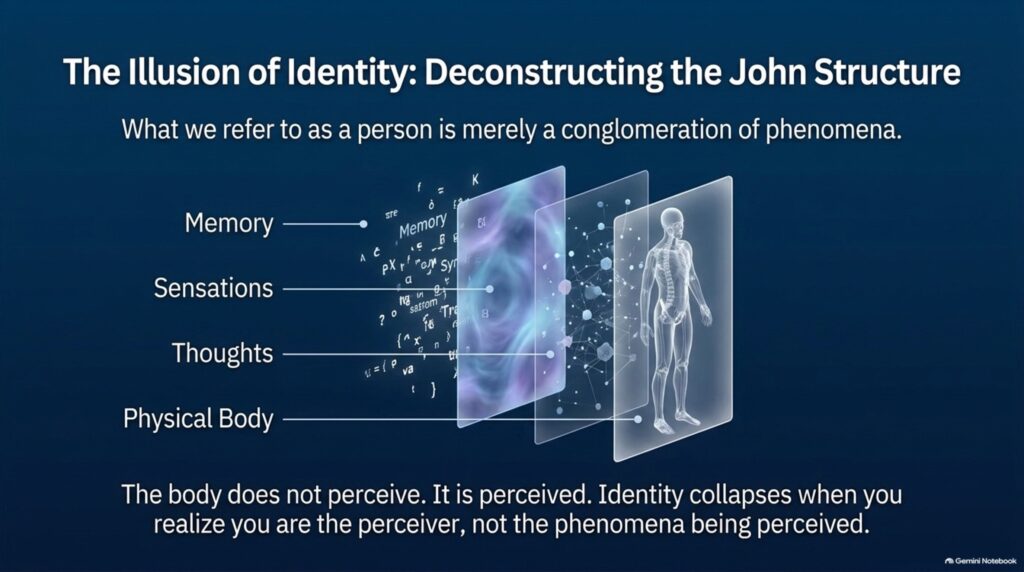
It’s more about the collapse of the John structure.
Yes, yes.
Not like where you become like a sort of a moron or something like that.
No. It’s still the functioning of the body-mind John,
But the identity—the collapse of the identity.
Yes, yes.
And I’m relating that to what you’re saying.
And again, like Maria was saying—
Because I was very interested in what she was saying
Because, you know, because of what I’ve heard too,
About, you know, having the so-called temporary happiness.
But I think it was, what’s his name, Rupert, probably at one point said—
Oh, I don’t know—
But he basically was saying that too.
It’s a taste. It’s a taste of the divine, okay, or something.
You know, maybe a glimpse.
So that’s what I’m saying.
I do get the glimpses, but I’m still on the personal side.
And I think that’s what you’re saying.
When in the beginning I saw the meeting on my phone,
It said, “Happiness is not personal.”
That’s it.
And I think that’s what you mean by “Can you drop it? Can you drop it?”
It isn’t about hurting myself. It isn’t about, you know—
The dropping is not something that you do.
It is something that happens.
It happens via your understanding.
There is an understanding that
I perceive John as memory.
I perceive John as sensations.
I perceive thoughts.
I perceive in the mirror,
Or by looking at the body, I perceive a body named John.
But I, that which perceives John, is not John.
That which perceives is not John.
The body does not perceive. The body is perceived.
The body form, phenomena, does not perceive. It is perceived.
Molecules and atoms and conglomerations of various molecules
Do not perceive. They are perceived.
So that understanding—
That in this moment, in this moment, you are this perceiving awareness.
And this perceiving awareness
Does not depend on the body, or others, or sunshine, or gravity.
There is this belief that this awareness is a result of the world,
Or a result of the body.
It arises out of the body or it comes into the body,
And when the body dies, it dies or transmigrates.
There’s all sorts of beliefs about awareness, about consciousness.
But experientially, awareness just is.
Yes, yes.
Yeah, it’s so interesting.
Because I say I’ve—but that I’ll say—that has grown.
I don’t know how to say it in words.
But that has grown.
But I’m just saying there’s still a, a part, or something.
And that’s why I say I have to let it go.
I have to—I don’t like, “Oh, I gotta get this, I gotta get that.”
Yeah, right.
I mean, we there is the understanding and there is a forgetfulness.
So we, for a while, are forgetting, recollecting, forgetting, and recollecting.
And so it’s like the metaphor of when you want to have a white sheet
And you want to turn it into blue.
You soak it in the dye many times.
You don’t just soak it in the blue dye once.
So there is a process of soaking the white sheet in the blue dye
Until at some point the color of the sheet and the color of the dye are the same.
There’s no longer a need to soak it.
It’ll be like a waste.
Yeah, so there is that process. It’s okay.
What matters is that our intention to dye the white sheet into blue—
As a metaphor—
That’s a steady intention,
Like Maria was talking about the intention.
There is that divine intention, which is love of truth,
Love of God.
Everything else, the ups and downs of forgetting and recollecting—
It irons itself out over time.
You know, Magdi, I remember you saying in a meeting one time—
I say a meeting all the time, but in a satsang or whatever—
But I remember you saying that more than once,
About “that’s why we come to the meetings,”
Or something to remind ourselves, or to see ourselves again, or whatever it is.
It’s all language, but I understand what it means.
Yes, we don’t realize.
We come and we’re still thinking,
“When will I become free?”
We don’t realize that we’re turning blue.
We don’t even realize it.
We’re still recollecting the white, you know?
There’s this sort of below-the-radar transformation that’s happening.
And at some point it becomes clear to you.
“Okay, I’ll stop holding my breath to turn blue.”
Well, that’s more like purple.
Okay, thank you, man. I appreciate it.
Good to see you, John.
Good to see you.
Any questions?
Well, many of you still have your videos off.
Lovely to be with you.
Lovely to be.
Recollect being.
Revisit being.
Drop into being.
Thank you.
AI Summary
Presence and Causeless Happiness
Key Points
- True experience is present awareness
- Love has no separate other
- Personal intention retains ego
- Happiness ends with desire
Overview …
| Concept | Detail |
|---|---|
| Present awareness | Direct experience is being now |
| Love | No separate lover or other |
| Personhood | Temporal fragment, not knower |
| Temporary happiness | Follows fulfilled desire briefly |
| Causeless happiness | Oriented to God or truth |
| Pure intention | Impersonal, from the heart |
| Prayer and chanting | Useful, but still dualistic |
| Transformation | Recollection deepens over time |
[[2026-10-25]] This session explores nondual inquiry through presence, love, intention, and happiness, then applies it to questions about spiritual practice and identity.
Present awareness
The opening centers on direct experience now, not on personal history or mental time. Presence stands outside past and future, and understanding has to arise from immediate experience rather than belief.
| Horizontal | mind in time |
|---|---|
| Vertical | love |
| Direct experience | being presence awareness |
| The search for peace does not complete itself in the future. It completes now through the recognition of being. |
- True experience is always present.
- Seeking the self elsewhere misses it.
- Finding the self requires stopping the movement of seeking.
- Suspending the belief “I am somebody” leaves pure formless awareness.
The reality available now is “I am, and I know that I am.”
Love
This section frames love as the living truth of being rather than a relationship between separate people. The meeting point of life and fulfillment is love, not mental narrative.
Life without love is not fulfilling. Love is not something a separate self gives to another separate self.
- Love happens as being itself.
- In loving, the lover is the love.
- Separation between self and other does not hold at that level.
The world, body, and mind appear as expressions or reflections of the light of awareness rather than as independent realities.
Personhood
The inquiry turns toward what a person is and why identification with personhood creates suffering. The person is described as a temporal appearance known by awareness, not the knower itself.
A person includes emotional experience, lack, worry, concern, and mortality. Those features belong to a fragment, and the fragment is perceived.
- What perceives the fragment is not itself fragmented.
- The limited form is known, but it is not the knowing.
- Believing a fragment can become whole creates the spiritual illusion.
Core shift: Awareness perceives the person; awareness is not the person.
Holding on keeps the illusion in place. Relaxing the mind and using it wisely opens the way back to the still point where “all is well.”
Happiness
The teaching on happiness distinguishes passing relief from causeless happiness. Temporary happiness comes when desire is briefly satisfied, while true happiness is not produced by acquisition, activity, or experience.
- Fulfilled desire brings a moment without lack or worry.
- Temporary happiness fades because desire survives and takes a new object.
- Causeless happiness is directed toward God, not toward a temporary object.
The path of divine happiness is described as a path of understanding and direct inquiry that dissolves belief in personhood.
Social needs
Human life can still include social interdependence. That truth does not define the deeper inquiry.
- The body-mind is social and tribal.
- Inquiry focuses on reality shared as the same awareness, presence, and being.
- Social need should not be confused with the freedom of essence.
Intention
A question about volition, free will, and intention leads to a distinction between personal intention and pure intention. Pure intention comes from the heart and carries no personal objective.
- Pure intention is impersonal and divine.
- Personal intention can still be good and loving.
- It still retains some trace of ego or world-reference.
- Going deeper means tracing intention back to its source.
When intention is free of memory, self-image, world, and others, it approaches the true intention. Inner discrimination helps reveal whether a movement arises from joyful freedom or from need and self-concern.
Practice
Questions about prayer circles, chanting, and similar activities bring out a practical distinction. These activities may be joyful or helpful, but they are not presented as the final truth when they retain separation.
- Prayer, chanting, and healing for others still contain a sense of world and other.
- Such practices can prepare or soften the mind for deeper surrender.
- Romanticism around tradition or guru devotion can trap the ego.
Enjoyable activities like food, music, swimming, hiking, yoga, or chanting are not rejected as simple enjoyments. The issue is only whether they are being treated as the path to wholeness.
Understanding
The closing exchange explains why glimpses of peace do not immediately end identification. The process includes cycles of forgetting and recollecting until understanding stabilizes.
- Peace and serenity are not attained by the person.
- “John” works as a practical name, but not as the truth of identity in inquiry.
- The body is perceived; what perceives is not the body.
The metaphor of a white sheet soaking in blue dye describes gradual transformation. Repeated recollection of being changes identity below the level of conscious tracking until the shift becomes obvious.