
Meditation
Transcript
Meditation
Welcome, everyone.
Lovely to be with you. Just to let you know that this meeting starts with a guided meditation, and then whatever questions you may have.
For the duration of this meeting, you can invite yourself to let go of the past. Simply be comfortable, sit comfortably, and let things be as they are.
Whatever thoughts appear to you, let them be. Give them all the space that they need. They don’t concern you.
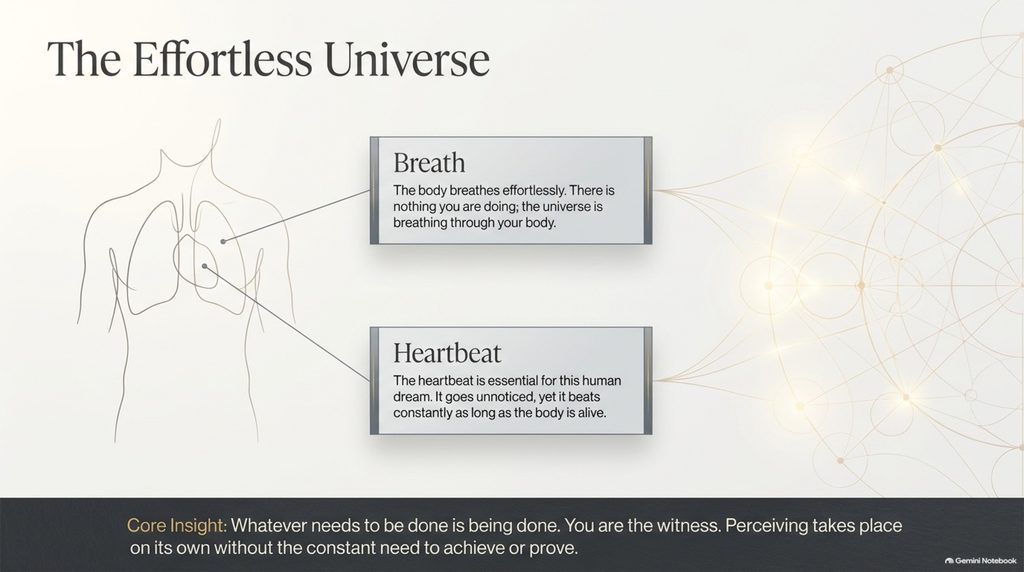
Notice the gentle breath of the body, which is happening effortlessly. There is nothing that you are doing. The universe is breathing through your body.
There is nothing that you need to do for the duration of this meeting. Whatever needs to be done is being done. You are the witness, meaning you perceive, and this perceiving is taking place of its own.
You can turn your attention and notice the heartbeat. It’s always beating as long as this body is alive. It goes unnoticed, and yet it’s there, like the sunshine shining onto the earth. It also goes unnoticed, and yet it’s there, essential for this human dream, for this human experience.
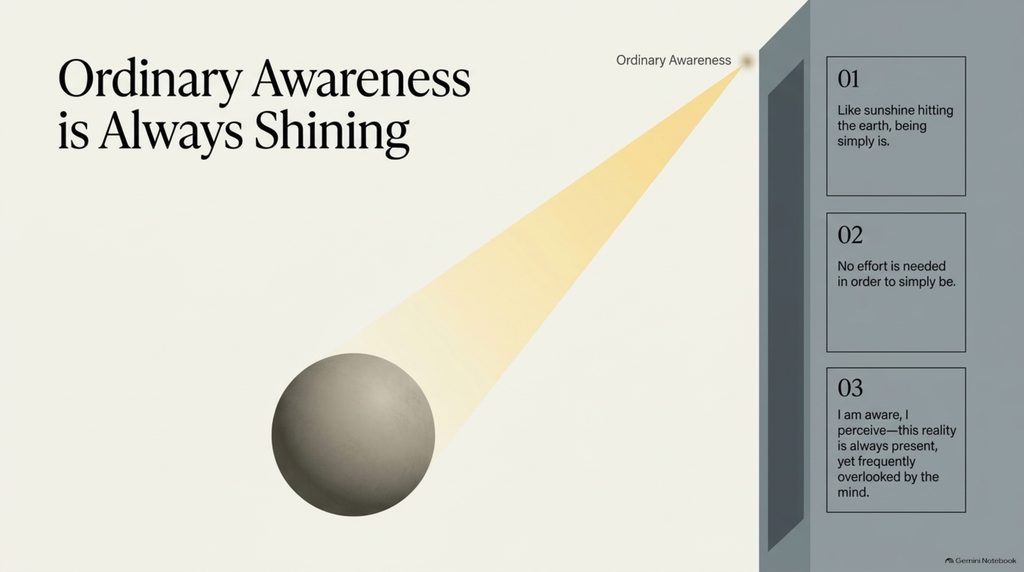
It is so lovely to simply be without this constant need to do something, achieve something, prove something. And like the sunshine, being is. There is no effort needed, nothing that you need to do in order to simply be.
Being means this ordinary awareness. This awareness is right there, always shining. I am aware, I perceive. It’s always there, shining and overlooked by the mind.
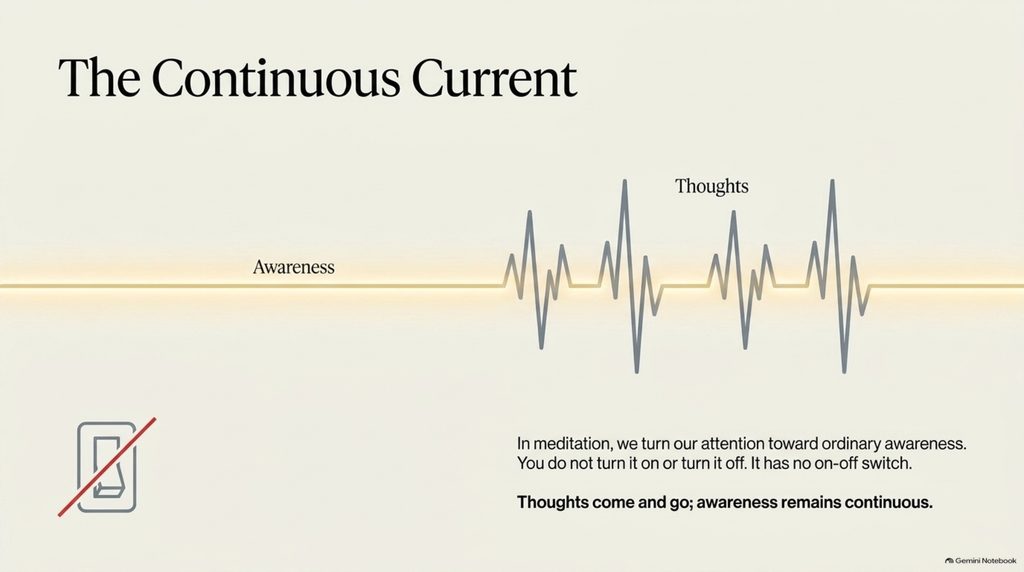
So in meditation we turn our attention towards this ordinary awareness, which you don’t turn on or turn off. It has no on-off switch.
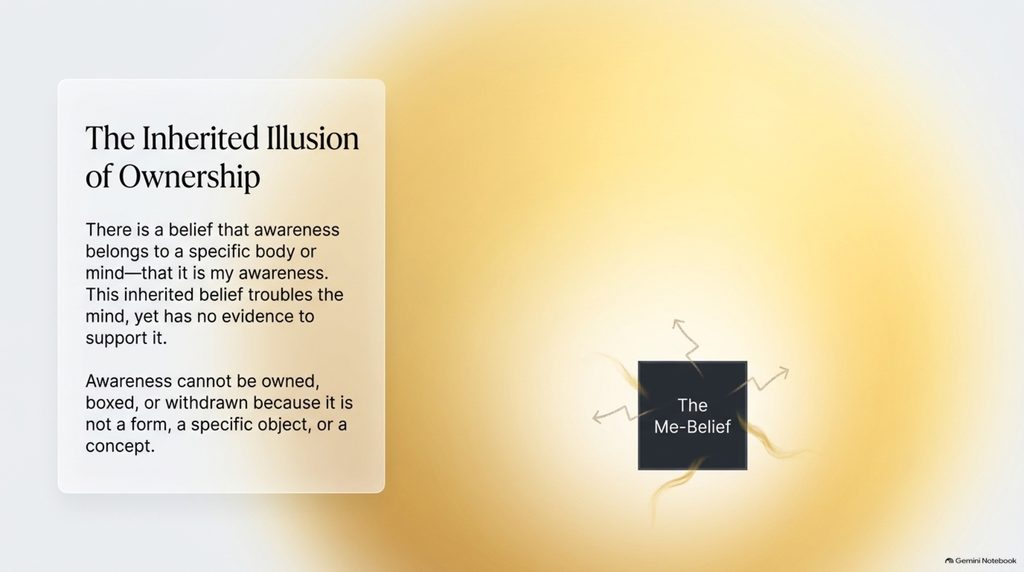
There is this belief that this awareness belongs to somebody, belongs to me. It’s my awareness. It belongs to this body, to this mind. This belief troubles the mind. The belief that there is a personal owner of awareness has no evidence to support it. It’s an inherited belief.
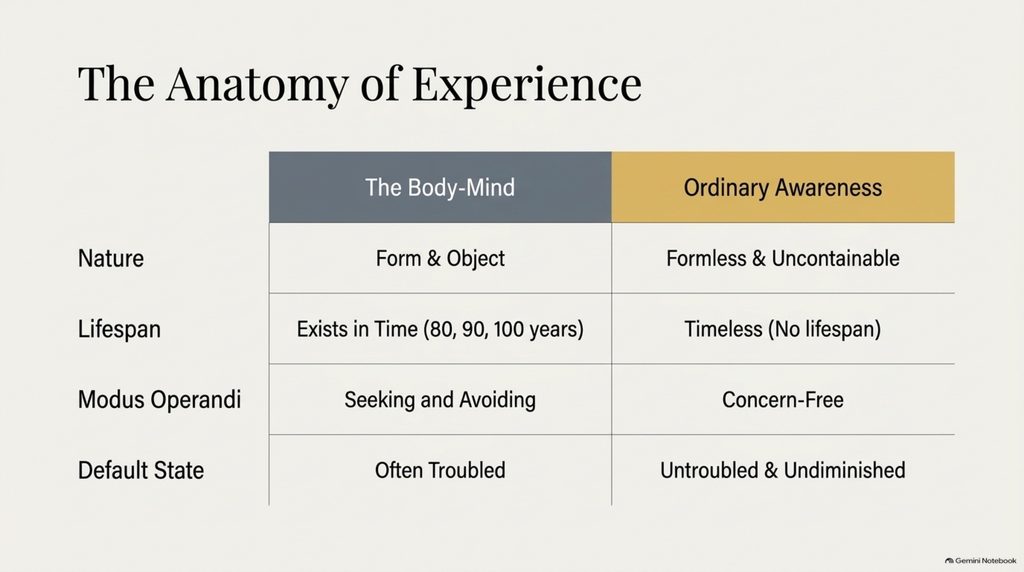
When you look at awareness, which is this reality that perceives right now, you don’t need to go far. You should look at awareness directly. You don’t find an owner. You may find a thought that says, “Oh yes, I am the owner. This awareness belongs to me.” But in fact, awareness is not something that can be owned or boxed or withdrawn. Because awareness is not a form. It’s not a specific object. It’s not a concept.
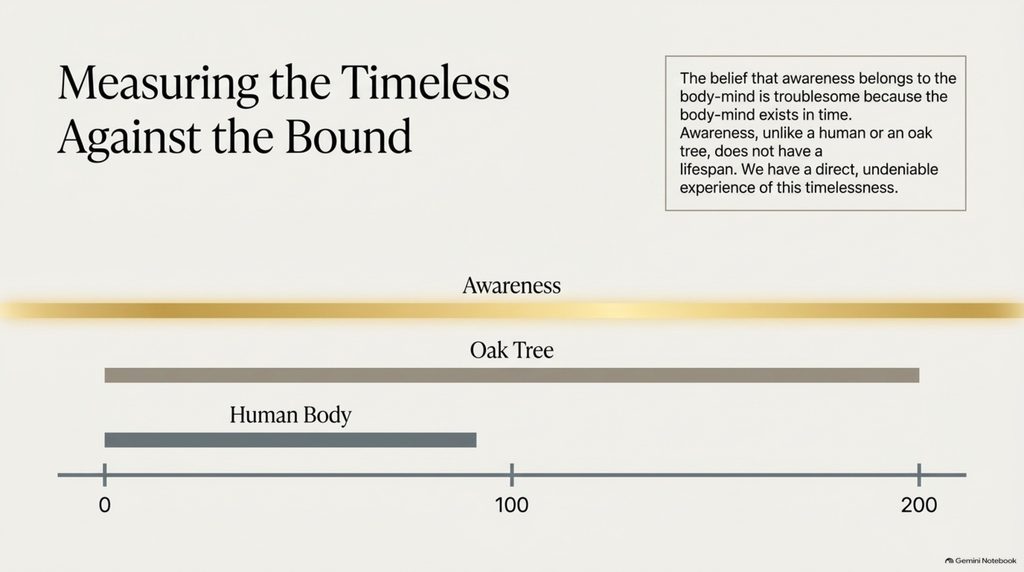
We have a direct experience of awareness. It’s undeniable. Awareness is not in time like an oak tree that has a lifespan of 100 years or 200 years. Awareness does not have a lifespan. But the belief that awareness belongs to me, to this body-mind, is a troublesome belief because this body-mind exists in time: 80 years, 90 years, 100 years.
So you can let things be as they are. Awareness being aware of itself. No worry, no concern. Seeking nothing, avoiding nothing. Awareness is concern-free, and you are this awareness.
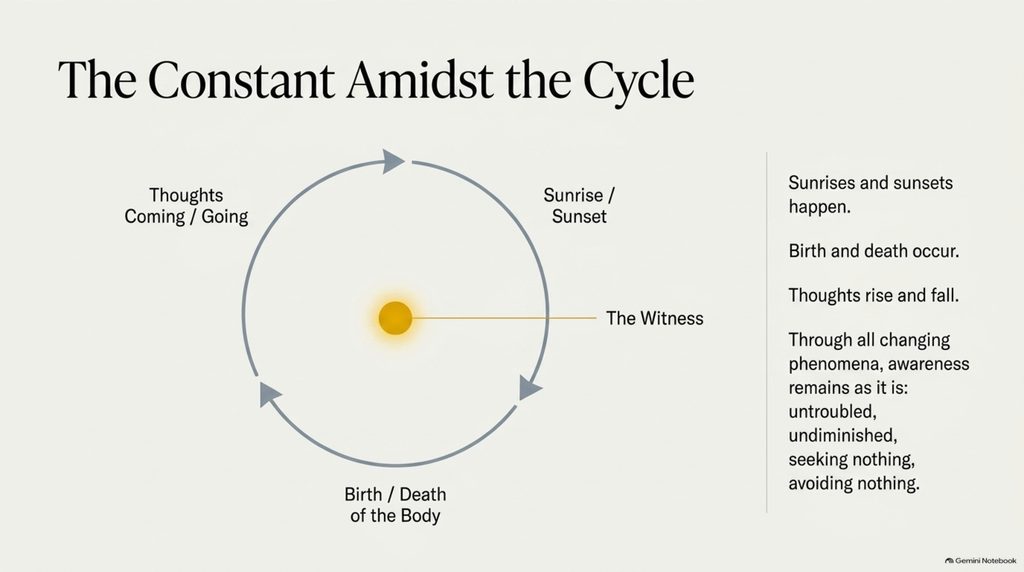
Thoughts come and go, awareness remains. Sun rise, sun set, awareness remains as it is. Birth and death of the body, awareness remains as it is. Untroubled. Undiminished.
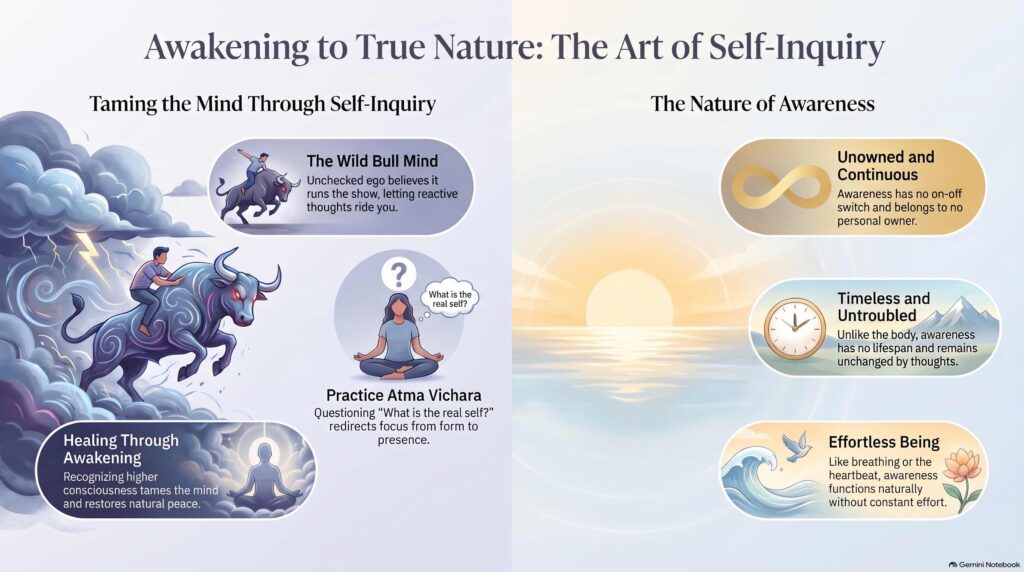
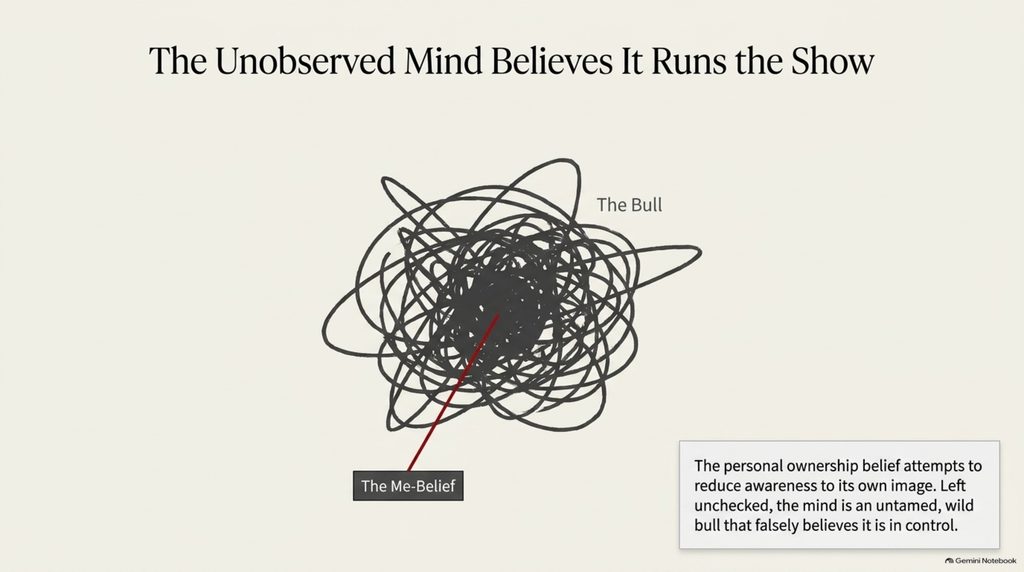
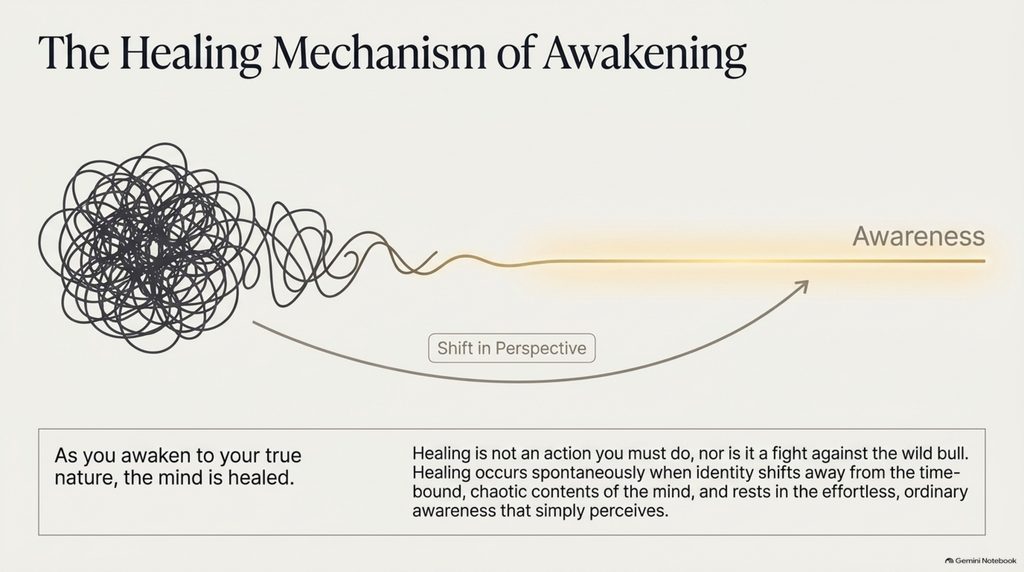
This me belief, personal ownership, attempts to reduce awareness to its own image. The mind is like a wild bull, an untamed bull. It believes it runs the show.
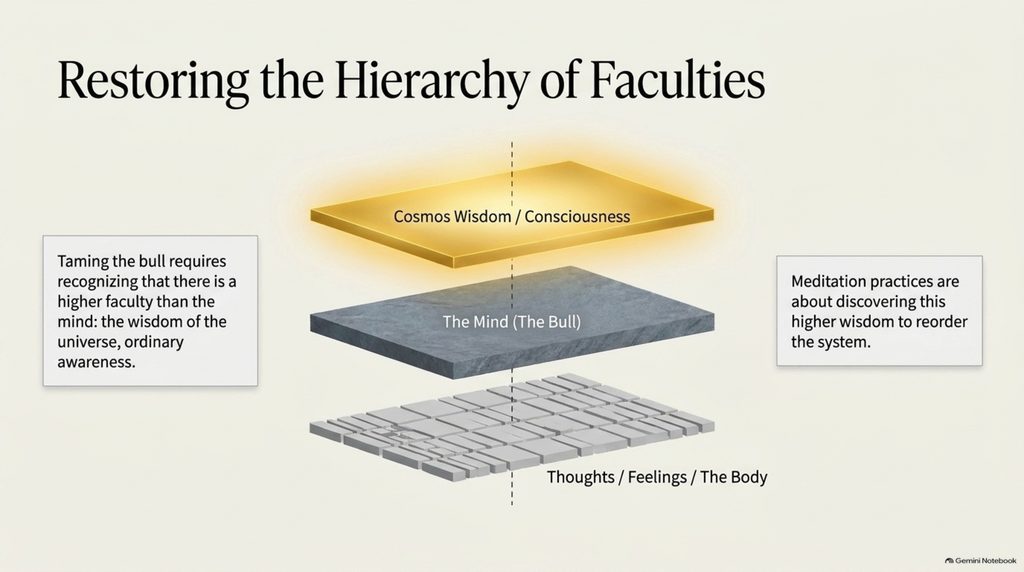
So in the various meditation practices we explore the mind. We tame the bull by recognizing that there is a higher faculty than the mind: consciousness, awareness, the wisdom of the universe, of the cosmos.
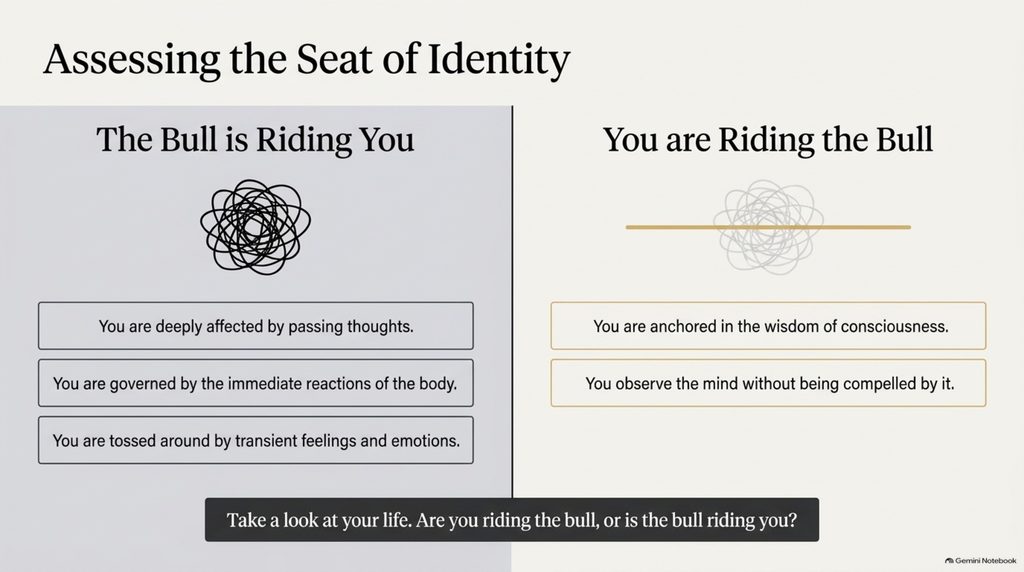
And your meditation practices are about discovering this wisdom. Or else the bull is riding you instead of you riding the bull.
Take a look at your life. How affected you are by thought, how affected you are by the body, how affected you are by feelings and emotions. Take a look. Are you riding the bull, or is the bull riding you?
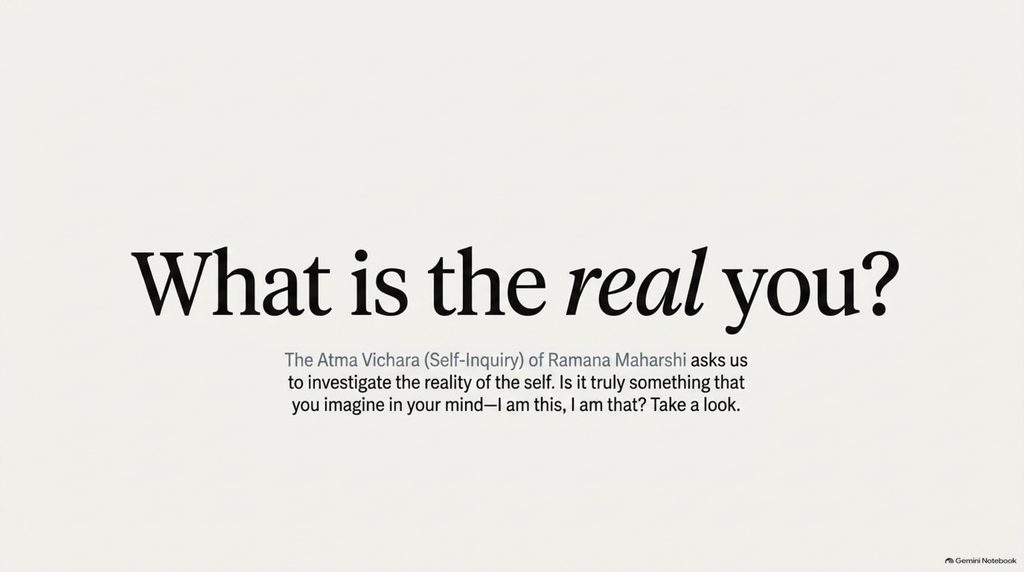
What is this you? What is you, the real you?
This self-inquiry that Ramana Maharshi spoke of, Atma Vishara: what is the reality of the self? Is it something that you imagine in your mind—I am this, I am that? Take a look.
As you awaken to your true nature, the mind is healed.
What is it that is real in your experience?
Satsang
Transcript
Satsang
So, if you can gently return to this group here, open your eyes and you’re welcome to turn on your videos, because I always enjoy seeing you.
You can take the rest of this meeting time to explore whatever questions you may have, to practice this meditation, whatever you would like to explore.
There is a raise hand icon on the bottom of the screen, or you can just raise your hand and unmute yourself.
So, any questions, anything that you would like to discuss or explore?
Yeah, I can throw one question. I think it was interesting that in the meditation, there’s really nothing for you to do, nothing for you to be, right? And I think you’re coming from a non-dual point of view. And sometimes the problem that I have with this view is it sort of goes into meaninglessness, right? Like if you’re a god, if you’re total, then there’s no point to this life, right? So how do you resolve that within you?
Well, first, when we say in the meditation there is nothing to do, nothing that you need to do, just let things be—this does not refer to if you need to cook a meal, you know, you need to go to the market and do some shopping. Or if you feel like you want to travel and visit some parts of the world that speak to you, you should not or cannot do that.
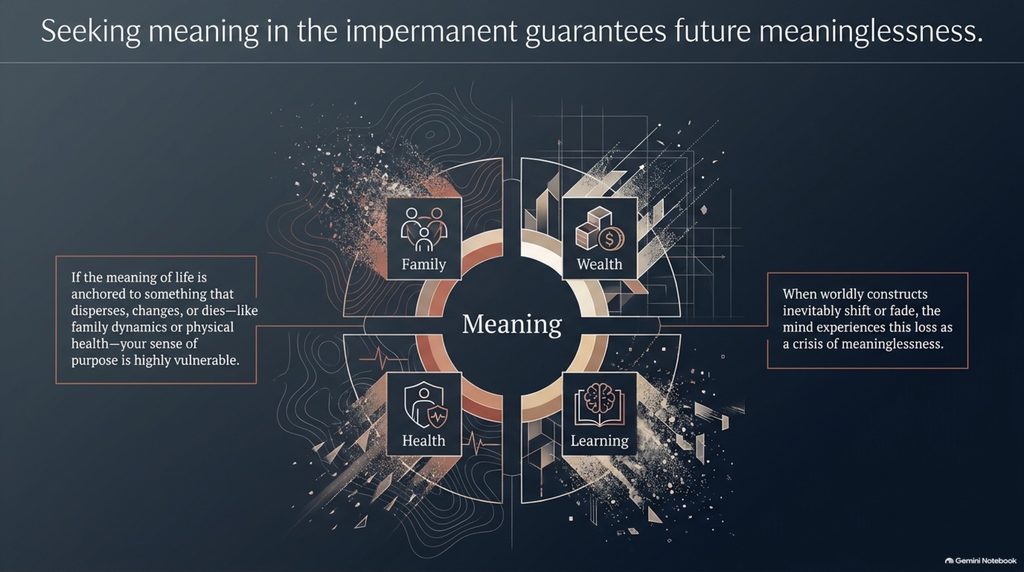
So, you mentioned meaninglessness. When you are seeking meaning in something that is impermanent—for example, the meaning of my life is to have a great family, a large family, be a member of a large family—you find meaning in your life in the family. But over time the family disperses, changes, dies, fights with each other, or whatever.
So we seek meaning outwardly. We seek meaning in having certain wealth or having great health of the body, or seek meaning in having a great job. All of these are impermanent.
So if you are really interested in meaning—non-meaninglessness—you need to seek it in that which is real.
So what is it that is real in your experience, Rupak?
Is it your mind? Your mind meaning thoughts and memories and events, which are constantly changing and shifting. Is the meaning in your body, which a few years ago was ten years old, and now it’s twenty and thirty and forty? It’s constantly changing.
Where would you find meaning?
Yeah, I’m not sure if you’re speaking with me. Yes, oh, I am. I am sorry.
Yeah, I can see the Buddhist point of view, right? Like things are important, and sure, we cannot find meaning in those things. But this existence still has value, right? So like, how would you approach that?
Well, that’s what I asked you actually. I’m asking you in your direct experience because you’re there right now. You’re alive. You’re having the experience of life. What is it that has meaning for you?
If you’re asking me, it’s learning. That’s what I like.
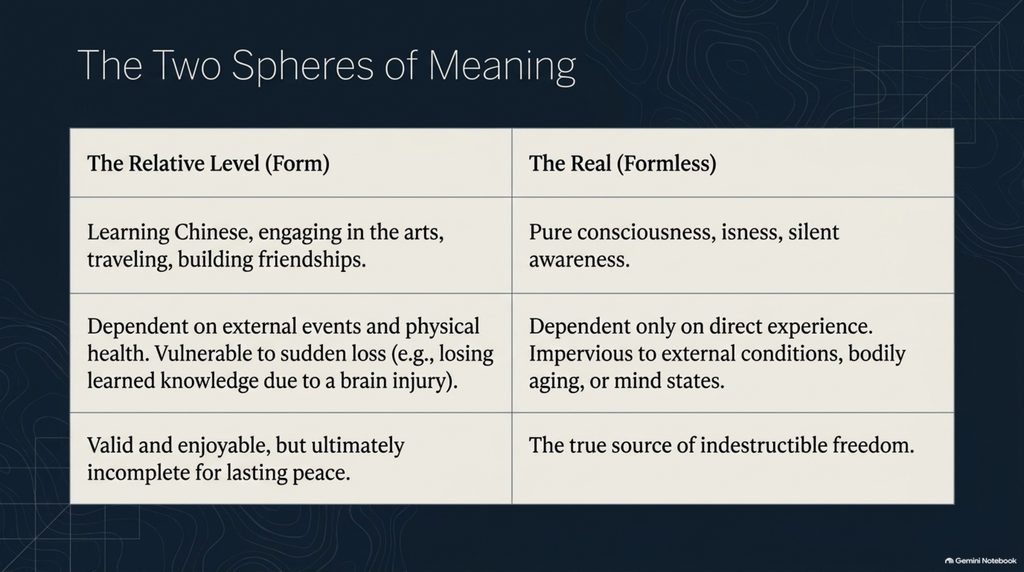
Okay. So let’s say that you learn Chinese. You’re enjoying learning Chinese, and it’s wonderful. It’s great. It gives you a certain sense of value.
And then you fall on your head. Something happens in your brain and all this Chinese knowledge, learning that you’ve acquired is gone. Now you’re in a hospital bed being treated.
So what happened to that meaning?
I find meaning in the arts. I find meaning in traveling. I find meaning in friendships.
Yes, that’s fine. Nobody is dissing that. But this is at the relative level.
So if your meaning is in this life, then you are fulfilled. You can enjoy food, travel, learning—whatever it is that you enjoy. And the Dharma doesn’t concern you because you already have your answer. You already have your meaning.
If you are satisfied with your meaning, which as you said is learning, then good for you. Why are you concerned about the Dharma?
I think I didn’t put it in the right way. It’s not so much that I don’t find meaning, but when you find meaning in the Dharma, right, like you will see that the things in the world are superfluous, they are changing, and you cannot interact with it. But I think it’s our duty in some sense, or it’s that we are compelled to act in the world, right? We cannot ignore them.
Yeah, I never speak about ignoring the world.
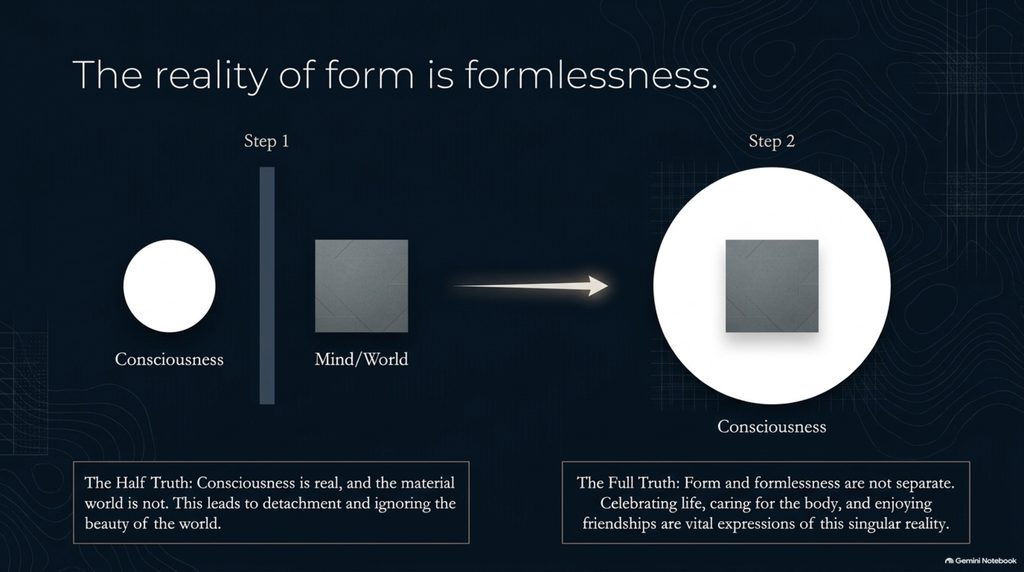
So for me that’s the problem here. Like, when I go into Dharma, right, like it’s sometimes easy for me to not be in the world and to not see the superficial beauty that’s out there. And then you are only getting half of the understanding.
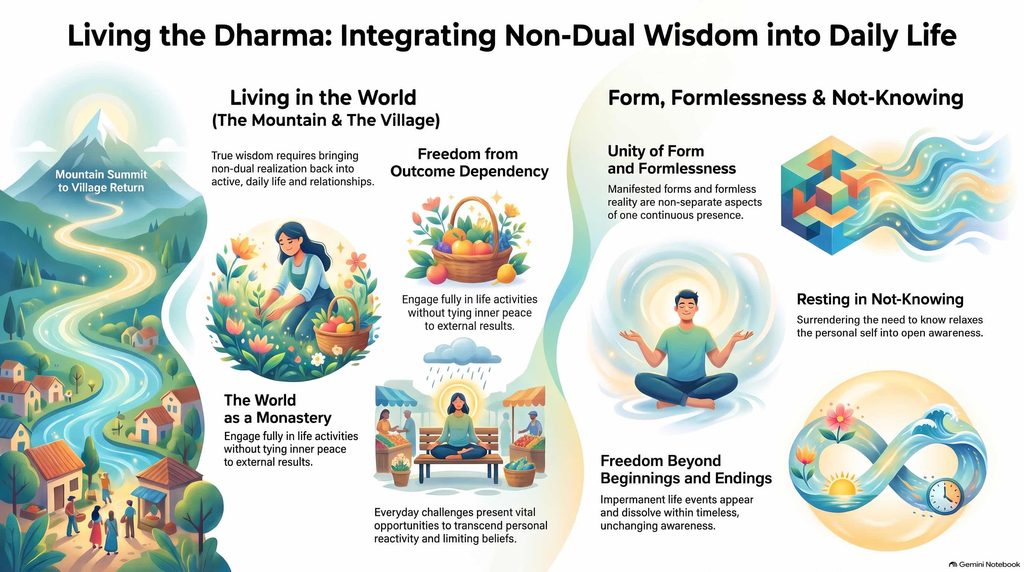
Yeah. The half of the understanding is that consciousness is real and consciousness is not material. The reality is not the form. It’s formless. So that’s half of the understanding. The other half of the understanding is that the reality of form is formlessness. In other words, they are not separate.
Engaging in taking care of the body, in celebrating life and celebrating friendships—this is part of the understanding. You have to find a balance between both. Otherwise you are misunderstanding the Dharma. You’re misunderstanding the scriptures.
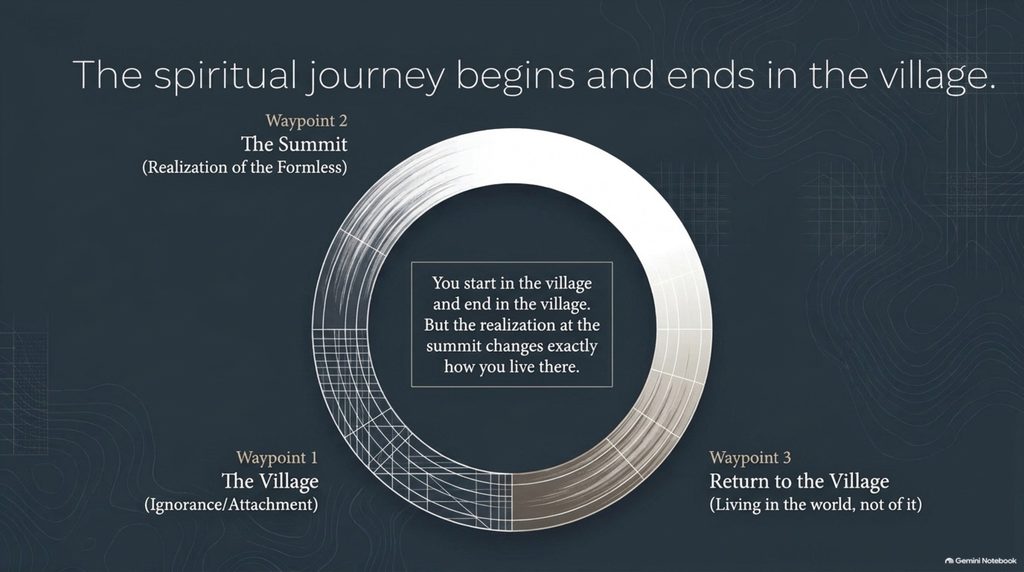
So you go up to the summit of the mountain from the village, and then you go back down to the village. Something has happened. Although you started in the village and you end up in the village, the fact that you went up to the top of the mountain has changed you.
You are no longer subject to world, body, mind events. You are living in the world, engaged in the world, but you are not of the world.
So you need to return to the world. How do you approach that in your personal experience?
Well, moment by moment, you know, there’s a certain listening. A certain listening. You listen to the body that says I’m hungry. You listen to the mind that says I would love to be with friends. Invite them to dinner. You listen to the mind that says, “Oh, I’d love to travel.”
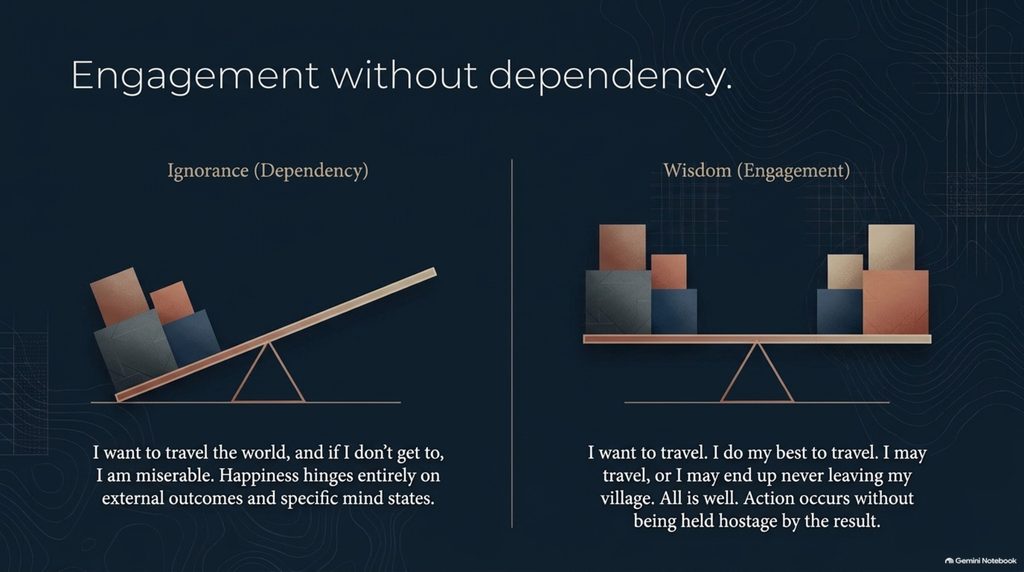
But the ignorance comes from: “I would like to travel the world, but if I don’t get to travel the world, I’m miserable.” That’s where the ignorance comes.
In wisdom: I like to travel the world. And so I do my best to travel the world. I may end up traveling the world. I may end up never leaving my village. All is well.
So the way you are living: if your happiness depends on something external, you are in trouble. But if your happiness does not depend on anything external, you can engage in all sorts of external things. You can become an athlete if you want. You can study various languages if you want. Travel the world if you want.
But your happiness is not subject to external events. It’s not subject to mind states. It’s not subject to the body. It’s not subject to the world.
So you’re engaging in the world, but you do not depend. Your peace of being, your freedom, your happiness does not depend on any outcome.
This does not mean that you’re not engaged in various activities. You may want to learn how to play the piano and you engage in various activities. And you may end up never learning how to play the piano because of various reasons—maybe there isn’t a good teacher around, or you found out that your fingers have some arthritis, or whatever. It’s okay.
You may end up learning how to play the piano. So there isn’t an attachment. There isn’t a dependency. You are in the world but not dependent upon the world. Do you understand?
Yeah.
One final follow-up question that I have in mind is: why do you engage in the world and not go on a path of renunciation? For example, why not be a monk and instead be in the world?
Yeah, you could be a monk and you can renunciate. The question, “Why are you in the world and not renunciate?” is a similar question to “Why are you a renunciate and not in the world?”
There is no why.
If you are drawn to be a renunciate, if it speaks to you and this is what vibrates for you and this is what fulfills you, be a renunciate.
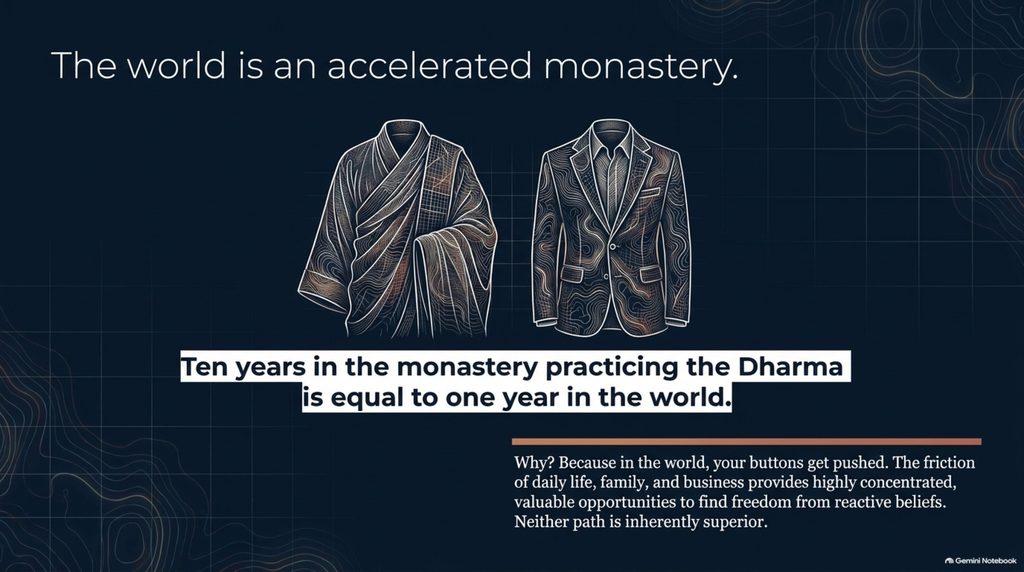
I would add the following: In the Buddhist tradition it is said that ten years in the monastery practicing the Dharma are equal to one year in the world practicing the Dharma. Because in the world your buttons get pushed, and when you are contemplating the Dharma, these are valuable opportunities for you to come to a deeper freedom from your beliefs and your reactivities.
Now, the Buddhists, by making this statement, were not speaking against being a renunciate or being in a monastery, nor were they praising being in the world. It’s just sharing how it works.
Again, there is no answer to your question: why not be a renunciate?
You have to find out for yourself what is it that really draws you, what really speaks to you.
I have never been a renunciate. I’ve done many retreats in monasteries in different centers, but I’ve never been a renunciate. So I share my experience, which is to be a layman. A truth lover, a follower of the path, while being a layman, while having family, kids, business, et cetera.
You can be in the monastery and not be a true practitioner of the Dharma. You can be in the world and not be a true practitioner of the Dharma. You can be in the world and be very engaged in your sadhana and your Dharma. Similarly in the monastery.
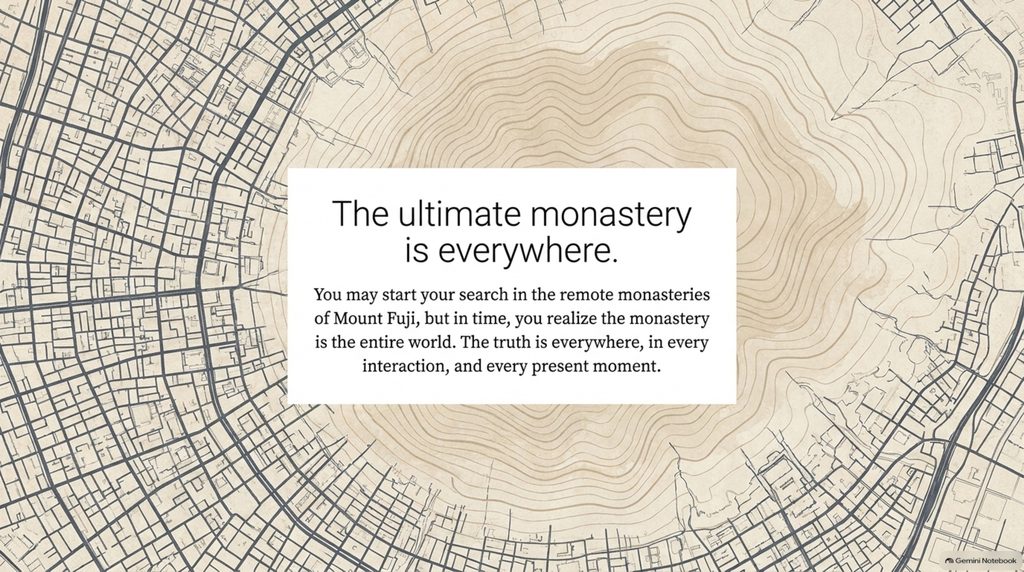
But the entire world is a monastery.
You may start with the monasteries on a certain Mount Fuji, but in time you realize the monastery is everywhere. The truth is everywhere.
Yeah, thank you for answering that. I agree with you that I think it’s a really subjective question that we have to find the answer to ourselves. I wanted to get your account, and thank you for sharing that.
Where do you live, Rupak?
Right now I’m in Seattle.
Okay. It’s quite a Buddha statue behind you.
Yeah, it’s really good, right?
By the way, for new people: I record these meetings. And if you want a copy of the recording, just put your email in the chat box.
Any questions?
I’m out on a ride, and I’m really enjoying listening to you guys in my ears. It’s been really beautiful.
Thank you.
Where are you riding?
Right out my backyard. I walk out my back door and into the trails. I’m up in northern Arizona.
Wonderful. It’s beautiful.
Yeah, beautiful. Yeah, so thanks again.
I just wanted to talk. Thank you, Patrick. Good to see you. Enjoy.
Any questions? Thank you. You can hear me okay?
Yes.
I don’t have a question, but I just wanted to share with you thoughts that have been coming up, feelings related to inquiry into nothingness. I used to, when I had a strong longing, have a longing for dissolution somehow. Now I can see that it would very easily end up with me hanging on with my fingernails to “maybe I’m not as much there as I used to be.”
But with fear of death—of the me—the me pops up. I’m not as engaged with that as in the past. As in the moment, I should say.
I, I guess, I feel not in a hurry. I feel maybe more engaged with no time. And I also feel the illusion of being able to hide dissipating. I’ll try to engage in an old addiction or whatever.
I don’t know what I’m trying to say. I don’t know what it is. I wanted liberation. I feel freedom. Is the last thing freedom from I?
I guess that’s my question.
No one could want that as a person. From the personal, really. Maybe when I was suffering horribly, I’m not trying to do anything. Maybe I don’t have a question. I just think I wanted to connect with you.
I’m not able to talk solidly about anything that’s going on right now because it’s fleeting. Something new is fleeting, new in my experience, maybe. Maybe not. It’s not new at all. It’s always been there, but I’m maybe noticing and being with it more.
Not knowing is to be close to God. Because all knowingness and not knowing—they meet. Because God is all knowing without any need to know anything.
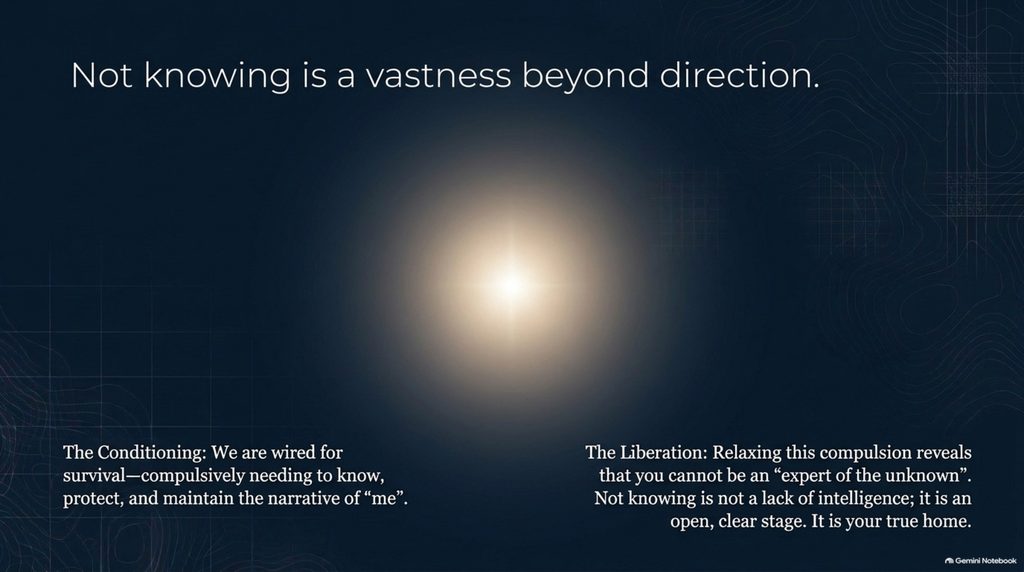
So in our life we are conditioned to engage in activity, to protect, to safeguard. Of course, at the body-mind level, we are wired. The body-mind is wired for survival. But I’m talking about this conditioning that we have to protect, maintain the me, the belief structure that I am this.
And as we are fortunate enough to start exploring this belief structure—like you have for many years—you find that there is no reality to this belief outside of mind.
And so all these activities about maintaining, holding on, safeguarding, protecting, becoming—over time it relaxes. And the mind is transformed. It’s still aware and awake, but it relaxes around the tendency of protecting and seeking and becoming. It relaxes and it becomes more and more not knowing.
Not knowing is an open, clear stage. It’s a vastness that has no specific direction. That is not limited by any direction. It is beyond direction.
It’s like the shining light. It shines in all directions without any specific direction.
This not knowing is your true home. You can relax into it.
I think I have—I trust. I don’t know, and I trust that I don’t know. It’s fine.
Well, who is it that trusts?
Well, as opposed to feeling afraid of not knowing, maybe in the past. I guess my mind is always comparing. But yeah.
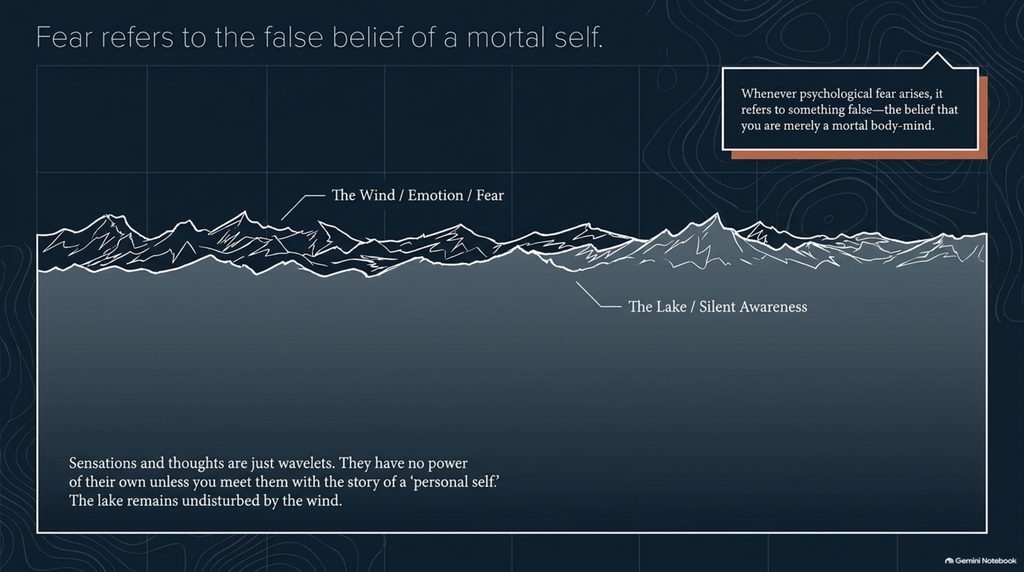
So whenever a fear arises, it’s referring to something false. I’m talking about psychological fear. I’m not talking about being chased by a lion.
Whenever a fear arises, it’s referring to something false. Because in God’s kingdom, there is no fear. Fear is the result of this old habit of still feeling and believing to be somebody, to be a body-mind, to be mortal.
So in the contemplation of the Dharma, there is the death of that belief structure, the death of the personal self.
Because in the death of the personal self, there is the wakefulness that remains. There is the immortality, the true immortality.
To access this immortality, you access it through your death—not the death of your body, but the death of your personal self.
And whenever you notice a personal self arising, it arises as a certain emotion in your body or a certain activity in your mind connected to an emotion in your body. You just simply see it as wavelets on top of the lake.
There’s a little tremor. The wind blowing over the lake. The lake is still, unmoved and undisturbed by the wind. It’s still the lake. It’s the lake.
So you can see these sensations, these thoughts for what they are: impermanent, passing, fleeting. They have no power of their own except for the power that you give them when you meet them.
Oh, my God, I’m still experiencing separation. You’re meeting them with a story. You’re meeting them as a personal self. You’re meeting them with a certain belief that they should not be there.
Everything that is there is there in its exact perfection.
You could get some water.
So you remain as the perfection. The perfection is not a personal perfection. It is awareness. It is a perfection of awareness. It’s that which perceives, the reality that perceives.
And you, you are this receiving aspect. You are that.
So the you is not male or female. The you is. You is it. It is isness itself. It’s isness and awareness. Such being, awareness. And that has no form, no shape.
Yeah, remain available for that.
Thank you. Good to see you, Lynn.
Hello, Maria.
Hi, Magdi. So good to see you.
See you too, Magdi.
I have this feeling lately. When something’s starting, there’s this sense of it’s already ending. It almost feels like—it’s hard to describe it—but sometimes I panic because I think, like, am I losing my mind?
But this feeling of: this trip is starting, but this trip is already ending. This day is starting, but this feeling that it’s already ending.
Yeah. That is how it is. That is how it is.
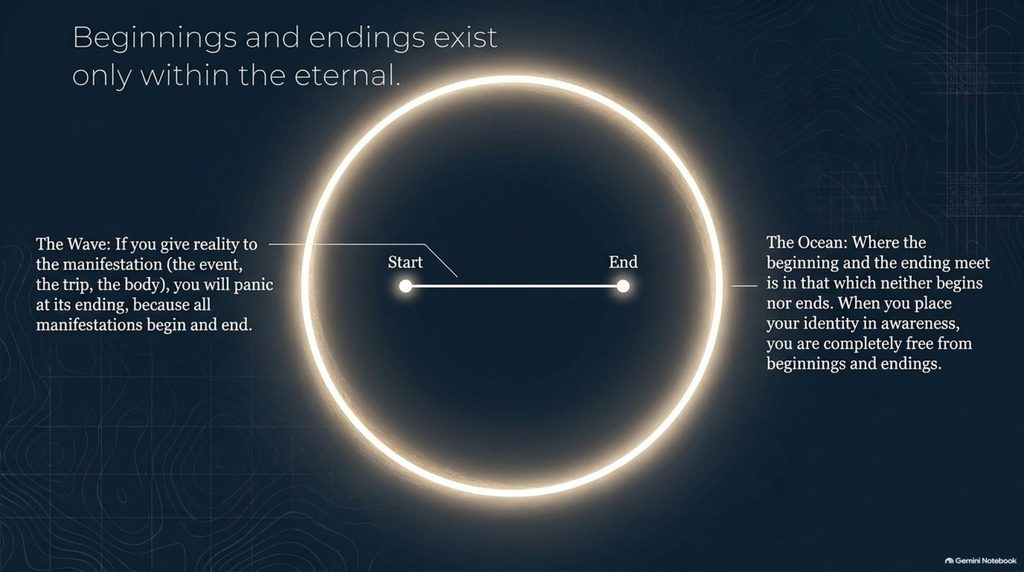
Where the beginning and the ending meet is in that which neither begins nor ends.
So there is that which doesn’t begin and doesn’t end. So when you are looking at that which begins, you see its ending. You could see its ending further down, or you could see its ending like you’re expressing now. It’s ending right now because it is beginning and ending.
Everything which appears to you is beginning and ending—whether you stretch it one meter or you stretch it one centimeter or one millimeter. It’s beginning and ending.
So what you need to bring on board is that which within which the beginning and ending appear.
The beginning and the ending appear in awareness, which has no beginning and no ending.
So do not be so concerned about the beginning and the ending because if you are concerned about the beginning and the ending—about that which appears and disappears—you are giving value to the wrong thing. You are giving value to something external. Although there is nothing external. You are giving reality to form. You are giving reality to manifestation.
And so you can enjoy manifestation. You can celebrate manifestation. You can invite one hundred people for a meal. You can engage in Qigong with a lot of friends and create whatever you’d like to create, with the understanding about consciousness, about what is it that really, really is of value, and not to be so attached about the beginning and the ending.
You engage in the world—like Rupak was asking earlier—you engage in the world, but you are not attached to the results. You don’t need to be attached to a certain beginning that leads to a specific ending. It can end anytime. You are free. You are free from the beginnings and the endings.
You are the beginningless and endless. You are that which has no beginning and no ending.
And as you understand that you are that which has no beginning and no ending, you will come to understand that everything which appears to have a beginning and an ending—its reality has no beginning and no ending.
So waves appear on the surface of the ocean. They have beginning and ending. But what is the concern? Only if you’re identified or give value to this wave—it’s got to stay, don’t end—then you are miserable. Because you are giving power and reality to the wave.
The unmanifest loves to manifest. It’s constantly manifesting like right now. Right now there is manifestation.
The manifest loves to manifest. And it manifests in many different ways.
And the unmanifest is inviting you to realize the unmanifest, to realize the self, to realize yourself, your true self, which is unmanifest. To realize God, to realize the absolute, to realize eternity.
So how could you realize eternity when you are so concerned about the beginnings and endings? I’m not saying that you are concerned. I’m just speaking.
I know that you didn’t express a concern. You were just expressing how you’re experiencing beginning and ending sort of coming together, which is true.
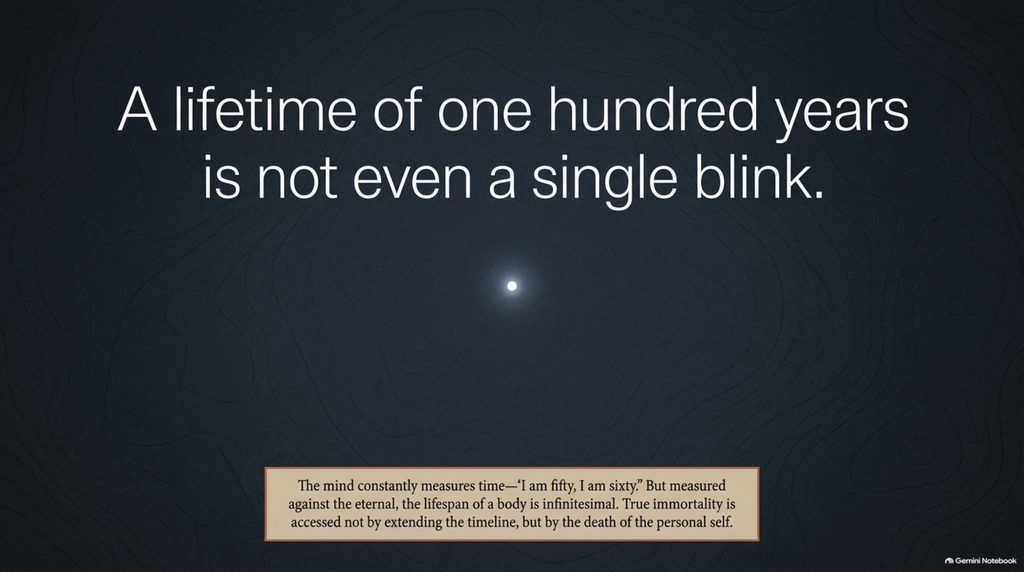
Everything—it’s like you look at a lifetime of one hundred years. It’s not even a blink in God’s eye. Blinking. It’s not even one blink.
I’m a little concerned about your cold and your cough. I know it’s been a while. Is that the remaining, the end part of your—
I hope so. Working on it.
I’ll share something that really helped me last time.
Yeah? Okay.
My—let’s see. I’ve been taking this course for a year. It’s called “A Year to Live.” And it’s about coming to terms with death and, I guess, the death of the body-mind. In order to live more vibrantly. I guess that’s how the course is. It’s from the Buddhist perspective, from Spirit Rock.
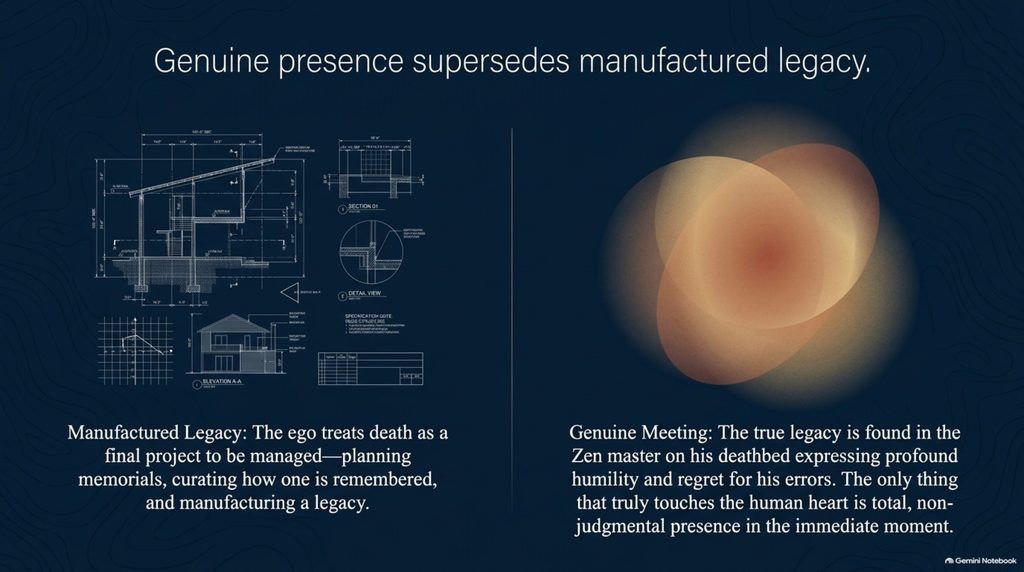
We are—it’s so interesting—we’re at the stage where we are talking about the homework. It is to come up with our own memorial ceremony. How do we want to be buried? What’s going to happen to our bodies? How do we want to dispose of this thing?
So, you know, and there’s a lot of homework questions about like: How do you want people to remember you? What’s the legacy you want to leave behind? What’s your favorite music and you want people to dance in your memorial celebration? How will you help loved ones grieve your death? Blah, blah, blah. All of that.
And I don’t know. I just feel like it’s a game, you know? Like, okay, we’re deathless, we’re endless. But here it is—here’s kind of a fun party planning where my body and mind might not be present. But since I’m planning it, it feels very present right now.
I’m trying to—let’s see. What is my point here?
Is that even at this relative level, in this course that we’re talking about the death of the body-mind, to bring in and the remembrance about how we are deathless and approach it from that angle?
And of course in the relative world there is the stuff like having your affairs in order. So, you know, get rid of your shit so your kids don’t have to deal with it. And that sort of thing.
But yeah, feelings do come up in the midst of all that. In the midst of planning my memorial.
But I do find myself contracting when people talk about like the legacy. What’s your legacy? It’s like blah. I just feel blah kind of feeling. I don’t even deal with that.
So I’m wondering what that is. Am I just doing spiritual bypass? Like, “There’s not a person here, so we don’t have to worry about legacy”?
Anyways, that’s what’s going on with me. Thank you for listening, you guys.
Thank you for sharing this. What’s coming to mind is the story about this Zen master who was on his deathbed. And his disciples were asking him: “What is it that you want to share with us as you are leaving this world?”
And he said something to the effect: “I’m aware of how many times I have acted in a non-harmonious way, in less than honorable ways.”
So his legacy was his regret, to have erred—E-R-R-E-D—to have been non-dharmic.
Such beautiful humility, you know, this great Zen master.
Yeah.
You know, the only thing that really touches people’s hearts is love. Not like this manufactured love, but this genuine meeting where you are being met totally, completely. Love in such a meeting is really precious. Something that touches the heart.
Thank you.
Meeting each other in presence, not out of judgment or “I like this, I don’t like that,” but to really be embracing—not for any particular reason. For no reason. Just it’s an expression of our beingness.
I think that’s a very beautiful legacy.
Anyways, it’s fun what you’re doing. It sounds like it’s fun. Enjoy it.
Any questions?
Hello, Mark. Good to be here. I just wanted to share: I heard a sentence from someone that said, “You cannot be an expert of the unknown.”
And for some reason, this is kind of interesting because it just invites me to just relax, relax. There is no going deeper. No struggle, no striving.
Yeah, be an expert of the unknown. Very nice.
I really like that statement.
Yeah, nice. It’s not like you’re resolved. You’re resolved in the unknown.
You. You are the unknown.
When—yeah. You cannot stand apart from the unknown and be the expert of the unknown.
Yeah.
Your true death is the unknown.
But what a liberation!
I mean, how beautiful.
The habit, the condition, is to be afraid of dying. And the reality is that you are totally free and held in what we call death.
Yeah. Whatever. Blah, blah, blah.
Every moment is love and death meeting each other. In every instant.
Isn’t it?
I don’t know.
In the mind it’s a different thing, you know.
Yes. In the mind it’s like, “Oh, no, 2027, 2028, 2026.” But in being and presence, life and death are meeting. Appearances and disappearances. Form and formlessness.
In fact, if you explore form—explore it, explore it, explore it—trying to find it, you find formlessness. You don’t find form. You die. You die. You dissolve.
Because form and formlessness are not separate. Life and death are not separate.
Again, in the mind it’s a different story. In the mind there is the me and time: “I am fifty. I am sixty.” It’s a different thing in the mind.
But if you look at the mind, what is it? Where is it? Grasp it. Is it graspable? What do you grasp?
What can you grasp?
There’s nothing to grasp.
The totality doesn’t grasp itself. It is.
It’s nothing that can grasp anything.
In fact, in truth, in reality—
Very nice beard, by the way.
Yeah, he’s looking good.
I realized that I’m now already a senior, and so I needed to change something.
A playful senior at that.
Yes, yes, yes, yes, yes.
So good to see you.
Thank you.
Maggie?
Yes, Lynn?
I just wanted to say something out loud that I’ve had an awareness of since a glimpse several years ago. I feel, because you were talking about this, but I have a sense that I’m dead and alive at the same time.
There’s always death in the background. But it’s not death in the sense that I mean—I don’t even know how to define death. But nevertheless, it’s like, yeah, it used to scare me. Now it doesn’t. I’m used to it. And it feels right.
Yeah. And it gives. Right now, for me, there’s not as much—there’s definitely not as much. Well, I can’t say that’s true. It’s moment to moment, really.
So I was going to say it’s not as much engagement in the world until Trump does something that I want to kill him for.
So anyway, I just wanted to say it out loud because I used to be afraid to say that out loud. And I felt that I could say that here. And you never know who’s new, and I didn’t want to scare anybody.
But thank you for making the space that we can talk about—
Sure. And it’s not even a big deal.
Yeah. Yeah.
I also wanted to share something. Like, I came in here right? And I didn’t know what to expect. And then like, you just put me on the spot. Yeah. What do you think?
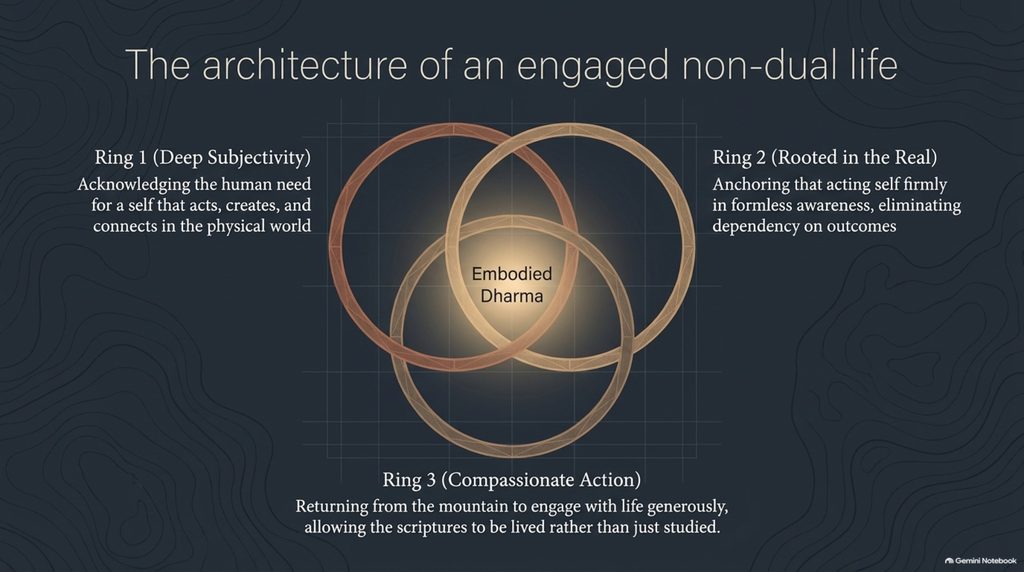
And I didn’t expect that. But the thing I wanted to share was: like, I started Buddhism and I went to the other extreme of like climbing to the mountain. But it was hard for me to come back down. And I’m starting this other tradition, psychoanalysis, and what is helping me to see is that the need for subjectivity, the need for self to act in the world—and it’s really nice because like, I’ve come from the mountain, I can see what’s happening. That I can establish a sense of subjectivity that’s rooted in something more real, something more generous, more compassionate.
That’s really good.
Yeah, yeah, nice.
I’m glad, you know, living life dharmically is part of the dharmic path.
There is the studying, you know, hearing the scriptures, the study of the scriptures, the meditation upon the scriptures. And then the living—the living of the scriptures. Living.
There is life that’s meeting you, and you’re meeting it, you know, every day in different ways.
How do we meet life? How do we live life dharmically, you know, with the understanding that it’s one reality? That only we are one. All is one.
And there is all the conditioning, you know. We’re conditioned, you know, as separate entities to react, to like, to dislike, to judge, to value. So the embodiment of the teaching is in the village. You have to come and live in the village and live the Dharma and explore the Dharma in the village.
Any questions?
Okay, well, thank you all. Lovely to be with you.
Wishing you a happy day. A peaceful day.
Yeah, thank you, Magdi.
Thank you everyone.
Yes, thank you everyone. Great to see everybody.
Thank you, Magdi.
AI Summary
Meditation and Dharma Q&A
Date: Sunday, November 15, 2026 09:58
Duration: 93:37
Key Points
- Awareness has no owner
- Meaning fails in impermanence
- Live engaged without dependence
- Not knowing can be home
Overview
| Topic | Detail |
|---|---|
| Awareness | Present, ownerless, unchanged |
| Meaning | Impermanent sources do not last |
| Worldly life | Engage fully without dependence |
| Renunciation | No universal path for all |
| Not knowing | Open, clear, trusted ground |
| Fear | Comes from personal identity belief |
| Death | Personal self dies, awareness remains |
This meeting opened with a guided meditation and continued with questions on nonduality, meaning, fear, death, and how to live the Dharma in ordinary life.
Guided meditation
The meditation turned attention away from effort and toward simple being.
- Let go of past and sit comfortably.
- Let thoughts be as they are.
- Notice the breath and heartbeat without trying to control them.
- Rest in the sense that what needs to be done is being done.
The practice pointed to awareness as effortless and already present.
Awareness
The central teaching framed awareness as ordinary, ever-present, and not personal.
Core view: Awareness is present by itself, has no owner, and remains unchanged while thoughts, feelings, birth, and death come and go.
- Awareness does not turn on or off.
- Awareness is not a form, object, or concept.
- The belief that awareness belongs to a person has no evidence.
- A thought may claim ownership.
- Direct looking does not reveal an owner.
Awareness was contrasted with the body-mind, which exists in time and changes.
You are this awareness.
Mind
Meditation and inquiry were presented as ways to stop living under the mind’s rule.
| Mind | Like an untamed bull |
|---|---|
| Awareness | Higher than the mind |
| Self-inquiry | Ask what is real |
- The mind acts like it runs the show.
- Practice tames the bull by recognizing a higher faculty than mind.
- Self-inquiry asks what the real Self is, beyond imagined identities.
As true nature becomes clearer, the mind relaxes and heals.
Meaning
A question challenged whether nondual teaching makes life meaningless. The response separated relative meaning from what is truly real.
- Meaning found in family, wealth, health, work, learning, travel, or friendships stays relative because those change.
- Lasting meaning cannot rest on mind, memory, body, or experience because all of them shift over time.
Life in the world still matters. The issue is not activity itself, but dependence on activity for fulfillment.
- Cook, travel, study, make friends, and care for the body.
- Do not tie happiness to outcomes.
- Engage fully without making peace depend on success.
Worldly engagement
The discussion returned several times to the balance between formless truth and life in form.
- Understanding is incomplete if it rejects the world.
- Form and formlessness are not separate.
- Return to the village after the mountain.
- Live in the world.
- Do not be subject to world, body, and mind events.
The example given was simple: listen to hunger, friendship, and the wish to travel, while remaining free whether those desires are fulfilled or not.
Renunciation
A question compared lay life with becoming a monk. The answer left the choice open and emphasized sincerity over role.
- There is no universal reason to choose renunciation or worldly life.
- Follow what genuinely draws you.
- Monastery life does not guarantee true practice.
- Life in the world does not block true practice.
A traditional comparison sharpened the point.
- Ten years in a monastery practicing Dharma can equal one year in the world practicing Dharma.
- Worldly life exposes reactivity and belief structures more directly.
The whole world was treated as a monastery when seen rightly.
Not knowing
A participant described a shift toward freedom, less urgency, and trust in not knowing. The reply treated not knowing as spiritually intimate rather than deficient.
- Not knowing is close to God.
- The mind’s habit of protecting and maintaining the personal self can relax.
- Not knowing is open, clear, vast, and without fixed direction.
This was offered as a place to rest rather than a problem to solve.
Fear
Fear was addressed as part of the belief in being a separate mortal self.
- Psychological fear points to something false.
- Fear comes from believing oneself to be a body-mind.
- Dharma includes the death of the personal self, not the death of the body.
When personal reactions arise, meet them lightly.
- See thoughts and sensations like ripples on a lake.
- They pass and have no power apart from the power given to them.
- Remain as awareness rather than as the story.
Beginnings and endings
One participant felt each beginning already carries its ending. The answer relocated attention from appearances to the field in which they appear.
- Everything that appears has a beginning and an ending.
- Beginnings and endings appear in awareness, which has neither.
- Suffering comes from assigning ultimate value to changing forms.
Manifestation can still be enjoyed and celebrated. Freedom lies in participating without attachment to a specific result.
Death and legacy
A course on memorial planning raised questions about legacy, spiritual bypass, and how to hold bodily death alongside deathlessness.
- Practical affairs still matter in ordinary life.
- Feelings can arise while planning death rituals and memorials.
- Legacy based on image or self-importance felt empty.
The response shifted legacy toward the heart.
- A story of a Zen master highlighted regret for non-harmonious action.
- Humility, kindness, presence, and genuine love touch people most deeply.
- A beautiful legacy is simple loving presence, not self-manufactured importance.
Unknown and death
Another reflection centered on the line that nobody can be an expert in the unknown.
- The unknown invites relaxation rather than striving.
- You cannot stand apart from the unknown and master it.
- Life and death meet in every instant.
Form and formlessness were treated as inseparable, just as life and death are inseparable in direct presence.
Living the Dharma
The closing exchange brought the teaching back into ordinary subjectivity and daily conduct.
- Study, meditate on, and live the scriptures.
- Embodiment happens in the village, not only on the mountain.
- Meet life dharmically in daily encounters.
- Let subjectivity be rooted in something more real and compassionate.
The path was framed as one reality lived through ordinary human conditioning.
Recording access
The meeting recording is available to people who want a copy.
- Put an email address in the chat to receive the recording.