Alternative MP3 player
Dear Jeff, please let me know if this works better (on your Android phone):
Meditation (Transcript)
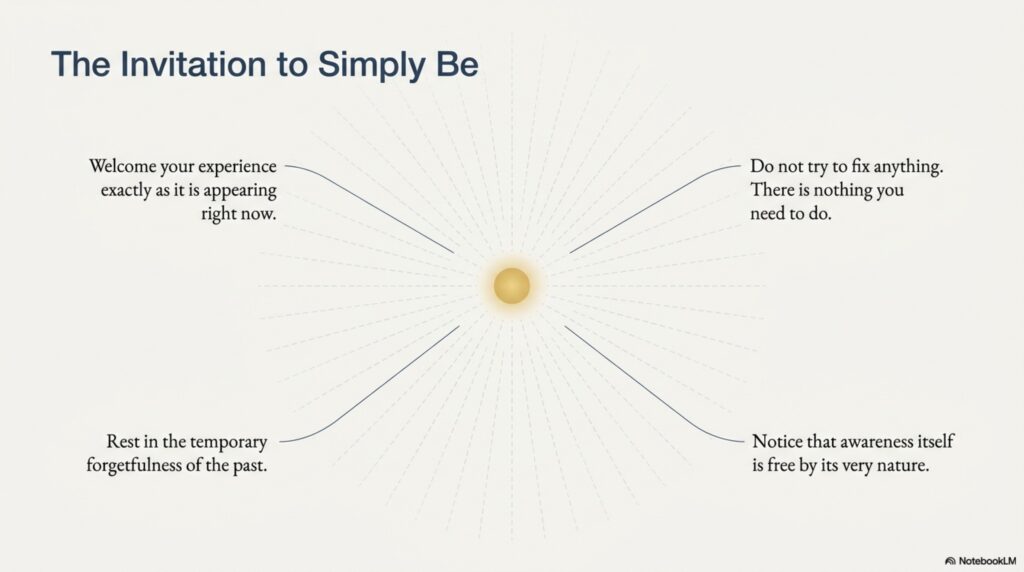
Lovely to see you and be with you. Let’s start by welcoming our experience just as it is, whichever way it’s appearing to you right now—whether you’re feeling peaceful or confused or stressed or whatever it is that’s appearing for you. Just let it be as it is, just for the duration of this meditation.
Let’s go for what’s happening. Don’t try to fix anything; just be. There’s nothing that you need to do. Simply rest in your experience as it is. This restfulness is an invitation to simply being as awareness. It’s a relaxation of the “me” story—a temporary forgetfulness of the past.
Notice the breath, how your body is appearing, and whatever sensations are appearing for you. There is the light of awareness shining on your experience, and this shining light of awareness is your true self because it is you that is aware when you move to this reality which perceives. There is a certain freedom—no sensations or experience of being constrained or lacking.
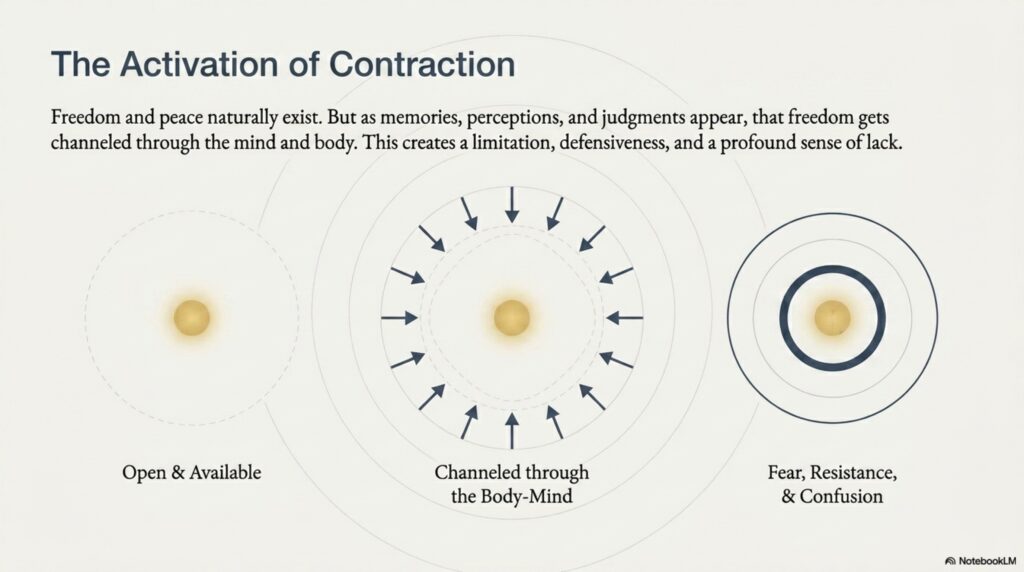
It’s not an attempt at avoiding anything; it’s simply how awareness is. It is free by its very nature. So, there is that aspect in your experience which is free. Then, memories, thoughts, perceptions, and judgments appear, and you find that freedom and peace get channeled through the mind and the body, creating fear, resistance, and confusion, which is a sort of unhappy dance at times—maybe most times.
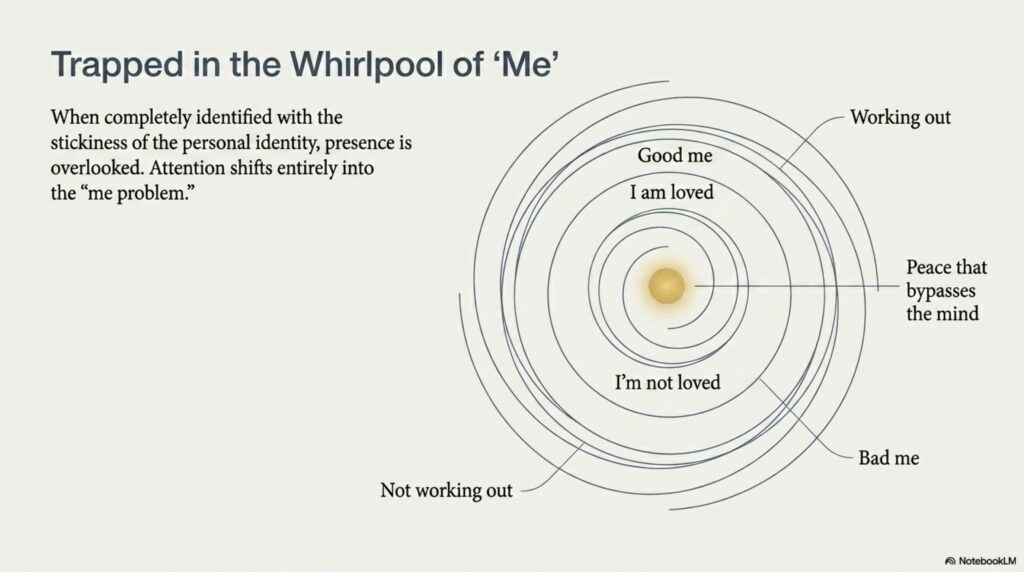
But awareness is always open and available. So, you as awareness are open and available, and I as awareness am open and available to what’s appearing. There is the understanding that within what’s appearing, there is a belief in “me” and “you.” There’s a belief in a better me and a better you, or a worse me and a worse you, a good me and a bad me, a good you and a bad you—all these old impressions, both mental and physical, that go back to this personal identity: I am me, I am loved, I’m not loved, I’m desired, I’m not desired. All this old body-mind stuff.
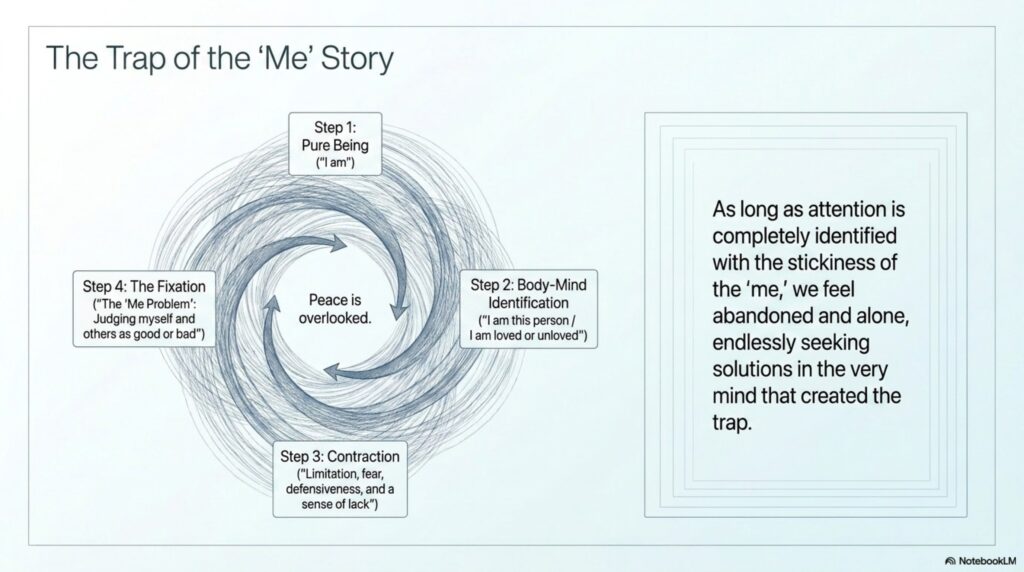
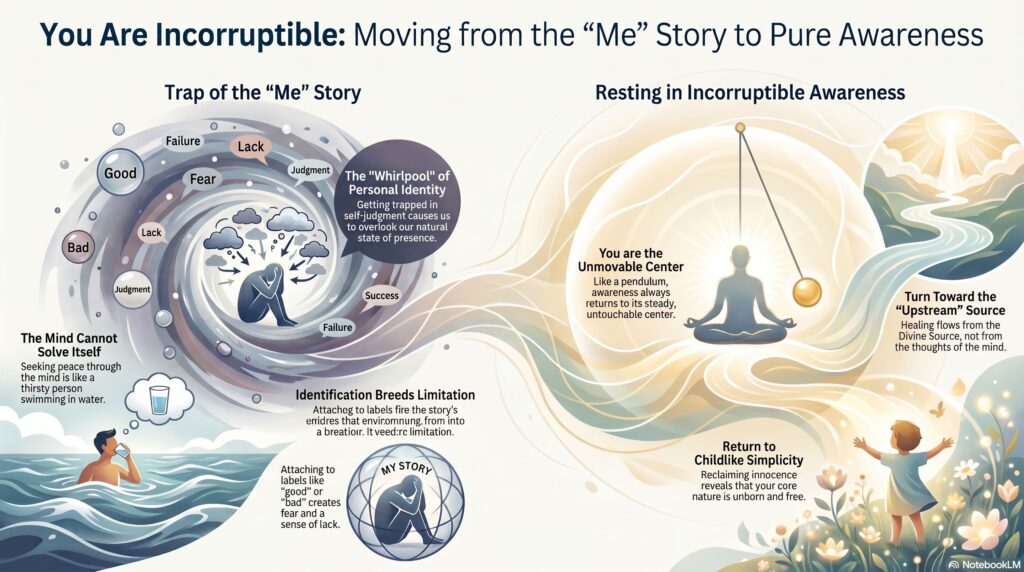
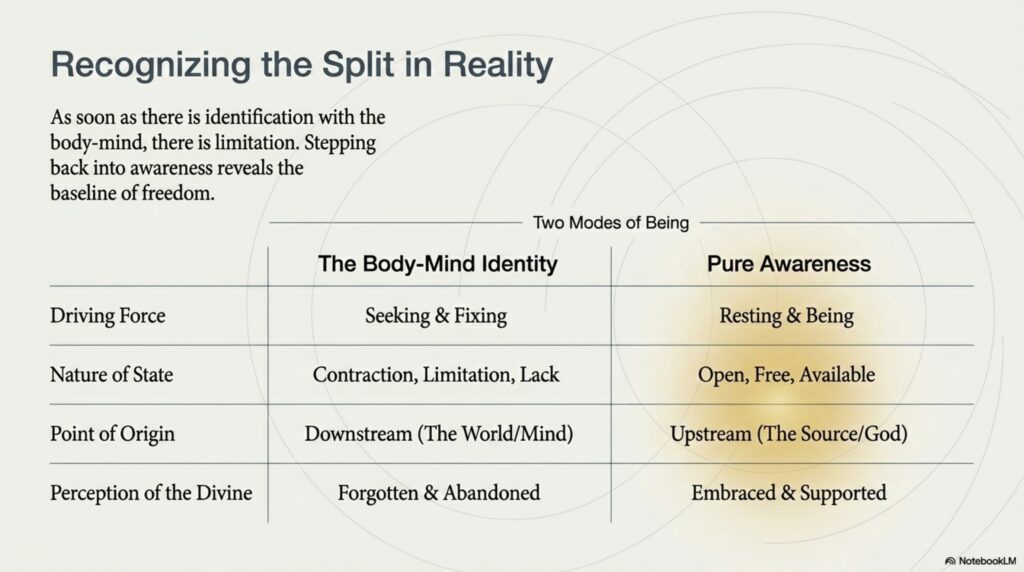
Within this body-mind stuff, there is an identification. I am that. I am this person, I am this child, I am this adult, I am this or that. As soon as there is this identification, there is limitation, contraction, fear, defensiveness, and a sense of lack. They go hand in hand. We get trapped in this body-mind impression of being somebody loved or unloved, somebody good or bad.
When we are trapped in that whirlpool, presence, awareness, being—the peace that bypasses the mind—is overlooked. The attention, the body, the mind, the feelings, and the emotions get shifted into the “me problem”: “Me good,” “me bad,” “This is working out,” “This is not working out.” All of these things are for “me,” the person. For “me,” this made sense.
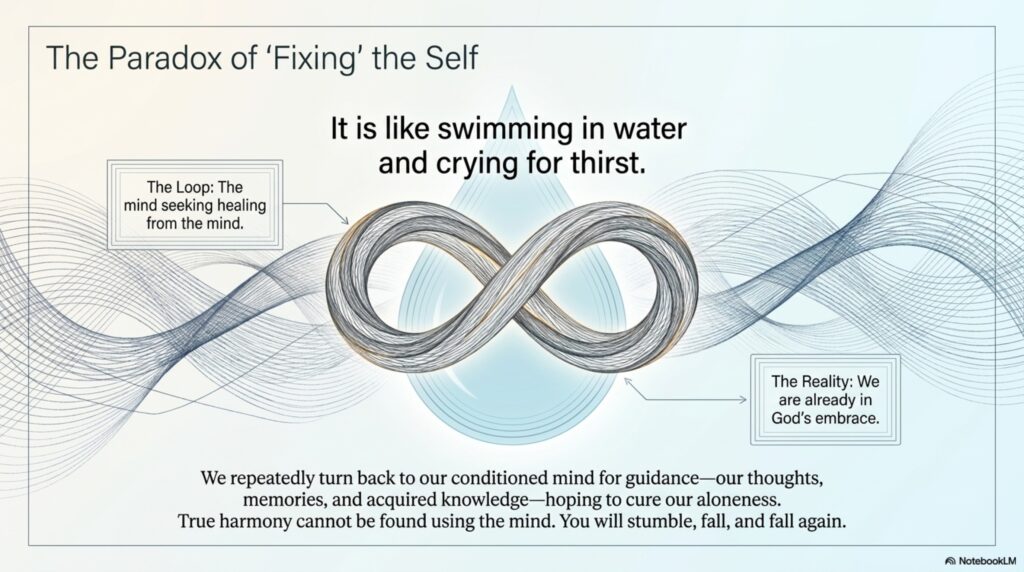
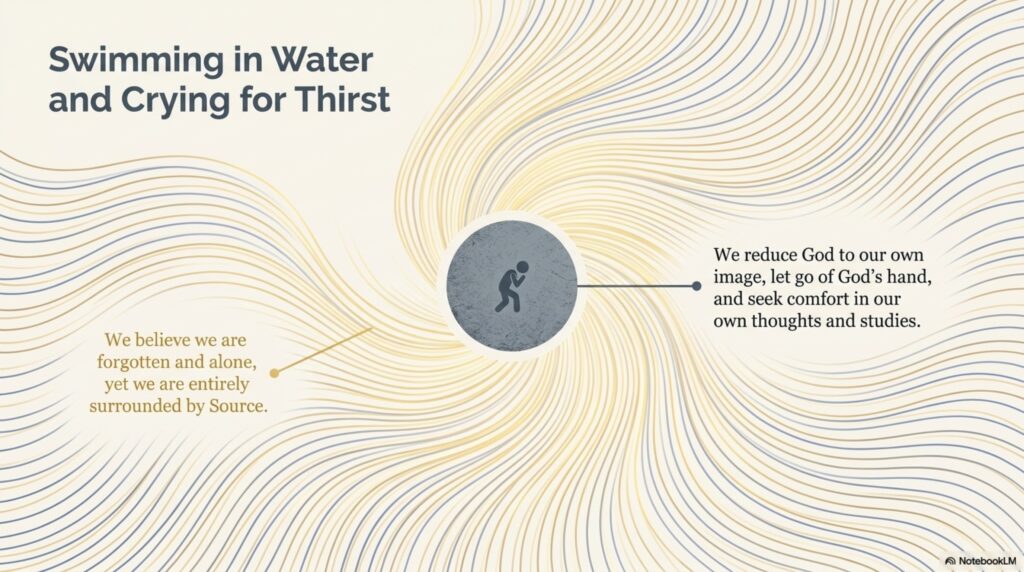
Yes, we can take a look. There are old patterns appearing, and yes, it seems to be magnetic and sticky. But as long as you’re completely identified with the stickiness of the “me”—the good me and the bad me—with self-judgment and the judgment of others, you’re far from God. You’re far from God because you have reduced God to your own image, your own thoughts, and your own beliefs. You can justify all your feelings, thoughts, emotions, and your personal self that you’ve moved away from God. We let go of God’s hand, and you are alone—alone in the world, seeking comfort, seeking a solution to your aloneness, your hurt, and your suffering.
We’re seeking the solution in the mind, in the world, and in the body, but the solution is very simple because God’s hand is always there, open and available to you—always. But you’re afraid of letting go of your emotions, your feelings, your thoughts, and your stories, because that’s the “you.That’s what you believe you are: forgotten and abandoned by God. It’s like this metaphor of somebody swimming in water and crying for thirst. We keep going back to our mind for guidance—things we’ve learned, heard, studied, and discovered—and we keep turning to our mind. But we don’t turn to God.
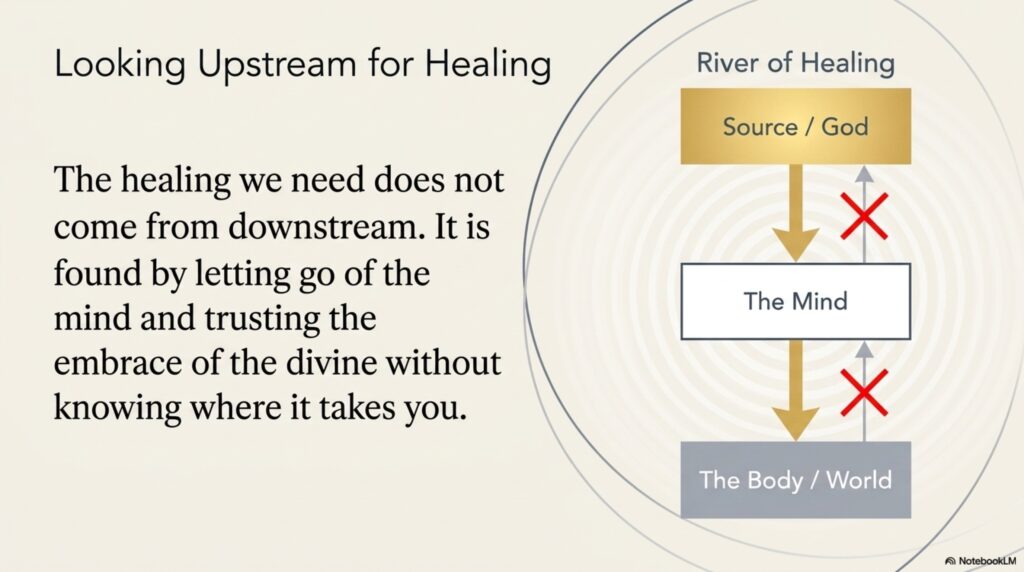
What is it like to turn to God? To let go of your mind? It’s a sort of profound, deep trust—trust in the divine. It’s allowing yourself to be embraced by God without knowing where it takes you. God’s embrace is sufficient. You’re already there in God’s embrace. Open your heart to God, not to the world, not to people, but to God.
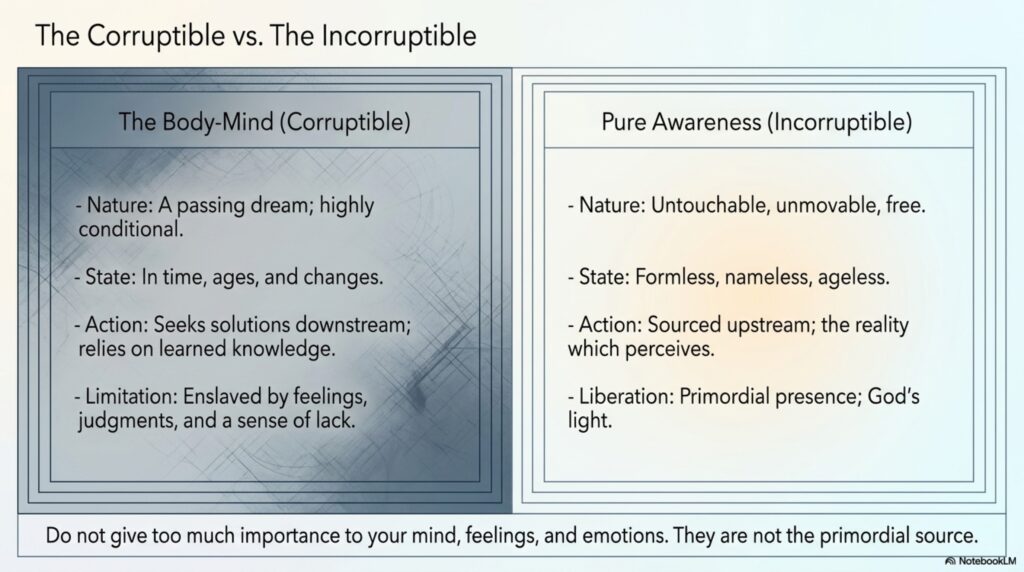
Everything flows from the source. The healing we need in our mind and body comes from the source. It doesn’t come from the mind; it doesn’t come from downstream; it comes from upstream.
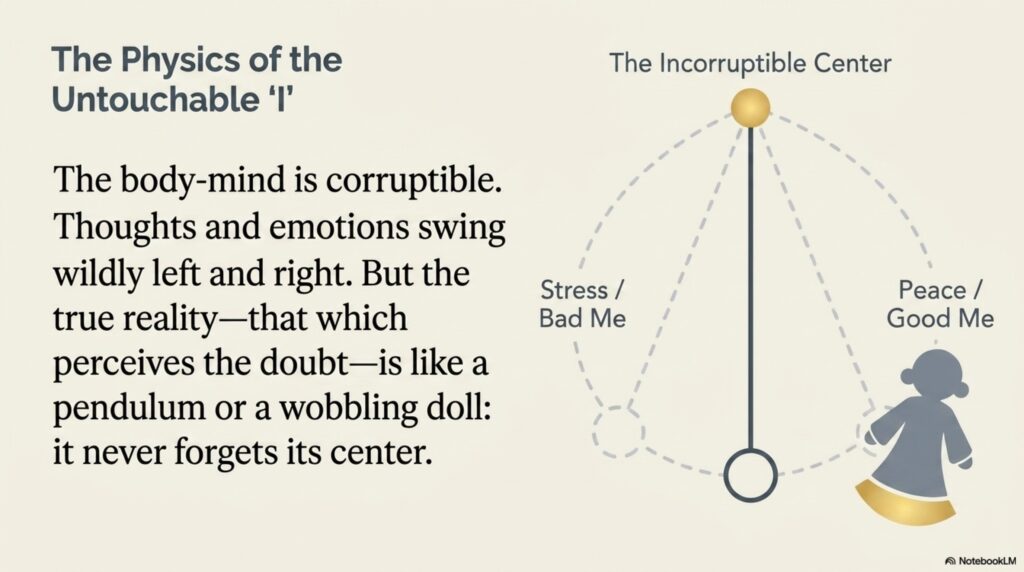
The title of this meeting is “You Are Incorruptible.” What am I speaking about? What is the “I” that we speak about? Of course, the body-mind is corruptible. What is this “I” that is untouchable?
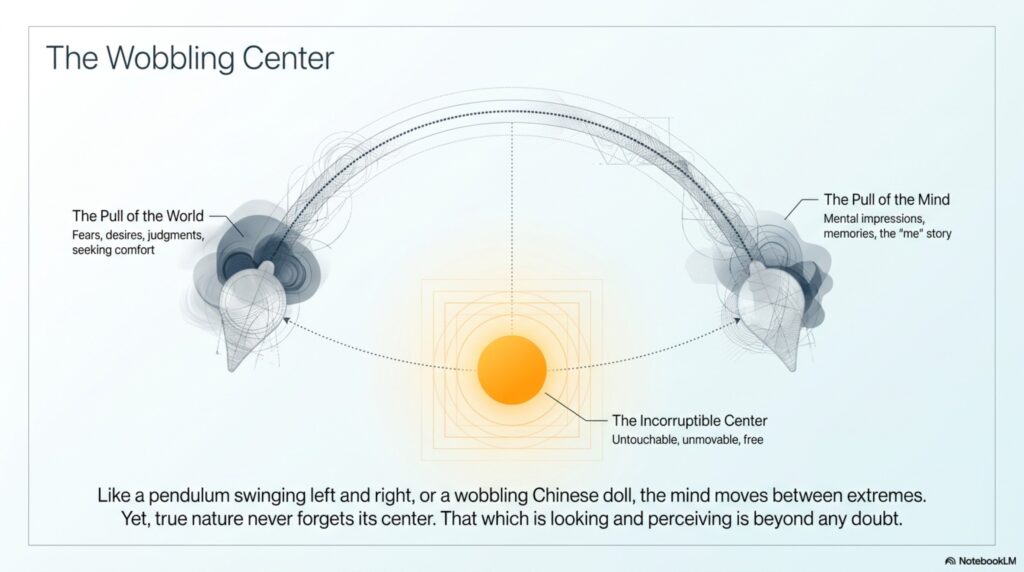
It’s like a pendulum that swings right and left, right and left, but it always returns to center. It never forgets the center. We’re like those Chinese dolls that wobble and then come back to center.
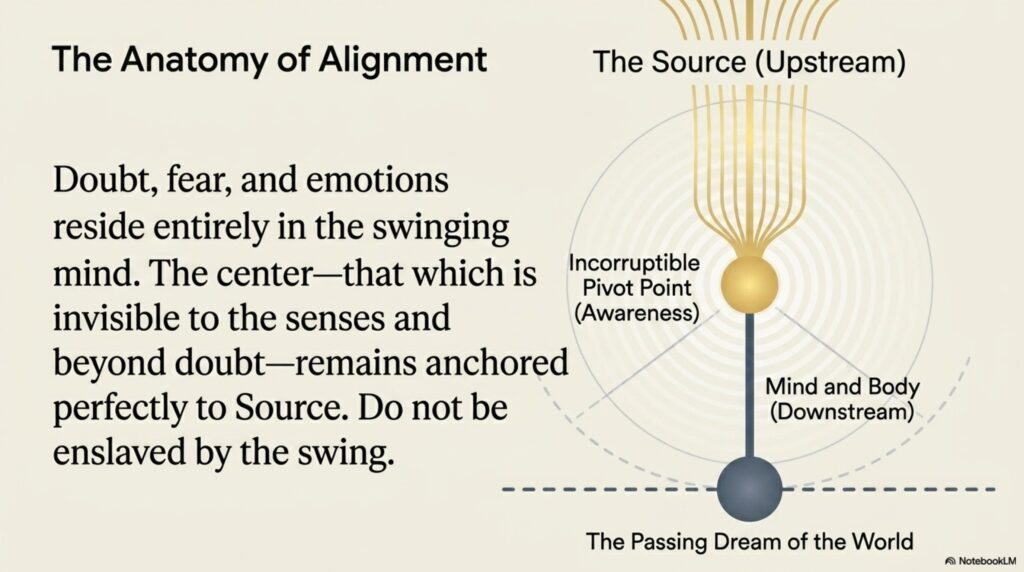
What is it in you that is the center? That true source through you, the reality, that which is beyond mind, beyond body, beyond world. It is said it is that which is looking, that which is perceiving. The mind cannot perceive that, that which is invisible to the senses. So what doesn’t need to be perceived by the senses? It is. Its business is beyond any doubt. Beyond any doubt—doubt of the mind. Doubt resides in the mind.
Doubt is perceived and sensed by what? What is it that is beyond any doubt, untouchable, unmovable, incorruptible, free?
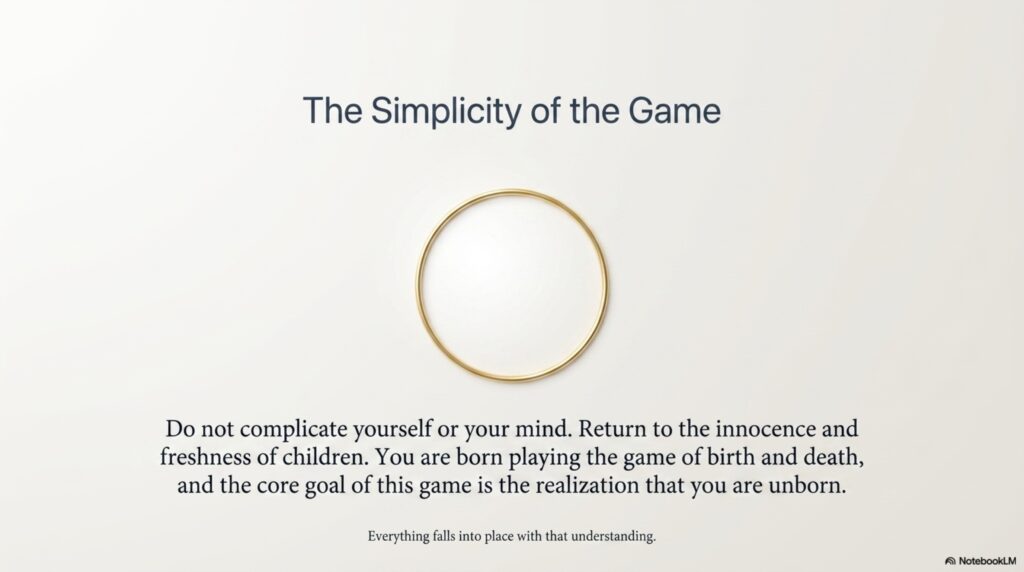
Do not be so mesmerized by the world. It is a passing dream that only serves the purpose for you to find true harmony. If you use your mind to find true harmony, you’ll stumble and stumble and fall, get up and fall again and again. Be careful not to give too much importance to your mind, to your feelings, to your emotions. Do not give too much importance. That does not mean deny them, no. Be gentle with it all. Don’t be guided, controlled, or enslaved by your body mind. Don’t complicate yourself, things, or your mind. Return to simplicity—the simplicity of children, their innocence, freshness, and bubbly nature. You are born playing the game of birth and death, and the core goal of this game is the realization that you are unborn. Everything falls into place with that understanding.
Q&A (Audio + Transcript)
Well, if you have any questions, feel free to raise your hand. Also, if you turn on your videos, I always enjoy seeing you.
So, any questions?
Hi. Hello, Lee. I just want to thank you for this guidance. It was lovely and led us right back to where we need to be. I really appreciated that so much. It’s a gift to feel free. Yeah, I just wanted to say that. Thank you. Thank you.
Any questions?
Thank you so much. What a gift. What a gift. I haven’t been with you for a long time, and I’m very happy to join back because what a shame that I skipped out.
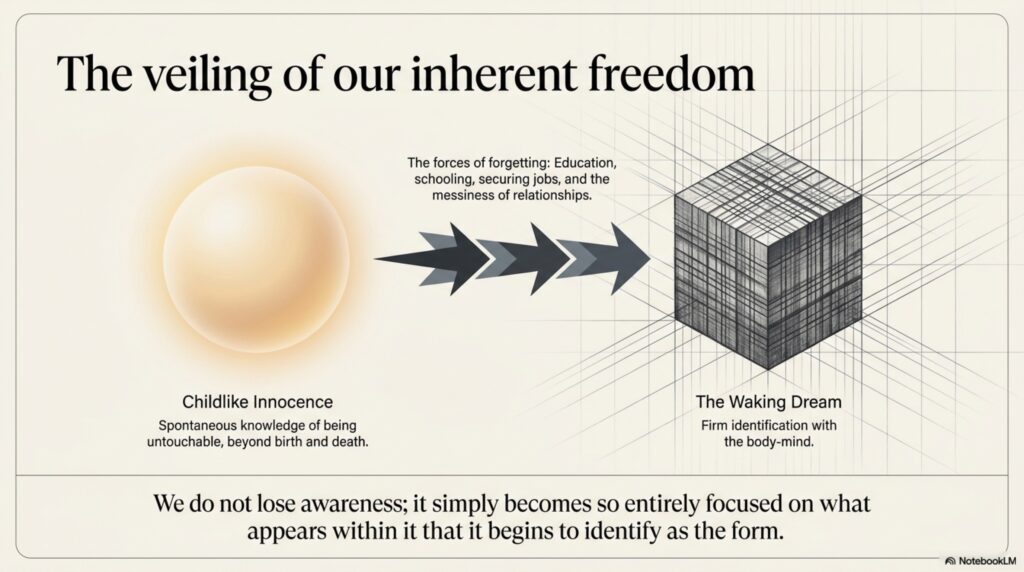
Yeah, I have a question for you. Do we, for someone, or for people who feel like they haven’t come to that final realization? You know, for example, when I was a child, I knew I was this light, this consciousness, without even having heard of those concepts. I spontaneously knew that I was untouchable, beyond birth and death, and so on. But then, education, schooling, getting a job, relationships—you forget this. You identify with the body-mind, and it feels like I’ve forgotten. I am very firmly identified with the body-mind most of the time.
So, my question is, would you recommend a specific practice? Is meditation actually useful? I know they recommend meditation in Buddhism. Ramana, I don’t think he ever really recommended meditating. He was more about bringing it back to the question, “Who am I?” Who is feeling this sensation? Who is having this thought? It’s me; who am I? And so on and so forth.
What would be your best recommendation for someone to return to that childlike state, as you say, and just stabilize it? To be firmly stabilized in it and be done with it—not having to identify with the body-mind and suffer again. Would you have some kind of a practice?
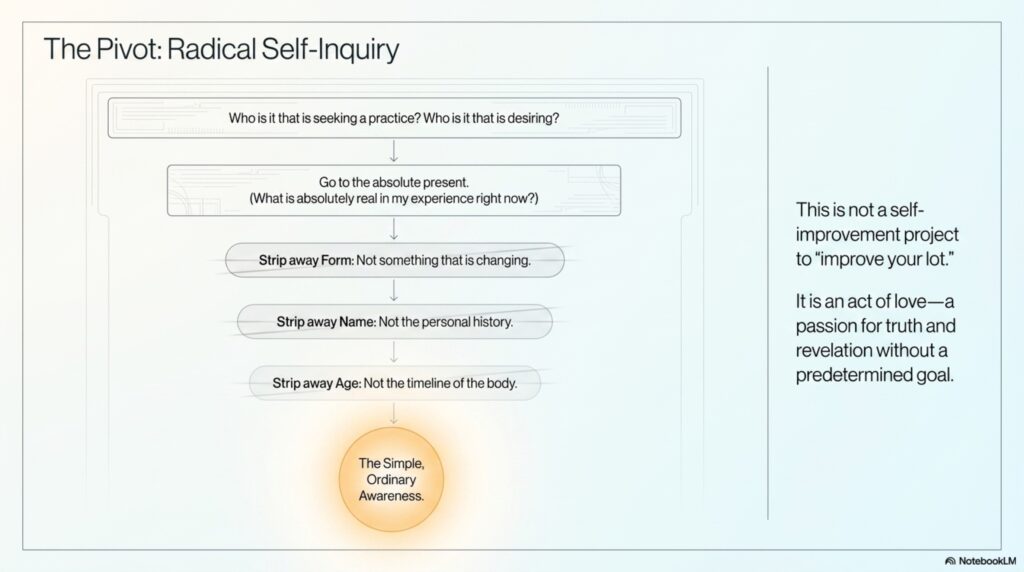
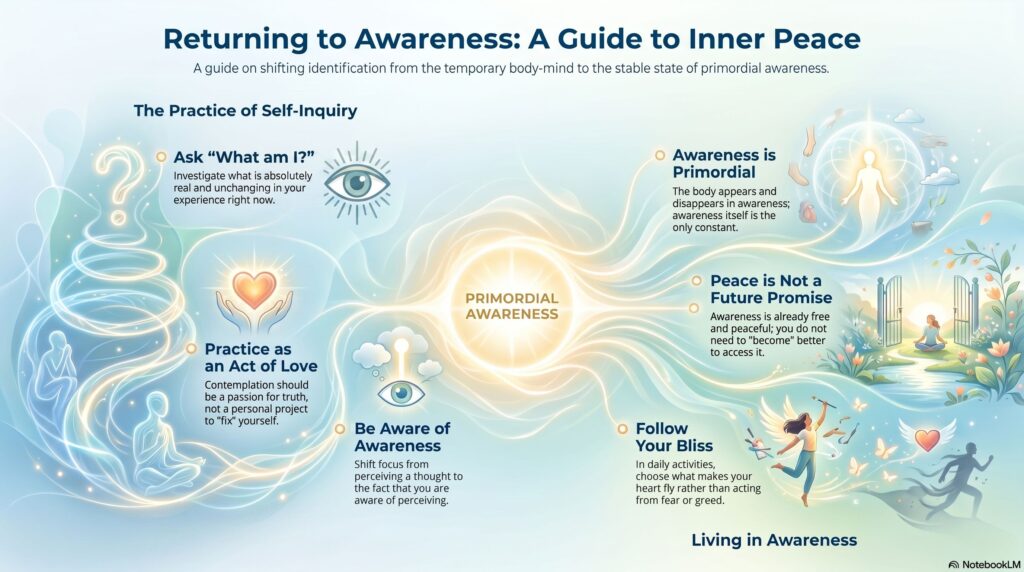
Well, again, the first thing I would say is to contemplate, to ask yourself, “Who is it that is seeking a practice? Who is it that wants freedom?” The teaching is basically this inquiry, the inquiry into, “What am I? Who is it that is desiring? Who is it that is wanting? Who is it that is perceiving right now? Not to think so much about it, but to go to the moment.”
“What am I?” means, “What is it that is absolutely real in my experience right now?” You may come to the understanding that that which is absolutely real in my experience right now is not a form, is not something that’s changing. That which is absolutely real in this moment has no form, has no name, has no age, and it’s always there. This is what we refer to as “this awareness,” the simple, ordinary awareness, which is extraordinary.
That’s a very powerful inquiry whenever it arises for you—not as a practice, but as an act of love. It is a love for truth, a love for understanding, and a love for the revelation. It’s not a personal interest, like, “Oh, I’m interested in this and that.” No, it’s a passion, you see.
In terms of practices, you have to sort of find what really resonates for you—what you feel drawn towards. Of course, taking some moments to sit quietly during the day in a quiet place and to contemplate, “What is it to simply be?” is good. Invite yourself to the experience of being without any idea of what it is, without any preconceived notions. Just sit, and your interest is in being. And notice whatever appears, just notice.
Often, we want to do a certain meditation or a certain practice for a personal cause. We’re not meditating for God; we’re meditating because we want to get something from God or we want to improve our lot, you see. Which is fine, but this is not what I speak about. I’m speaking about meditating without any idea of what I’m meditating for, without any goal. It is a passion and an interest.
As you said, you had this awareness of this innocence, this freedom, that somehow got veiled because of life, with thoughts and worries and concerns. But you had that—that experience still resonates for you—of this innocence, this freedom. Of course, because I knew it to be true. I mean, it was so obvious, so it cannot go away. Yes. But you know still, the life gets so messy at times, and it’s hard not to identify with the body because wherever the body goes, here I am. Right?
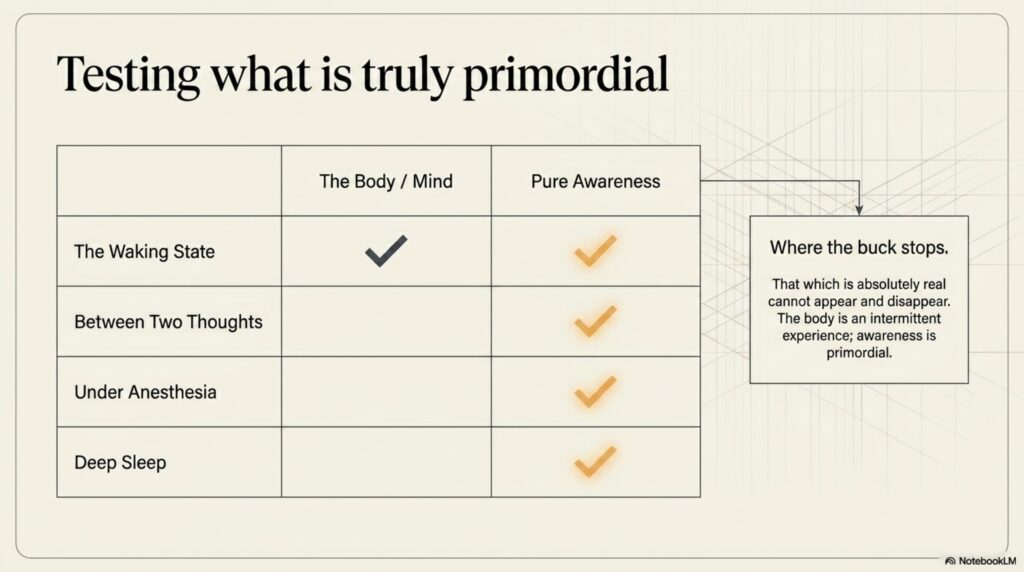
Well, no. Wherever the body goes, here I am. No, no. Wherever you go, the body can come, can appear and disappear. In deep sleep, the body doesn’t appear and disappear. So the body is not primordial. Under anesthesia, the body doesn’t appear. Between two perceptions, the body doesn’t appear. So the body is not primordial. What is primordial is awareness, is consciousness. That is what is primordial. And that is what is lost. I think, as you said during the meditation, “Do not give too much importance to the body-mind.I think this is what happens. Awareness tends to be so focused on what appears within it that it comes to identify with it. Even if it appears, then it comes back again, and it’s so strong not to be pulled into it. Right. And so, yeah, I guess it’s this pull that I would—I mean, yeah.
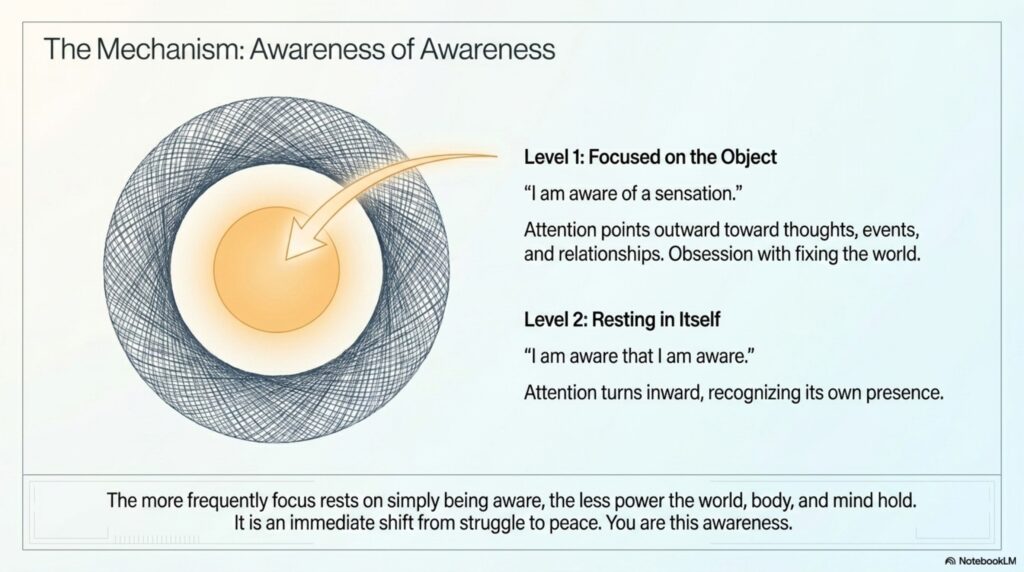
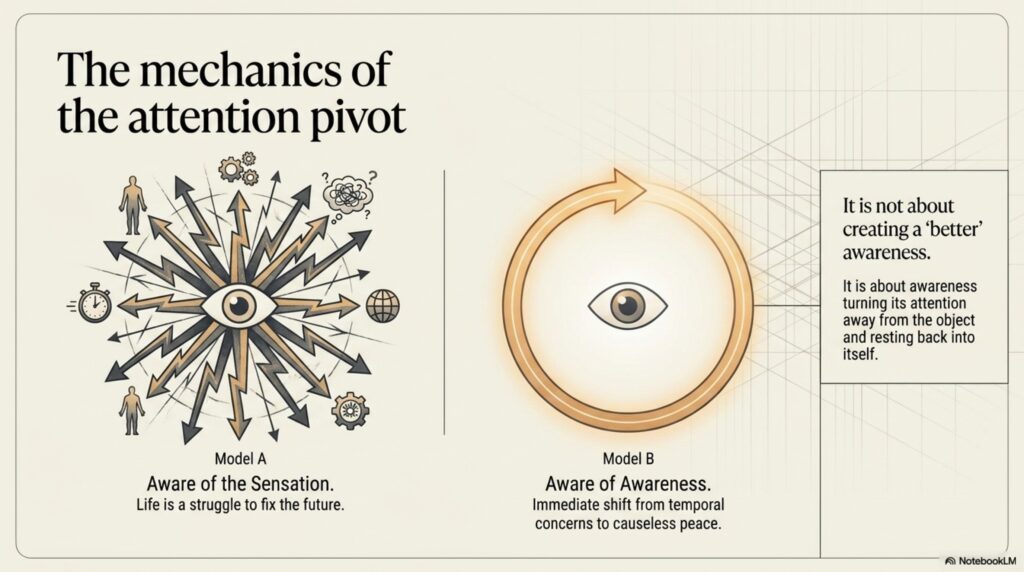
So, you know how to—right. So the invitation is, rather than awareness being focused solely on the world, the mind, events, and relationships, to invite awareness to also rest in itself. In other words, to be aware of awareness.
So, there is: “I’m aware of perceiving this thought,” and there is: “I am aware that I’m aware of perceiving the thought.” So, two different aspects. They seem to be the same, but they’re not.
“I am aware of a certain sensation,” and “I am aware that I am aware of the sensation.” So, the focus in the first one is on the thought or the sensation, but in the second one, the focus is on awareness.
So, there is the possibility of the attention somehow going back and resting into, “Ah, there is awareness.” Yes, there are images and thoughts and sensations, but there is awareness. When there is awareness, there is awareness that there is awareness, awareness that there is awareness, and that’s a shift. The more frequently you have that experience of being aware—the focus on being aware—the less power the world, body, and mind have, and the less obsession we have with the world, body, and mind.
You have to understand, the obsession with the world, body, and mind to fix it and have a better life, a better experience, is a struggle. It’s a struggle where you’re working hard, hoping to find this balance and peace tomorrow, or after tomorrow, or hopefully even today. But our actual experience is still a struggle with a future promise.
That is different from shifting your attention to the peace, because awareness is free. It’s not trying to become a better awareness. It’s not trying to become a red awareness, a blue awareness, or a shiny awareness. So, when you shift your attention to awareness, there is an immediate shift from the concerns and struggles to the peace.
Plus, there is the experience we overlook, but I’m going to bring it to your attention now: this awareness is you. I am aware. I is awareness. It’s not like awareness is somewhere else or coming from Neptune; it’s here. Who else is aware? It’s I. I am aware. So, I is awareness.
There is a shift into “it’s okay if it’s a temporary moment of peace and then the mind goes back.” But it’s precious, you see. It is precious. When you are digging for diamonds and you perceive a little something glittering in the dirt, it’s precious because this is just where the diamond is. It’s still buried in the dirt, yeah, there is dust around it, etc., but there is a little glitter—something catches your attention.
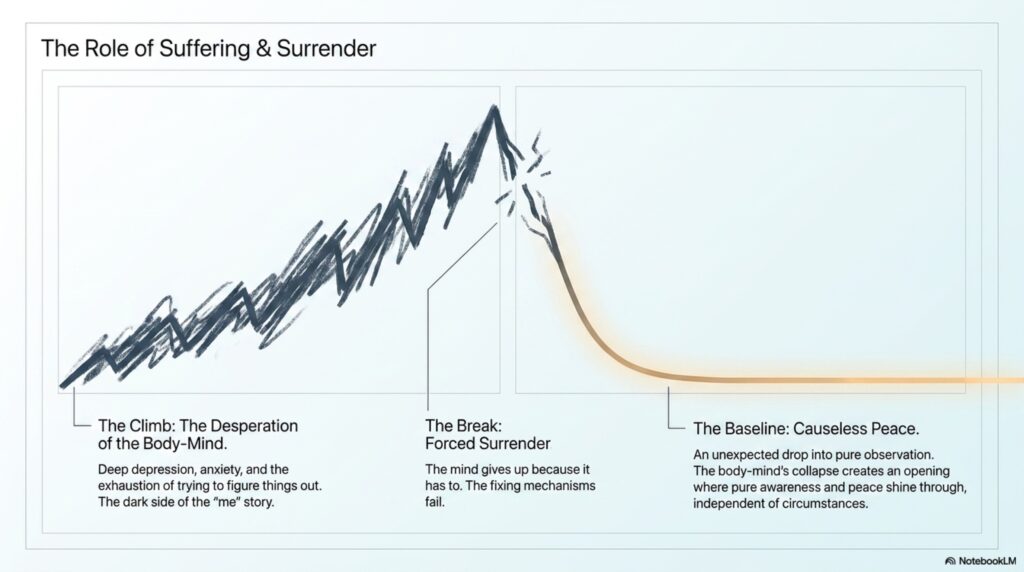
Then, this peace—this causeless peace that bypasses the mind—registers and draws you. It is God’s voice. It draws you more and more.
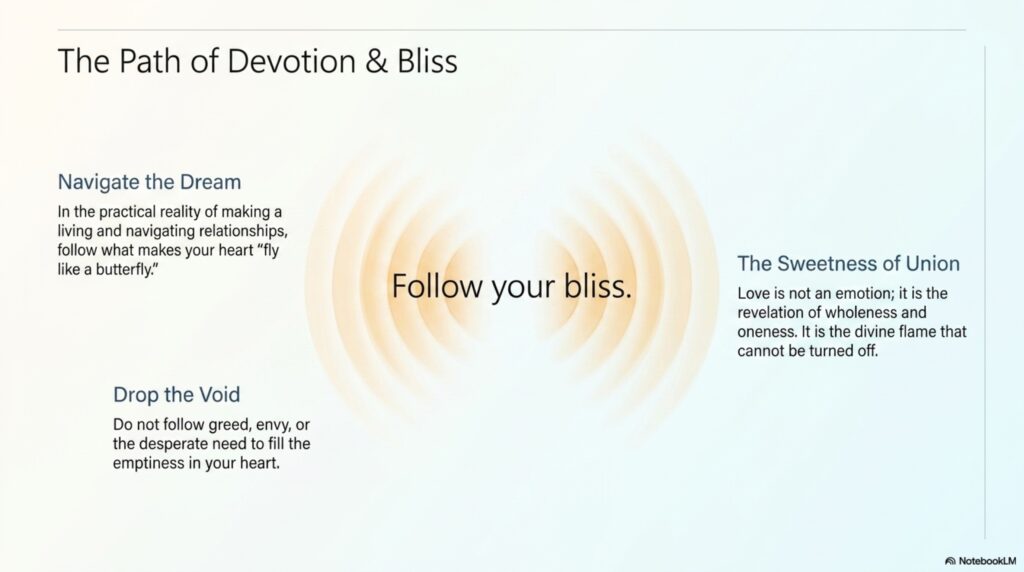
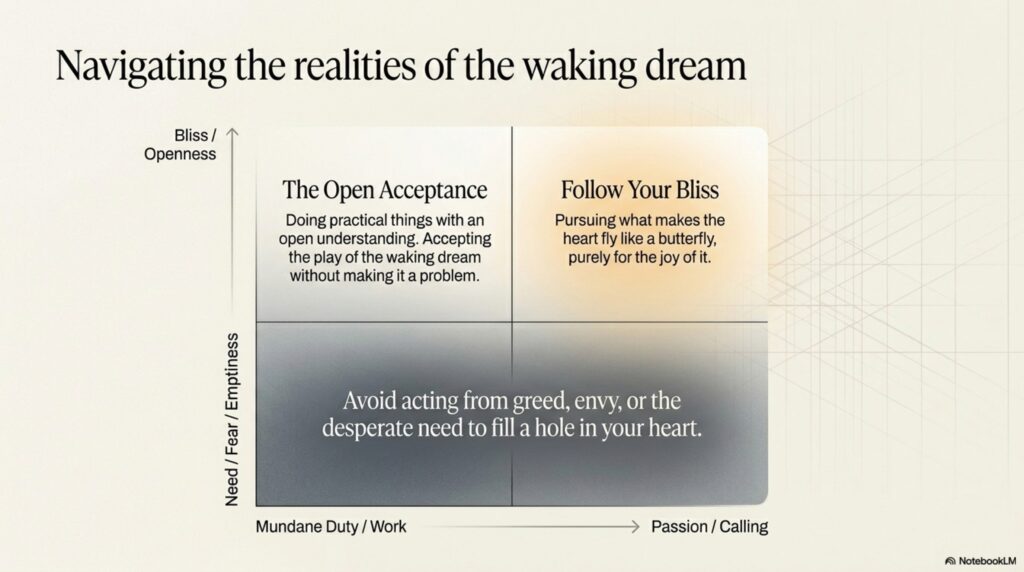
So, in terms of practice, I would say contemplate who is practicing, who is desiring, who is wanting. Turn your attention towards awareness, meaning awareness turning its attention towards itself on occasion. And in life, follow your bliss. Don’t follow your greed, or your envy, or your fear, or your need to fill the hole of emptiness in your heart. Follow your bliss. Thank you.
Ask yourself, “What is it that really will make my heart fly like a butterfly, you know?” Just explore that for your highest good. And when you are engaged in relationships, in activities—whatever it is—also follow your bliss. Explore that. Of course, sometimes in life we have to go to work or whatever. There are some practical things. But when we do them in a certain open way, understanding, “Oh, yeah, this is how it works in this waking dream—we work, we make money, more money, less money, whatever,” and we accept that rather than making it a problem, you see. So there is also the possibility to even find that in the activities that we must do, so to speak, you may also find that it’s okay. It’s just a play.
Thank you, Magdi. Yeah, thank you. You’re welcome. Nice to talk with you, Eric. Thank you. Eric Fred. Oops, can I share? I think it was not John, I’m sorry. Sorry, John, can you hold on a minute? Go ahead, John. Oh, okay. Am I good? Can you hear me? Yes. Yes, I do. Yes. All right. I can open. I don’t see you, but I hear you. Yes.
Yeah, I, let me—I’m slow at this and my vision isn’t the greatest. Oh, I can’t find the mic. I mean, there it is, camera, I think. Oh, I hit it, but I don’t see it working. Anyway, yeah, I would have to say that I was happy to look at my calendar this morning and I saw the link for the meditation. I know it’s the perfect time, the perfect day, you know. I said I always get that, and then I have to be honest, I got worried. I was like, “I’m going to get on there, and it’s all going to be talking about conceptual things and this and that,” which sometimes bothers me.
But I realize now that what really bothers me is the idea of the mind going on—for me, it’s the mind. That is that, okay, well, awareness is awareness; it’s not an object, it’s not this and that. I got that. I understand that.
And then, the other part that still bothers me, even after all these years, is this part of being nothing—in other words, being nothing. I don’t know how “being” and “nothing” go together, but being nothing. The mind still comes in on that aspect of it.
However, the word that I like—and I’ve been, oh gosh, within the last year, I guess it’s been, I’ve been dealing with a lot of very bad depression, taking medicine now and stuff like that. It doesn’t always work; there are side effects and anxiety and stuff like that. I think the suffering itself has helped me—well, I know it has. It has helped me because I can’t get the body to do things, and I can’t get the mind to figure out how to do things. However, they are involved, and one does try to take care of them.
Long story short on this was I noticed something I had never really noticed or maintained, and that was (and you can say this is all about the material world, but it’s not, because we are playing this game or whatever it gets termed and described). I liked what you said. I’m probably a little scattered, but hopefully you guys are patient with this. What you had said once really hit me, and that was something about, um… Oh. Well, see, it’s not important to say it. If I can’t remember it, then it’s okay.
I need to get to my point, and my question, really, a lot of times, is this: What I have found out is that I started writing things down and working in the objective world of the body, mind, and things like that. It is suffering, and it is doing this to the point of not wanting to be here, and so forth and so on. That doesn’t mean I’m going to end my life, but I think of non-duality and try to practice something or do something. But I have to tell you the truth: what I found—and I do go to a non-duality meeting every Thursday night, which has been so beneficial because it’s open to sharing, and I can share my doubts and so forth and so on.
Anyway, the point is—because it has to do with what we’re talking about right now—I remember it was said that you can kill the body, but you can’t kill the spirit. And that resonates with me. So, that resonates with non-duality and consciousness and awareness and all that other kind of stuff. And I like that, and I understand that. I say, “I know that.How do I know that? Because I am that, and I go through all these things.
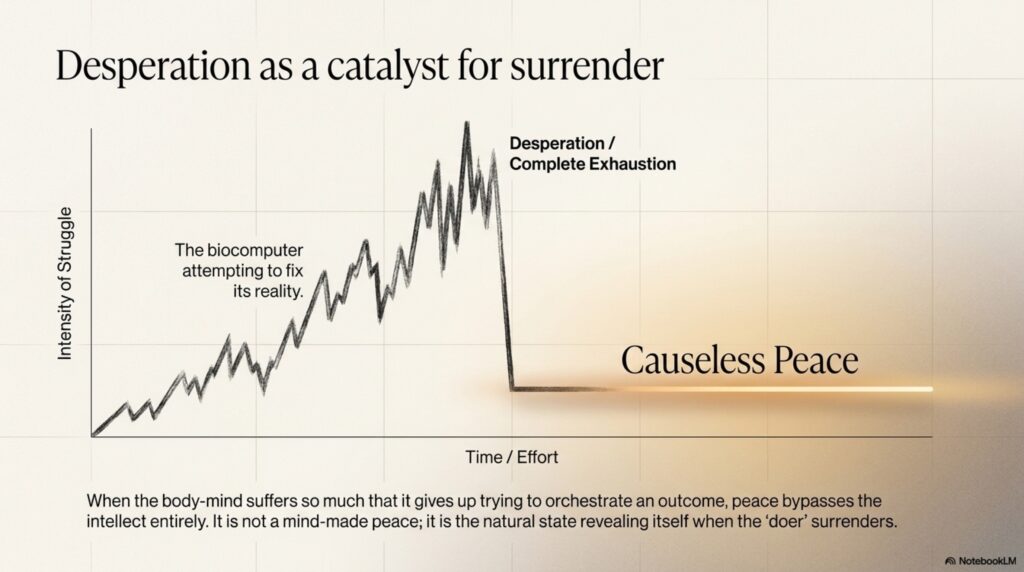
The bottom line is, it happens on its own. The desperation of the body-mind that wants peace, that wants love, that doesn’t want all this other stuff—the desperation of it—it can end up taking the body’s life or whatever, or it can just surrender because it has to. Sometimes it has to happen.
All of a sudden, I would call a group, like a different person every morning, and share my process of getting up, always with depression and anxiety. It could get worse or get better.
Long story short, I realized I have a dark side that will not let me go in a direction. What direction am I going into? What is it worth? Nothing. So, all this bad stuff—you know that stuff. Everybody here probably knows it.
All of a sudden, one day, I noticed that I had thoughts of peace. I had peace; I had some kind of direction. I was taking care of myself and all that. So I started writing down these things when that happened, and that’s what I would share each and every day with somebody: “When did I notice? When was I aware of peace, of happiness, of love?”
Then I realized the other stuff dropped, and even if I had pain, a lot of times that dropped. Other times, it went along with the pain. I still had it, and it surpassed the pain. Nonetheless, that became believable because it just happened. So, it wasn’t a body mind making it happen. It was a body mind that was suffering too much.
The body mind will do that, too. I understand that the body mind sometimes, like with depression, will have a drip in the—I can’t remember what it was—but it will drip stuff in the brain or do something like that, and it will try to help it, okay? But we can call that God, we can call that whatever.
That’s what I’ve been noticing: the peace. For me, it has to be the peace because it works along with the body mind. It can’t be a mind thing.
I’m glad that you’re experiencing the peace, whichever way it’s appearing to you. I’m glad. I’m glad that you are in the process of finding your way more and more often, or as often as possible, to receive peace. I’m really glad.
My question would be, does that make sense as far as finding peace? Anything that brings the experience of peace forward is welcome, as long as you’re not hurting anybody. So, please go ahead. Continue along with the path that brings you more and more into the light and into the peace.
I would just say that it’s good to also give your mind a little break, a little rest. Sometimes it can be too much when there is a lot of mind. So, invite yourself to allow things to be as they are and invite your mind to rest as well.
Exactly, both. Yes, that is what I’m doing in most cases. I accept what is, but I also know that it is possible, especially in a very deep depression, and it’s always available. And if that’s what the mind can do, that’s what the mind can do, but it somehow improves, I guess we could say, and it’s there more often, and that’s really a beautiful thing. So when you’re experiencing the peace, also the mind is peaceful and relaxed, you know? Yes, yes. So sometimes we tickle the mind, we invite it to relax a little bit sometimes, and it goes, “Okay, okay, let me give myself a break,” and then you experience more of the peace. Thank you very much for sharing, John. Nice to nice to see you and nice to be with you. Nice to see you too. All right. Okay. Not bye. Not bye.
Hello. I was going to share, but then Frederick and then John kind of reinforced that I should share this. So I was in one of my therapeutic baths a couple of days ago, and a fairly rare experience happened for me. I usually get very relaxed in these baths, but it always feels like there’s an edge. But this time, for well over an hour, there were no edges. Everything was relaxed, just a very deep sense of peace, which is physically somewhat rare for me, it seems. I noticed it by contrast.
So I got out of the bath, and I think I laid down or sat up—I forget which—and I was meditating. What happened is there was this feeling, and I can see why the sages go the full spectrum of opinion: from the body being this corruptible, nasty thing that’s just a bunch of poop that you shouldn’t even pay attention to, to it being this incredible vehicle for awakening. And really, the whole spectrum of those opinions is true.
I was feeling that spectrum. On the one hand, it was very clear to me that there’s a gift in having this physical experience; there’s something happening in consciousness. Of course, I don’t know whether there’s another universe, another world, or another possibility where it could be easier. I do feel like it could be worse, though, so I feel there are these incredible opportunities.
There was a lot of thankfulness for that, and then simultaneously, somehow, it’s almost like I was seen through. For those who are aware of this system, the first chakra itself—I was experiencing the body’s agenda to keep itself alive, to pump, and to process. And the whole bouncing of the molecules against themselves, and how attached, how completely obsessed it is with its own consciousness.
The spectrum between those two was, “Thank God I have a body,” and “The body’s never going to get it because it really has its own way of experiencing this.” Part of what I’m seeing now, and part of why I’m talking to you about this, is that I’m wondering if there’s… I know one resolution of that is the practice and the meditation that you give us and that I experience, which we all do when we do them.
Today, the awareness was very simple. I just followed your guidance of “don’t even try.” So, activities were happening, and whatever shone through, shone through when it shone through.
But there’s this kind of odd thing about having this wonderful loca that we live in—it includes the body, other people, and the stratus of the world—at the same time. I mean, it’s not that the mind is not in the way, and it’s not that the relationships in the heart are in the way, but it seems like the body is the thing that’s the most in the way because it really is stuck on its particularity. In the way of what? It just doesn’t seem like it wants to be self-conscious.
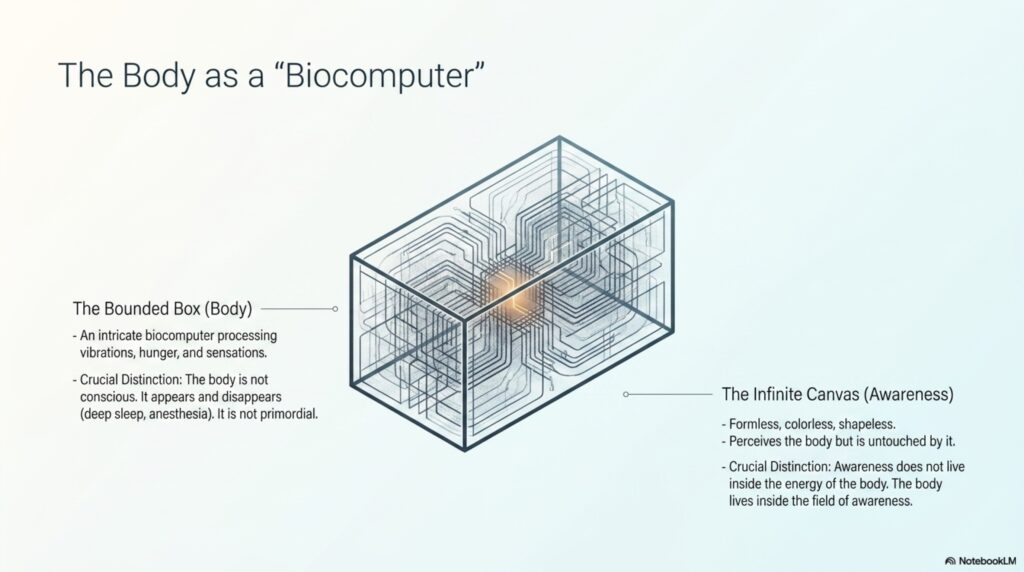
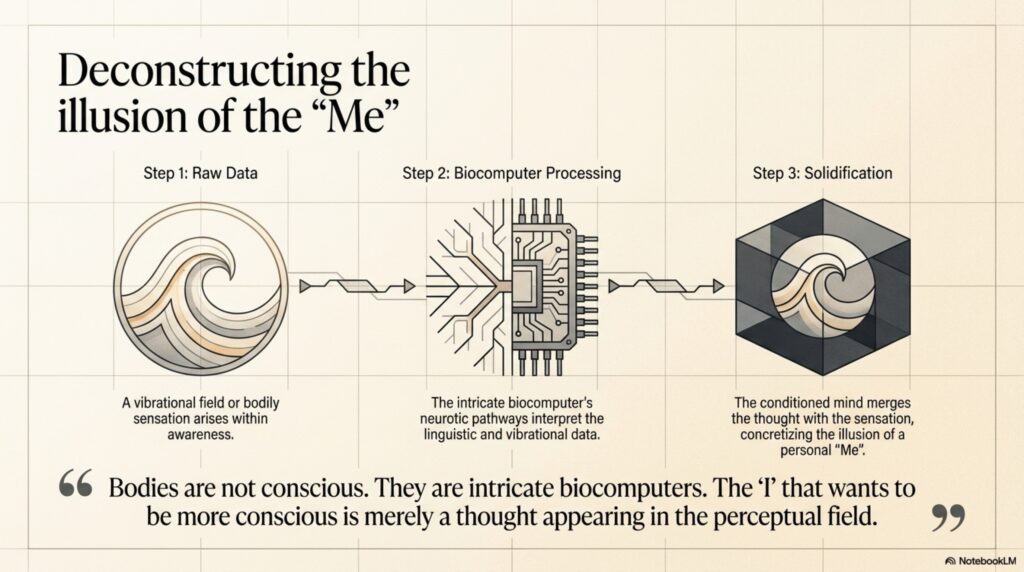
Well, bodies are not conscious. Bodies are biocomputers. They are a very intricate biocomputer, but it’s not the form, the body, or the biocomputer that is conscious, no? Would you agree with that?
I agree with it, but I’m also aware of your teaching and others that reveal that consciousness is still not present within the energy of the body.
Well, it depends on how you define consciousness. If you define consciousness as something which is present here, not present there, more present here, or more present there, then I would like to understand what we’re talking about. That is not the way I define consciousness at all. For me, consciousness is experiential. Let me use the term awareness, or presence.
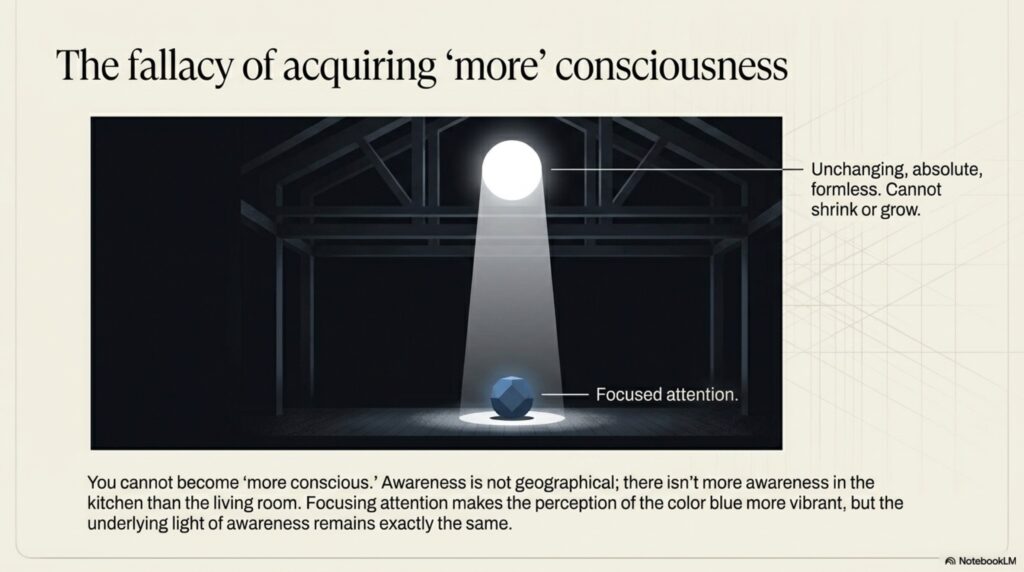
There is awareness. There isn’t more awareness in the south and less awareness in the north. There isn’t more awareness in the kitchen and less awareness in the living room. Awareness is. Living room, kitchen, world, body, and mind appear within awareness. Awareness/consciousness is that which is real and absolute, that which is and cannot not be—where the buck stops. So it depends on how you define consciousness. You’ve got to be careful.
Yes, that’s absolutely clear. What I’m getting is that I can be aware of the body and all these things. If needed, that doesn’t mean the body can be aware of me. I can be aware of the body, but the body can’t be aware of me. Absolutely. Absolutely. You’re aware of the body when there is hunger; you perceive a sensation of hunger or tiredness. So you perceive the body and do what you have to do. You have the freedom of feeding the body or fasting—that’s your freedom as consciousness.
In terms of what you were talking about before, I heard you use the term “consciousness” in a different way. It seemed more conceptual, like the body being conscious. I’m not sure how you’re sharing that, but we have to be careful not to conceptualize consciousness.
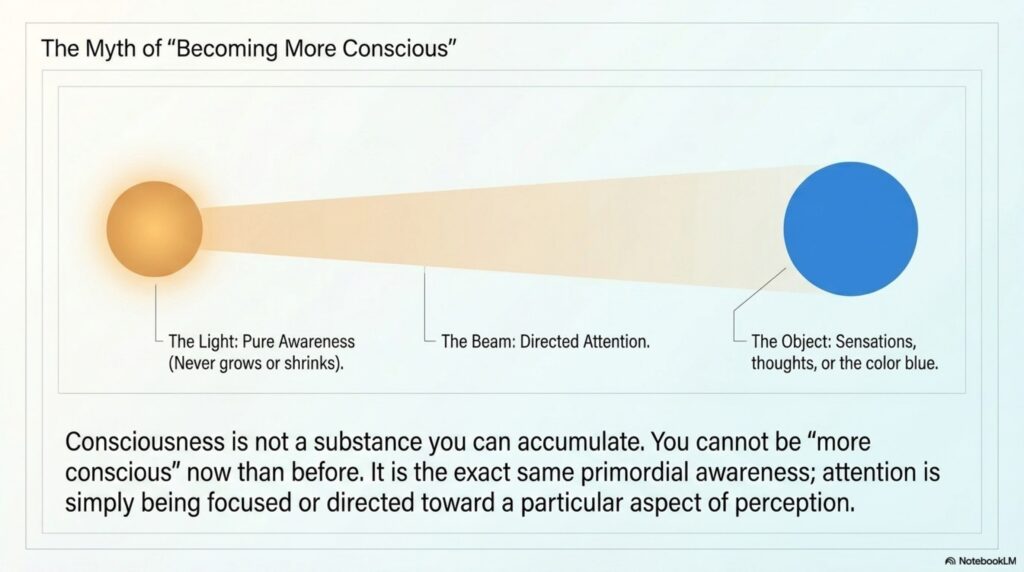
Consciousness is an experience. It is your experience of being conscious. It’s not “I am more conscious now and less conscious before.” No, how can you be more conscious of something? What would that mean? You can choose to focus your attention on the color blue, and then the color blue becomes more vibrant when you’re looking at a painting. It’s not that there is more consciousness of the color blue. It is the same consciousness, but the attention is being focused and directed toward a certain object or form. Therefore, there is a more focused awareness directing its attention on a particular aspect of what is being perceived. This doesn’t mean there is more awareness; it is the same awareness. Awareness is just the perceptual field—the reality which perceives. Does that make sense?
Absolutely. There’s a part of me that wants to believe I can become more conscious. That’s the perception desiring to be either free, more aware of reality, or safer, but consciousness isn’t doing that. You’re right. When you say, “I want to be more conscious,” what is this “I” you’re referring to?
Exactly. So, we say, “Okay, what is this I?” “Me.” It’s me. It’s an idea I have of myself, or an image I have of myself, or a conglomeration of beliefs, feelings, history, whatever, spiritual knowledge. But all of that is mind—it’s a concept of me. Because in this moment, awareness is. The “me” can appear as an idea, an image, or a sensation, and you say, “Oh, that’s me.” Awareness perceives a sensation; the sensation appears within awareness. Then the conditioned mind says, “Oh, this is me.” Even that thought, “This is me,” appears in awareness. Awareness is primordial. If the thought says, “This is me,” it’s just a thought; it’s just a movement. A thought is just a vibrational field. So, there is a vibrational field triggering the brain in a way—the neurotic pathway that is the linguistic aspect—which somehow interprets this neuronal movement as, “This is me.” A sensation within the body, combined with the thought, solidifies or concretizes a “me.” But all of that is biocomputer functioning and has nothing to do with the real you—awareness—which in this moment is formless, colorless, and shapeless, and doesn’t give a hoot about what appears, what it creates, or what it perceives. It can create and perceive a volcanic eruption, tsunami, beautiful sunsets, birth, death, thoughts, sensations, hunger, or creative symphonies—but it’s untouched. It’s complete freedom. It’s God’s freedom.
So, when you say, “I want to be more conscious,” I would invite the question: What is this “I” in this moment? Because if you don’t examine what this “I” is in this moment, it’s going to go galloping, it’s going to gallop like crazy.
Yeah, well, I was saying that as a critique of it. It doesn’t take much of it to go against. I appreciate you reinforcing the critique because it never hurts, you know, because the mind is so—and my mind in particular—it’s taken decades to learn to calm it down at all. It’s just one of those high-functioning minds. Yeah, yeah, yeah.
So, where does that leave us? A little more preference for not having to answer questions. Nice. That spaciousness takes over the questioner. It’s nice. Yeah, always. I enjoy this.
And there is a deeper peace—that becomes increasingly obvious—when the question is not even being asked than when the question is being asked, or the question is being answered, or the question is being understood. It’s not that there isn’t peace in those to some degree, but there’s a far deeper peace when there is just no question arising. Mhm.
Oh, thanks again. Yeah, it is fun to hang out with you. There’s something about the way you approach these things that meets me very, very nicely. I very much appreciate it. Thank you. You’re welcome.
Just in terms of questions for everybody here: it’s really important if there is a question for you to really look into it and to bring it up when you’re drawn to bring it up, because the question is a sort of tension within the field, and it’s seeking its release. It can’t find its release within itself; it’s got to dig. And here we have the opportunity where you can bring it out in the open and see how it goes.
John, you raised your hand. Did you want to say something? Sorry again. Yeah, I just wanted to add a little bit since nobody is raising their hand. I wanted to add a little bit to what I said. Okay, so the bottom line I was trying to get to goes more to the point of using non-duality maybe in some ways. It’s simply that I become the observer, and I notice, and you used that word a long time ago, and that word really stuck with me. It somehow resonated better than anything else, and also the word love.
What I was trying to explain is that a lot of the conceptual things for myself—conception, all that—is the body-mind working to try to get somewhere, as you said. The actual suffering has helped because it gives up in a sense. It gives up once I observe the mind and the body. For me, the mind causes a lot.
Once I observe that and see that, it’s very interesting that I can now see that there are other thoughts besides what I call the dark thoughts. I’ve had to talk to people; I have to talk to others. So I’m in that place where that has to happen. I haven’t been enlightened, and I’m not floating in the clouds. I have to accept that, and it’s been very good for me to accept that. That’s what I just want to say. I think that’s going in the right path. If you have any other things to suggest, but it’s all about love to me.
If I think of love, then I’m not worried about death and nothingness. Children have love, adults have love, it comes of its own accord. And when it’s there, it’s happy. It’s changed, it’s different. That’s all there is to it. I don’t know what else to say.
I don’t do it as a body mind. I may suffer and try to get out of stuff, but it is actually awareness itself that is aware. When I realize that, that realization says, “I am awareness.” Yes, yes, yes, good. That’s nice, John. Yeah. Okay. I just wanted to double-check with you. So, yeah.
Love, wholeness, oneness, intimacy. In love, there are no two. Love is a sweetness—the revelation of the union, of the oneness, of the wholeness. Love is God. It’s this one reality which we refer to as God. This pure awareness is God’s awareness; it’s God’s light. That which views, that which creates, that which is, is love.
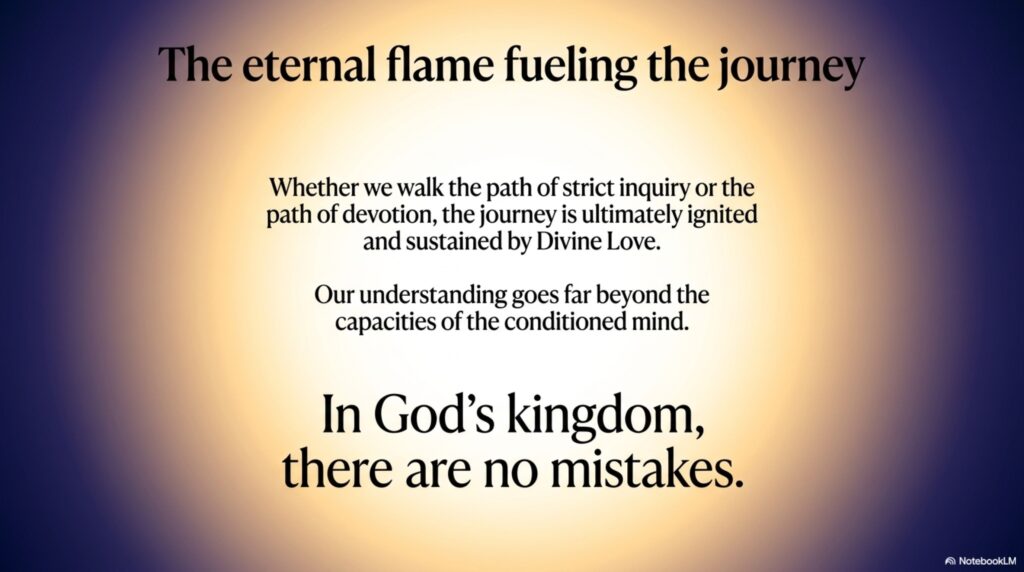
So, the path of love is a beautiful, beautiful path: devotion—devotion to God. In a way, all paths have love in them. Some paths are very, very focused on love. Other paths, like our path here, are devoted to the love of truth, which brings understanding, exploration, and inquiry, but it’s all fueled by love, and love for the divine.
So, divine love may not be what we emphasize, we may not be carrying the flag of the love of God and waving it, but it is there. You cannot proceed along this path without God’s love. It comes to you, it touches you, it ignites the flame within you, and that flame cannot be turned off. This is the true eternal flame.
Yeah, very good, John, very nice. Hello Carrie. Hello dear Maggie. Hello everyone. I have what I would consider a little bit of a funny question. If awareness is all there is, if there is just one self, and it allows itself to dance and flow in this Maya and other altered states of consciousness, and the Maya, of course, is impermanence, and the permanence is awareness, the unchanging, are these experiences a byproduct of awareness?
I’m sure that, let’s say, going back before the Big Bang, supposedly, awareness always has been, is now, and always will be, but this experience of life is just like a little spark. It’s simply—maybe I consider my experiences “Luffy.” Like you’ve said before, we are like an octopus tentacle for awareness.
So, back to my curiosity: Is life simply a byproduct of awareness because ultimately awareness is the empty fullness, the unseen that comes through to animate all life? I hope I have described that. I hope that wasn’t just word salad. I hear what you are sharing.
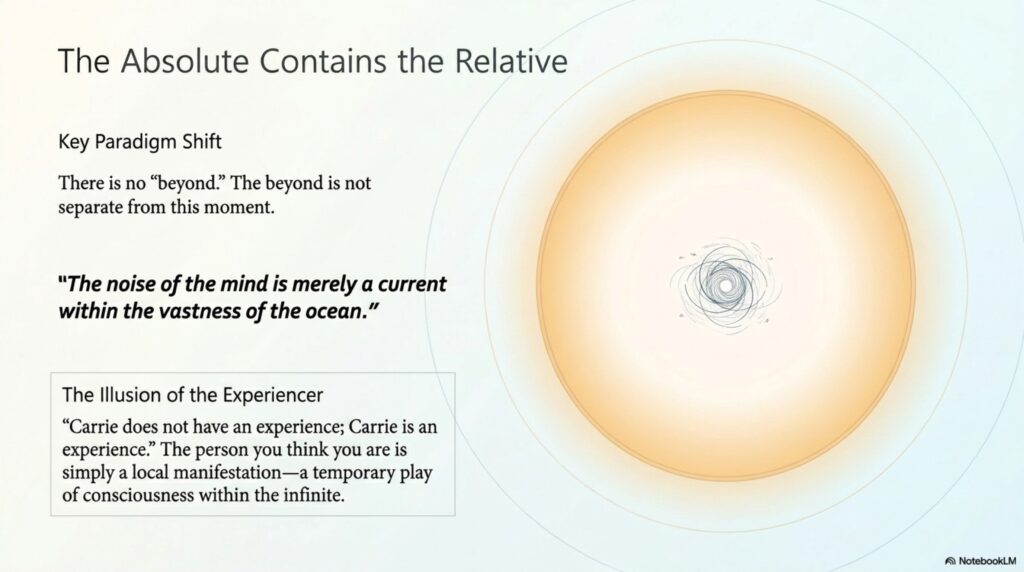
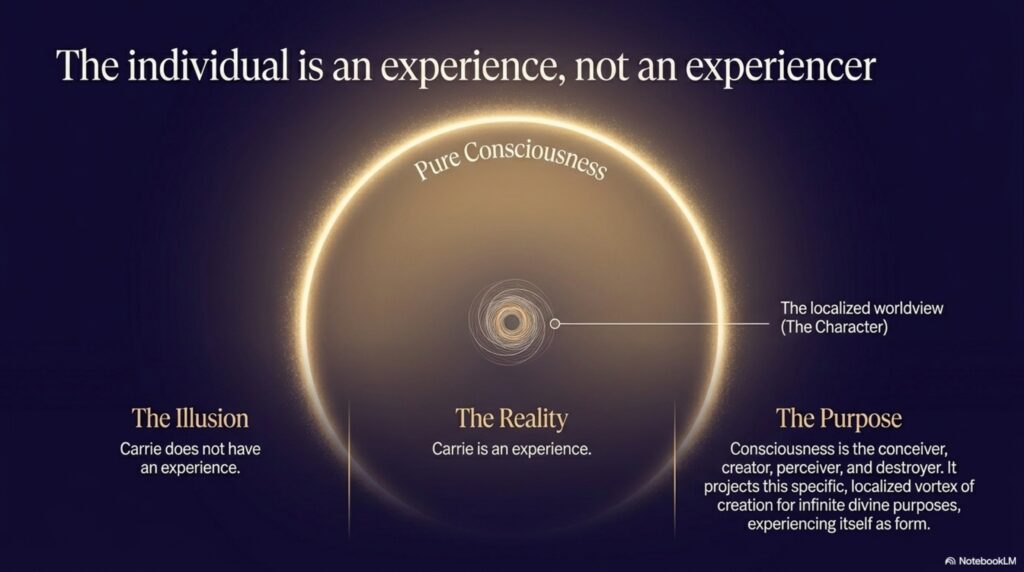
Yes, awareness, or let’s say consciousness, is the conceiver, the creator, the perceiver, and the destroyer. It is that which is absolute and has no byproducts. The experience that you refer to as “Carrie experiences” is a falsehood. There is no “Carrie experience.” Carrie does not have an experience; Carrie is an experience. She does not have an experience.
In order for Carrie to have an experience, there has to be a reality called Carrie. But the reality of Carrie is consciousness. It’s not Carrie. Carrie is a play—the play of consciousness, the creation of consciousness. So, you perceive Carrie—you, God, you delight—you that which is and cannot not be.
It’s not that you’re perceiving a process in time and space. You are perceiving world-body-mind forms. You’re not just perceiving world-body-mind forms; you’re perceiving infinite perceptions. In this particular local worldview, you speak of what you are perceiving, but simultaneously, you are perceiving infinite other perceptions. In this present dimension, which is not separate from all other dimensions, you as consciousness are creating, perceiving, and experiencing this experience for a divine purpose. The divine purpose is what consciousness is constantly creating—it’s creating infinite divine purposes.
What for? Who would God answer to? What do you mean, “what for?” Who is asking “what for?” To whom is God going to turn and say, “Oh, you asked me a question, let me answer you?” There is nobody to whom God is going to turn and say, “I heard your question, let me answer it.” There is no “what for.”What for” is part of this local manifestation of particular minds asking, answering, and wondering, but all of that is a divine expression—it’s God’s play, one way of saying it.
All the various realms of existence are similarly God’s manifestation, God’s play. In our forgetfulness, we are remembering this moment, experiencing this moment—this particular vortex of creation. But in a snap, you’re experiencing something completely different. There is a little hint of that in your dreams. But between every perception is the infinite. You’re actually experiencing infinite dimensions in the gap between every appearance because there isn’t a continuity. There is not a real continuity to our experience right now. No, the continuity is the infinite.
We are connected to this infinity, this infinite continuity, because it is our true reality. It carries reality, it magnets reality. That’s pretty incredible. That always amazes me when I stop and think about it. It’s hard to comprehend. We must go beyond the mind, beyond the little mind, and drop into that divine love.
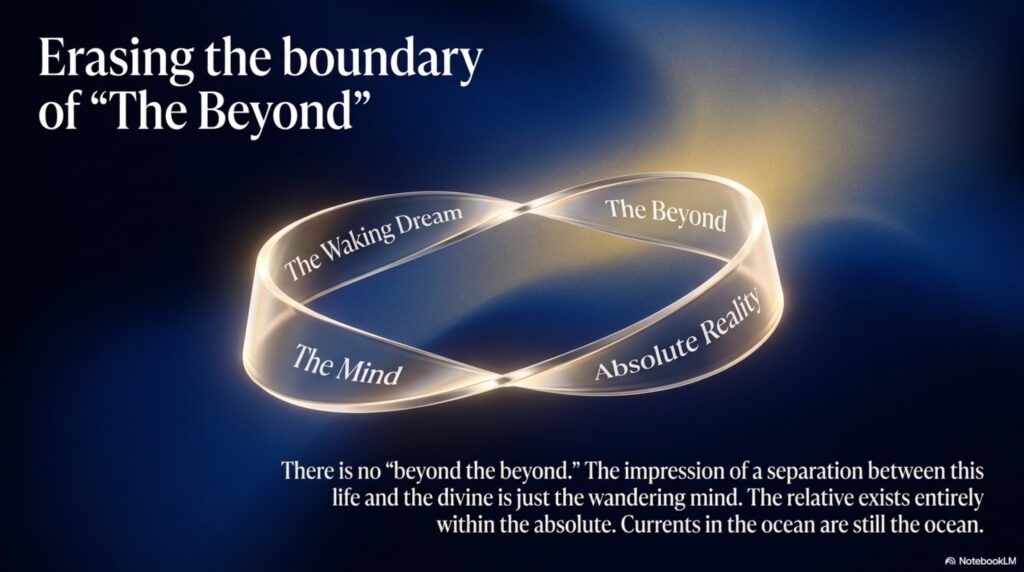
So, my last question, Magdi, because you’re so gracious to explain and help us awaken out of this sleep of not knowing into knowing truth, is silence. So, when I speak or when I think, that’s not going beyond the mind into the divinity, into that saturation of complete love that is the fullness, the empty fullness. And I’m having a struggle trying to… you never go beyond it. You never go beyond it. So we are it then? Yeah, absolutely. You never go beyond it. There is no beyond the beyond.
The impression that this is not the beyond is just an impression. And so, from the impression that this is not the beyond, there is “going beyond this.” So there is then an illusory separation between this and the beyond. And then there is the judgmental mind or the wandering mind, wandering about the relationship of this with the beyond. But there isn’t a relationship between this and the beyond because this is the beyond. One could say that this is the manifestation of the beyond, if you’d like, or an aspect of the beyond, if you want to use those terms, but that’s just words. There isn’t duality, separation. There is, in reality, the relative in the absolute, or in reality, that which is not beyond and the beyond, the mind and beyond the mind. All of this is within the beyond—movements within the beyond—currents within the vastness, currents in the ocean, in the stream.
So, when we compare language, which is data—data of maybe even mental impressions, data that comes out of my mouth—and then the conditioned mind, about how I’m patterned to see: Is silence the truest form of truth and reality? The silence. Yeah, where there is a complete calm and there’s no conceptualization. Yeah, right.
So, let me say two things.
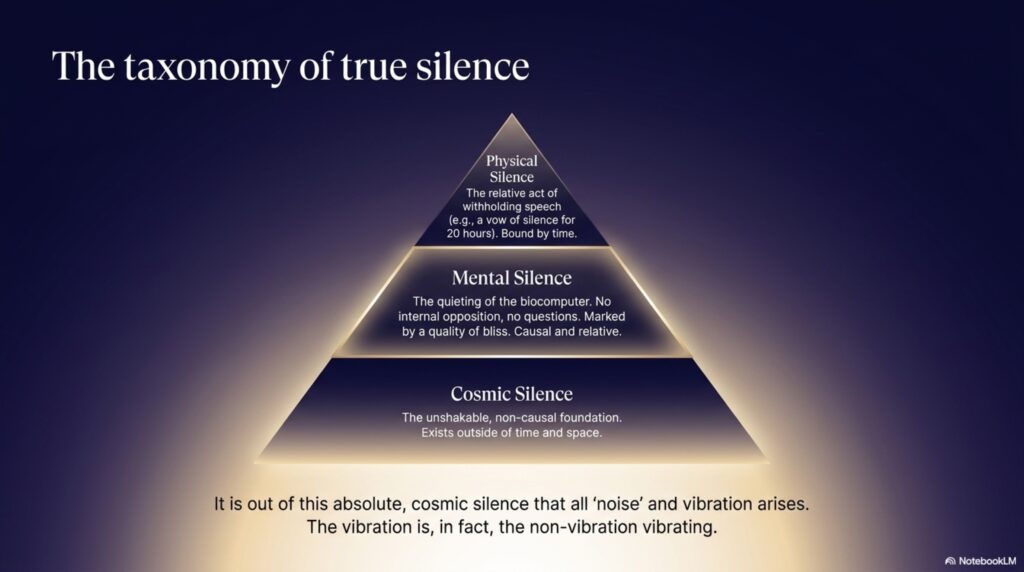
First, in every impression or vibration of movement, there is the non-vibration. So, the vibration is, in fact, the non-vibration vibrating out of God’s will and freedom. Therefore, God’s silence, when you use that term, is absolute and permeates every impression of non-silence. That is very difficult to understand.
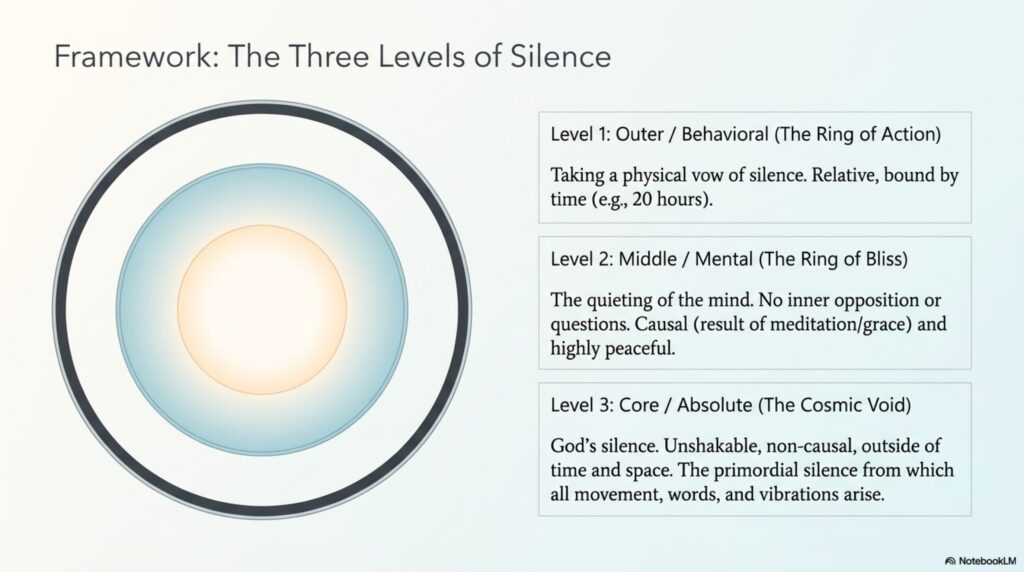
So, let me speak about silence in a different way. In the relative realm, within this energetic field of human life, there is the silence of the body-mind where we might take a vow of silence for 20 hours. That is one aspect of silence where we choose not to speak.
Then, there is a silence that is the quieting of the mind. There is no opposition within the mind—no questions, no issues. When the mind is still, you are experiencing silence; it has a little quality of bliss in it. These are different aspects or levels of silence. And it is also relative because it has a duration; it is in time. It is a causal result of something, maybe meditation or contemplation or grace.
There is another silence, which is non-causal. You can call it the cosmic silence, God’s silence, universal silence, or the divine silence. That silence is unshakable, causeless, and does not exist in time and space. It is within that silence, and out of that silence, that all seeming non-silence—seeming words, language, thoughts, and movement—arises. Every movement has a certain vibration; it is not silent.
It is out of that silence, within that silence, to that silence, and from that absolute silence that movement arises. The experience of this silent silence within our human experience is the full awakening, the full realization, and the full dissolution of the sense of separation. It is the crossing of the threshold from which there is no return. And that is silence.
Sometimes we speak of it as causeless peace, or we speak of it as the silence that cannot be touched, or can never be non-silent. I forgot your question, Carrie, but what you’ve just shared is awe-struck wonder to me. It’s the silence within the silence, within the silence.
I’ve had to wear my glasses because of an eye injury. I just want you to know that is so incredible to me because I can go so deep. I’ve had the near death experience, I’ve had my child in a coma, all of these things that keep on lowering the boom, just lowering into those subtle realms. To hear you guide us, it’s just incredible. I just want to jump out of my skin to say, “I don’t understand in my conditioned mind, but I do understand the remembering, this intuitive remembering.” I can’t put it into words, so I’m forever grateful for you being a mentor, teacher, and guide to all of us. It’s very humbling. Thank you, thank you, thank you.
Our understanding is beyond the mind. Our understanding is beyond the mind. And don’t forget, in God’s kingdom, there are no mistakes. Thank you.
Oh, very lovely to be with you all. Thank you for this wonderful opportunity to be together and share the love and our friendship for each other. Yes, Namaste.
Thank you, Magdi. Thank you, McD.
Ai Playground (only Meditation):
Ai Playground (only Q&A):
Ai Playground (both recordings together):
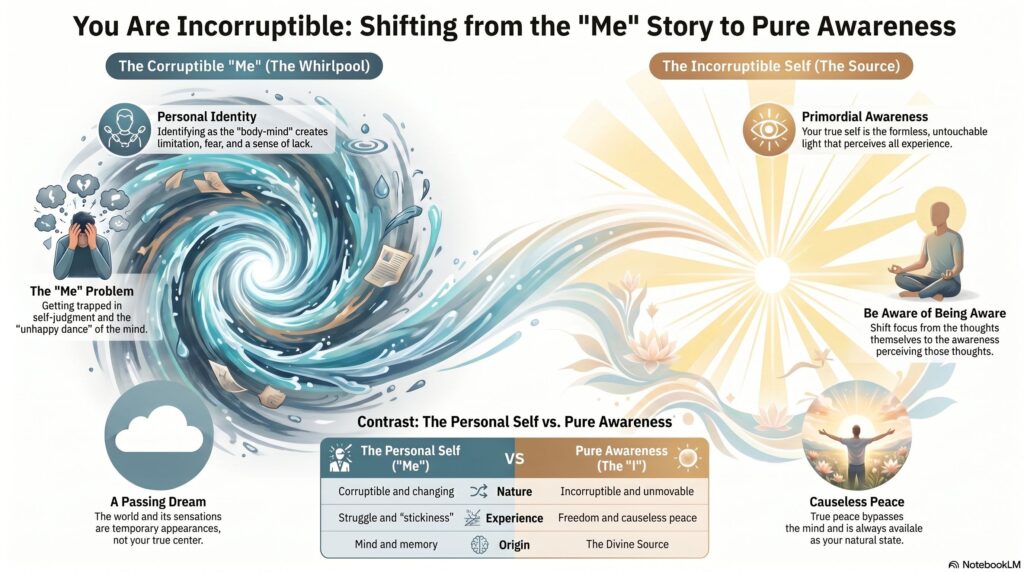
- The practice involves resting in present experience without trying to fix or change anything, allowing for the relaxation of the personal “me” story and temporary forgetfulness of the past.
- True self is identified as the incorruptible, free light of awareness, which is always open and available, and functions as the perceiver beyond the body-mind.
- Identification with the personal body-mind narrative (the “me” story, judgments, and beliefs) creates limitation, fear, and a sense of lack, leading to a state of being “far from God.”
- The solution to suffering and aloneness is simple: profound trust in the divine and turning to God (Source) by letting go of the mind, which is the source of doubt and seeking comfort in the world.
- True harmony and realization come from recognizing the self as the unborn, incorruptible center, and not being enslaved by or overly prioritizing the body-mind’s thoughts, feelings, and emotions.